

This Content Is Only For Subscribers
Hedge funds have always carried an aura of mystery. They’re whispered about in financial media, portrayed as billion-dollar powerhouses that can move markets, and often viewed as the playgrounds of the ultra-wealthy. For the average person just starting their investing journey, hedge funds may seem distant, complex, or even irrelevant.
But here’s the reality: hedge funds are simply investment vehicles—pools of money managed with the goal of delivering returns. They just happen to use a wider toolkit than traditional funds. And the stories of famous hedge funds, whether triumphs or disasters, contain valuable lessons for anyone who wants to understand how markets work.
In this article, we’ll walk through the rise (and sometimes fall) of some of the world’s most notable hedge funds. Along the way, we’ll highlight what everyday investors can learn—because even if you’re just managing a retirement account or building your first portfolio, the same principles apply.
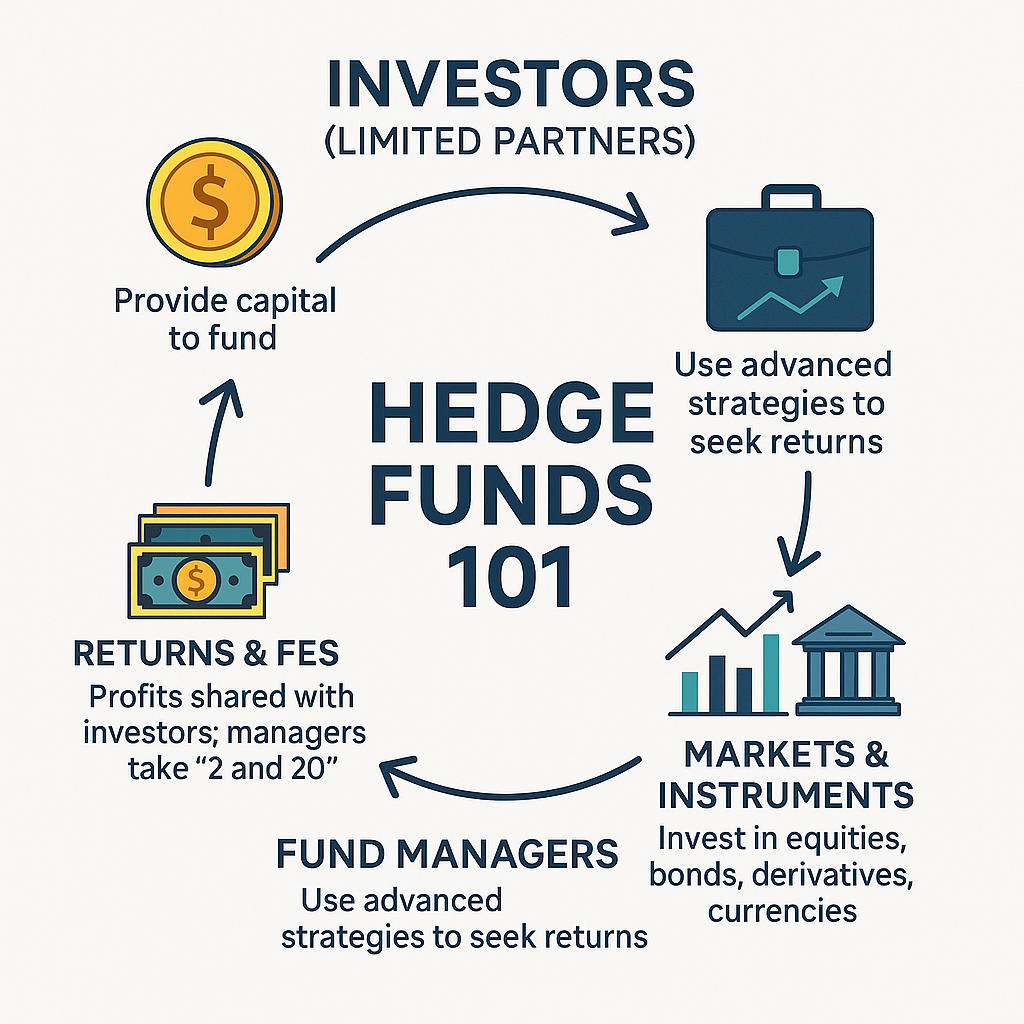
Hedge Funds 101: A Quick Primer
Before diving into the stories, let’s pause for a moment on the basics.
What is a hedge fund?
At its core, a hedge fund is a partnership between professional money managers (the “general partners”) and wealthy investors (the “limited partners”). Unlike mutual funds, hedge funds face fewer regulations, which allows them to use strategies that are off-limits to traditional funds: short selling, leverage, derivatives, and highly concentrated bets.
Why “hedge”?
The term comes from the idea of hedging risks—using financial instruments to protect against downturns. Over time, though, hedge funds became less about hedging and more about aggressively seeking outsized returns.
Who can invest?
Most hedge funds are limited to “accredited investors”—those with high income or net worth—because of the risks involved. This exclusivity fuels their mystique.
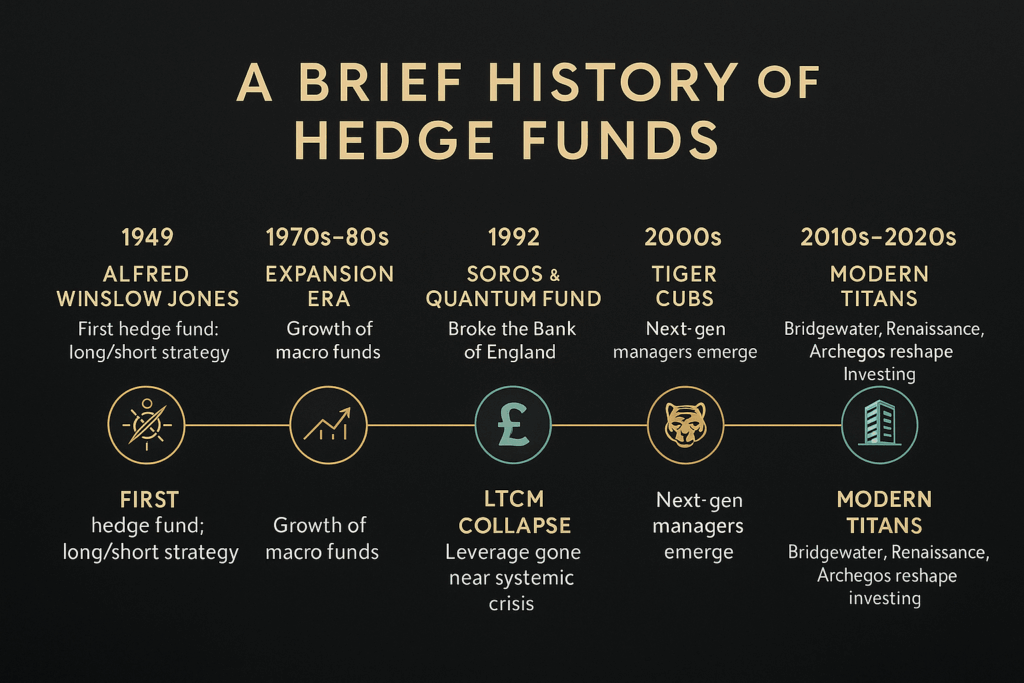
A Brief History of Hedge Funds
The first hedge fund is widely credited to Alfred Winslow Jones in 1949. Jones introduced the “long/short” strategy: buying stocks he thought would rise, while shorting those he thought would fall. The goal wasn’t to gamble, but to reduce risk by hedging.
By the 1970s and 1980s, hedge funds expanded rapidly. Big personalities like George Soros, who famously “broke the Bank of England” by betting against the British pound in 1992, cemented hedge funds’ reputation as bold and sometimes dangerous players.
Today, hedge funds collectively manage trillions of dollars. While many funds quietly grind out modest returns, a handful—through massive wins or dramatic blowups—have become legends.
Common Hedge Fund Strategies (Explained Simply)
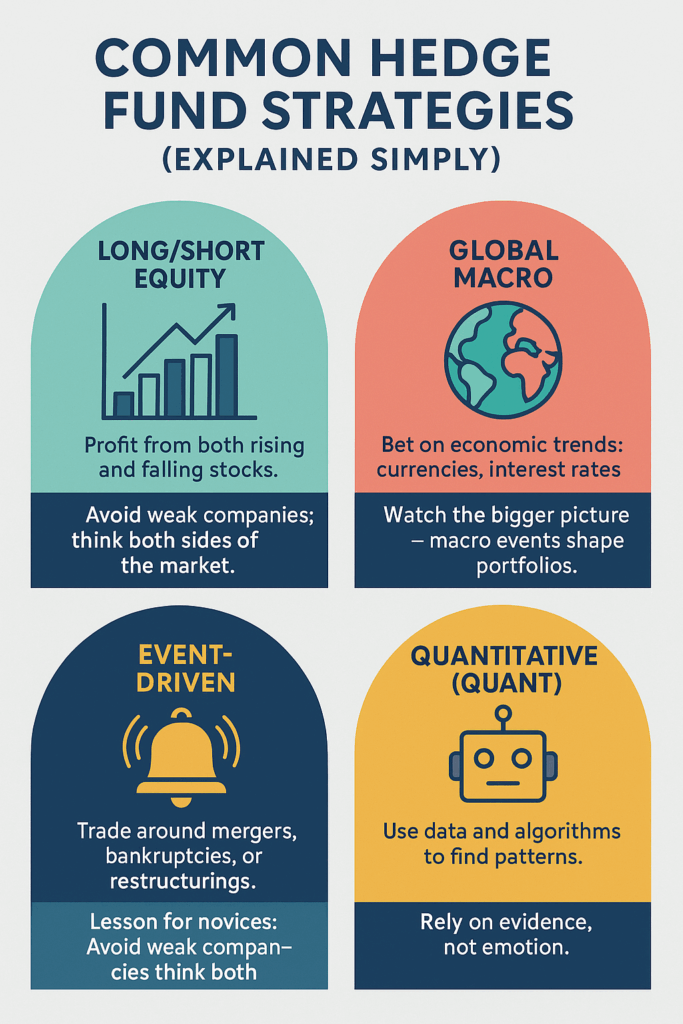
Not all hedge funds look alike. Here are four of the most common strategies:
- Long/Short Equity
Managers buy stocks they expect to rise (“long”) and sell stocks they expect to fall (“short”). The idea is to profit on both sides while reducing exposure to the overall market.
Lesson for novices: You can “think long/short” without actually shorting stocks. Simply avoid companies you believe are weak instead of chasing everything. - Global Macro
These funds bet on broad economic trends: interest rates, currencies, commodities, or government bonds. Bridgewater is the most famous example.
Lesson for novices: Pay attention to the bigger picture. Even if you only own a few stocks, economic shifts—like inflation or rate hikes—affect your portfolio. - Event-Driven
Event-driven funds profit from corporate actions like mergers, bankruptcies, or restructurings. For example, if a company is being acquired, a hedge fund might bet on the deal closing at a higher price.
Lesson for novices: Remember that news moves markets. Earnings announcements, lawsuits, and mergers can make or break investments. - Quantitative (Quant) Strategies
Firms like Renaissance Technologies use math, data, and algorithms to spot patterns. Computers, not humans, decide the trades.
Lesson for novices: Even without supercomputers, you can adopt a “quant mindset” by basing decisions on research and criteria, not just gut feelings.
Bridgewater Associates: Principles as a Compass
Ray Dalio founded Bridgewater Associates in 1975 in his apartment. Today, it’s the largest hedge fund in the world, with assets peaking above $100 billion.
Bridgewater is known for its “global macro” strategy—betting on interest rates, currencies, and economic trends. But what truly set it apart was Dalio’s cultural experiment.
Dalio built Bridgewater around radical transparency:
- Meetings are recorded and shared internally.
- Employees are encouraged to challenge anyone, regardless of rank.
- Mistakes are studied so they aren’t repeated.
Dalio later distilled these ideas in his bestselling book Principles. His view: success comes from building systems that minimize bias, encourage clear thinking, and embrace feedback.
Investor takeaway: Write your own principles. Even if you’re just starting, create a list of rules you’ll follow—like diversifying, setting stop-losses, or rebalancing yearly.
Renaissance Technologies: The Math Wizards
Founded by Jim Simons, a former codebreaker and math professor, Renaissance Technologies is perhaps the most secretive hedge fund in history.
Its flagship Medallion Fund has averaged returns of around 40% after fees for decades. That’s unheard of. To achieve it, Renaissance hires scientists—not Wall Street veterans. Their models scour oceans of data to uncover hidden patterns.
Renaissance’s success highlights the power of removing human emotion from investing.
Investor takeaway: Use data and discipline. Even if you can’t replicate Renaissance’s algorithms, you can use evidence (financial ratios, earnings history) instead of chasing hype.
Long-Term Capital Management: When Genius Failed
LTCM is the ultimate cautionary tale. Founded in 1994 by John Meriwether and staffed with Nobel Prize-winning economists, LTCM sought to exploit tiny inefficiencies using massive leverage.
At first, it worked. In its early years, LTCM posted returns of over 40%. Wall Street couldn’t invest fast enough.
But in 1998, the Russian debt crisis blindsided markets. LTCM’s models assumed certain relationships between bonds would hold—they didn’t. With enormous borrowed positions, LTCM lost billions. The Federal Reserve organized a bailout to prevent contagion.
Investor takeaway: Risk management is more important than intelligence.
Archegos Capital: A Modern Meltdown
Archegos, run by Bill Hwang, collapsed in 2021. Though structured as a family office, it acted like a hedge fund—quietly building giant positions through derivatives.
When those bets soured, Archegos unraveled almost overnight, costing global banks tens of billions.
Investor takeaway: Hidden leverage and over-concentration can destroy fortunes.
The Tiger Cubs: Passing the Torch
Julian Robertson’s Tiger Management was one of the earliest hedge fund giants. Though Robertson closed it in 2000, his protégés—the “Tiger Cubs”—launched their own funds and became highly influential.
They carried forward Robertson’s culture of deep research and bold bets, but with more adaptability.
Investor takeaway: Learn from mentors, but adapt strategies to your own era and personality.
George Soros and the Quantum Fund: The Power of Bold Bets
No discussion of famous hedge funds is complete without George Soros and the Quantum Fund. Soros is most famous for his 1992 bet against the British pound. Convinced the currency was overvalued within the European Exchange Rate Mechanism, Soros built massive short positions.
When the UK government finally devalued the pound, Soros reportedly made over $1 billion in a single day. The move earned him the nickname “the man who broke the Bank of England.”
But Soros’s genius wasn’t luck. It was his willingness to challenge consensus and his belief in “reflexivity”—the idea that market participants’ perceptions influence market outcomes, not just the other way around.
Investor takeaway: Boldness has a place, but it must be informed boldness. Soros did his homework before taking on a central bank. For novices, this means doing research before making a big move, not just following the crowd.
How Hedge Funds Think About Risk vs. Reward
One thing that sets hedge funds apart is how they weigh risks against potential rewards. They don’t just ask, “How much can we make?” They ask, “What happens if we’re wrong?”
This mindset can be valuable for individuals too:
- Before investing in a single stock, ask: What happens if it drops 30%?
- Before chasing a trend, ask: Am I prepared if this bubble bursts?
- Before taking on debt to invest, ask: Can I survive if my returns disappoint?
Successful hedge funds balance offense and defense. They look for upside while protecting the downside.
The Psychology of Hedge Funds (Expanded)
Hedge fund history is full of human behavior at extremes:
- Overconfidence: LTCM’s Nobel Prize winners assumed the world worked like their equations.
- Greed: Archegos pushed leverage far beyond reason.
- Fear: During crises, even skilled managers often panic-sell at the worst possible moment.
- Patience and Discipline: Renaissance refused to let human emotion override its models.
Novice investors face the same forces. The 2008 financial crisis and the 2020 COVID crash both showed how quickly fear spreads. Those who stayed calm and disciplined often came out stronger.
What Hedge Funds Teach Us About Ordinary Life Decisions
Interestingly, the lessons of hedge funds extend beyond investing. Think about it:
- Diversification applies to careers. Don’t rely on one skill or employer.
- Risk management applies to health. Don’t take on more stress or debt than you can handle.
- Principles apply to relationships. Set boundaries and values you won’t compromise on.
- Adaptability applies to everything. Life changes fast; rigid plans can break.
Studying hedge funds is really about studying decision-making under uncertainty—something we all face daily.
The Fee Question: “2 and 20”
Most hedge funds charge a steep fee structure: 2% of assets under management plus 20% of profits.
For a fund managing $10 billion, that’s $200 million a year in fees before even considering performance bonuses.
This explains why hedge funds attract top talent—but also why many investors underperform cheaper index funds.
Lesson for novices: Costs matter. Even modest expense ratios add up over decades.
Hedge Funds vs. Everyday Investing
Here’s the surprising truth: most hedge funds don’t outperform the S&P 500 after fees. Studies show that passive index funds often beat them over long horizons.
So why do hedge funds matter? Because they push boundaries. They test new strategies. Their stories—both victories and blowups—offer timeless lessons in risk, reward, and human behavior.
Final Takeaways
- Process beats prediction. Build rules and stick to them.
- Risk is everything. Avoid concentration and over-leverage.
- Stay humble. Even Nobel Prize winners get it wrong.
- Adapt constantly. What works today may fail tomorrow.
- Mind your psychology. Investing is as emotional as it is rational.
Closing Thoughts
Famous hedge funds are fascinating not just because of their size or secrecy, but because they show us universal truths about money and human nature.
They remind us that brilliance without risk control leads to disaster. That discipline beats gut instinct. That humility is as valuable as boldness.
For novice investors, the lesson is clear: you don’t need to mimic hedge funds. But by studying their successes and failures, you can build a calmer, smarter, and more resilient approach to your own financial journey.