

This Content Is Only For Subscribers
When people think of hedge funds, secrecy and complexity usually come to mind. But the world’s largest hedge fund, Bridgewater Associates, built its success on something surprisingly simple: a set of principles.
Founded in 1975 by Ray Dalio in his two-bedroom apartment, Bridgewater grew from a small advisory business into an investment giant that has managed more than $100 billion in assets. Its story offers important lessons—not just about markets, but about how to think, make decisions, and avoid the traps that cause many investors to stumble.
From Apartment Startup to Market Giant
Ray Dalio didn’t come from privilege. He started out as a clerk at the New York Stock Exchange before studying finance and economics. In 1975, he launched Bridgewater Associates, at first advising clients on managing currency and interest rate risk.
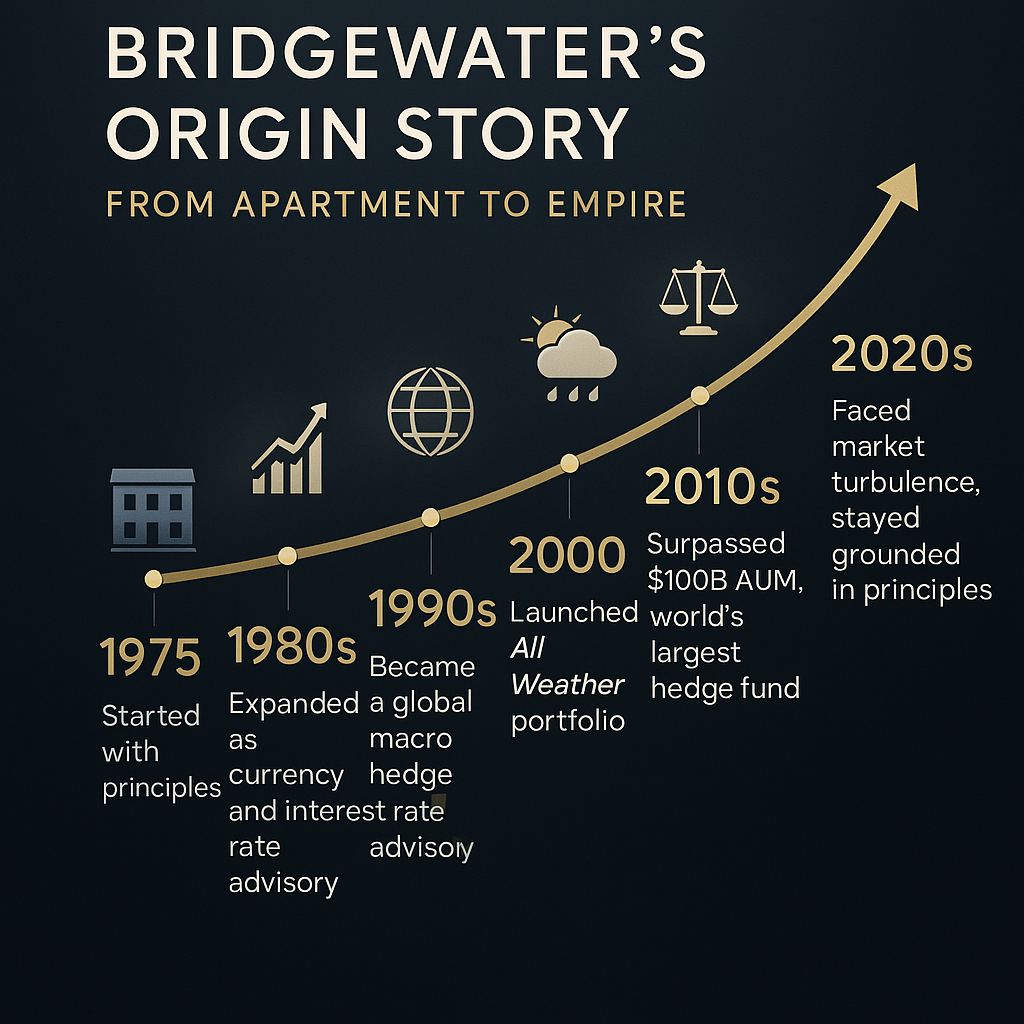
The firm gradually expanded into a global “macro” hedge fund—meaning it makes investment decisions based on big-picture economic forces. Today, Bridgewater’s moves in bonds, currencies, commodities, and equities are so large they can influence entire markets.
Radical Transparency: A Culture Experiment
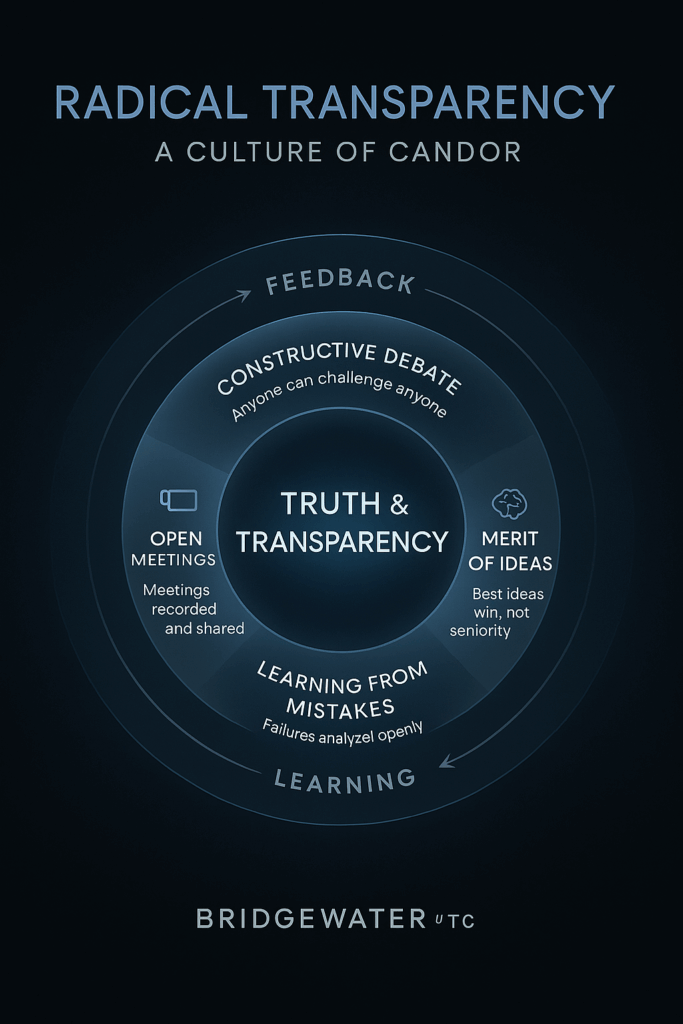
What makes Bridgewater stand out isn’t just its size or strategies—it’s its culture. Dalio created what he called “radical transparency.”
At Bridgewater:
- Meetings are recorded and shared.
- Employees are encouraged to challenge one another, even their bosses.
- Mistakes are openly analyzed so the same error isn’t repeated.
Dalio believed that this environment of candor and honesty would lead to better decision-making. He argued that too many organizations fail because people are afraid to point out problems or challenge leadership.
For some, this culture has been inspiring. For others, it’s been overwhelming. But whether you love or hate it, Bridgewater’s transparency has shaped how the firm thinks about risk, markets, and investing.
The “All Weather” Approach
One of Bridgewater’s most famous ideas is the “All Weather” portfolio.
Most investors make the mistake of betting too heavily on what they think will happen. If inflation rises or interest rates fall, their portfolio might do well—but if the opposite happens, they suffer. Dalio wanted to design a portfolio that could survive in any environment, whether it was inflationary, deflationary, booming, or crashing.
The result was an asset mix that balanced risk across different economic conditions. For example:
- Stocks do well in growth periods.
- Bonds do well when growth slows or interest rates fall.
- Commodities and inflation-linked bonds help when inflation rises.
For ordinary investors, the All Weather concept reinforces a timeless truth: diversification is protection. You don’t need to guess the future if your portfolio is built to withstand many possibilities.
Lessons from Bridgewater’s Wins and Losses
Bridgewater hasn’t always gotten it right. In 2020, the firm suffered one of its worst years in decades as COVID-19 shook markets and some of its models failed to anticipate the pandemic’s effects. Yet the setback highlighted another of Dalio’s principles: failure is data. Instead of hiding losses, Bridgewater studied them, adjusted its models, and continued forward.
Lessons for novice investors:
- Have a system. Whether it’s rebalancing once a year, diversifying across sectors, or setting stop-losses, create rules you can stick to.
- Expect to be wrong sometimes. Even the largest hedge fund in the world doesn’t win every bet. What matters is how you manage losses.
- Think about the big picture. Bridgewater focuses on economic trends—growth, inflation, interest rates. As an individual investor, you don’t need complex forecasts, but staying aware of the economic climate helps you interpret market moves.
The Power—and Limits—of Principles
Dalio eventually published his philosophy in the bestselling book Principles, which became a kind of life manual as well as an investing guide. The core idea: decisions should be based on clearly articulated principles rather than emotions or ego.
For investing beginners, writing down principles can be surprisingly powerful. Examples might include:
- I will not invest money I can’t afford to lose.
- I will not chase “hot tips.”
- I will always keep at least 20% of my portfolio in broad index funds.
These rules can keep you steady when markets get turbulent.
But principles have limits. Some critics argue Bridgewater’s culture can be too rigid, and Dalio himself has admitted that being “principled” doesn’t mean being inflexible. As conditions change, principles should be updated.
Why Bridgewater Matters
So why should everyday investors care about a multi-billion-dollar hedge fund they’ll likely never invest in?
Because Bridgewater shows that success in markets isn’t about having a crystal ball—it’s about discipline, preparation, and humility. It shows that even giants make mistakes, and that building resilience into your strategy matters more than predicting the future.
Bridgewater also reminds us that culture drives outcomes. Whether in a hedge fund or a household, decision-making improves when people can speak openly, learn from mistakes, and adapt to reality.
Final Thoughts
Bridgewater’s journey—from a small apartment office to the world’s largest hedge fund—is more than just a Wall Street story. It’s a lesson in how ideas, discipline, and principles can scale into extraordinary success.
For novice investors, the takeaway isn’t to copy Bridgewater’s trades. It’s to copy its mindset:
- Diversify your bets.
- Write down your principles.
- Learn from mistakes instead of hiding them.
You don’t need billions under management to benefit from these lessons. Whether you’re saving for retirement, your child’s education, or your first home, Bridgewater’s story shows that steady, principle-based investing is the foundation of long-term success.