

This Content Is Only For Subscribers
When most people think about investing, they imagine a traditional setup: professional managers, a legal entity like a fund or trust, and clear structures for ownership. But in the world of digital assets, a new model has emerged that challenges the old playbook—the Decentralized Autonomous Organization, better known as a DAO. DAOs are reshaping how groups pool money, make decisions, and manage investments. For novice investors, understanding DAOs is crucial to grasping how innovation is colliding with finance.
What Is a DAO?
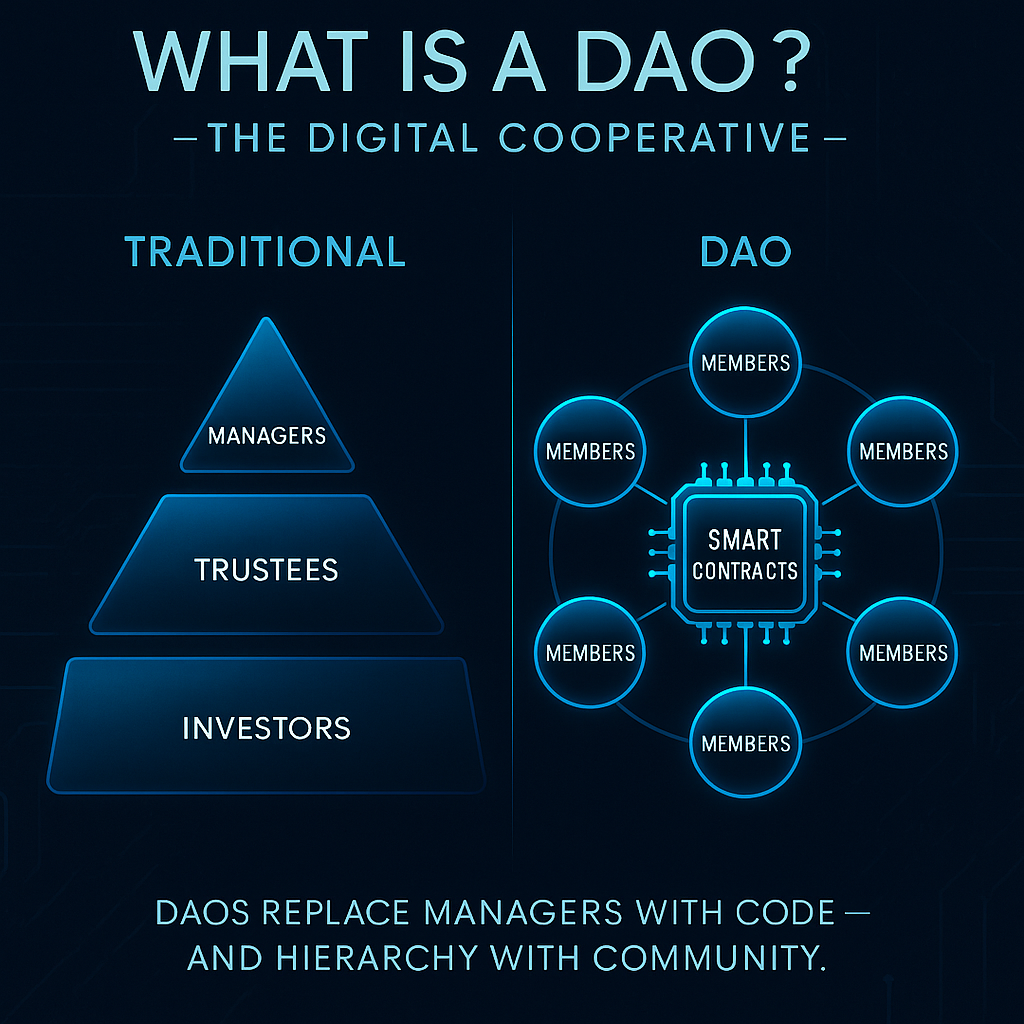
A DAO is essentially a community-run organization built on blockchain technology. Instead of relying on corporate boards or executives, a DAO uses smart contracts—pieces of code that execute automatically when conditions are met—to handle governance and operations. Ownership and voting power are usually distributed via tokens, and participants vote directly on proposals ranging from investment decisions to rule changes.
Think of a DAO as a digital cooperative. If you hold its governance token, you’re a member with the ability to shape its direction. This structure reduces the need for centralized authority and, in theory, increases transparency and fairness.
Why DAOs Entered the Investment World
Traditional investment funds are often criticized for being exclusive, expensive, and opaque. DAOs attempt to address these shortcomings by offering:
- Open Participation: Anyone with an internet connection and the DAO’s token can usually join and vote, making access more democratic.
- Transparency: All transactions and governance decisions are recorded on a public blockchain.
- Efficiency: Smart contracts automate processes like profit distribution or proposal voting, reducing administrative overhead.
For many crypto enthusiasts, DAOs represent the next evolution of collective investing.
Types of Investment-Focused DAOs
Not all DAOs are created equal. In investment management, three main types stand out:
- Venture DAOs: These pool capital to invest in early-stage blockchain projects, NFTs, or tokens. Example: MetaCartel Ventures, one of the first well-known venture DAOs.
- Index DAOs: These create tokenized portfolios that track baskets of crypto assets. Example: Index Coop, which offers tokenized indices like the DeFi Pulse Index.
- Grant DAOs: Rather than seeking profit, these allocate pooled funds to support open-source crypto projects. Example: Gitcoin DAO.
While each has its quirks, they all share the principle of community-led capital allocation.
Governance in DAOs: Token Voting
The most common governance model is token-weighted voting. If you own 1% of the tokens, you typically have 1% of the vote. This resembles shareholder voting in corporations but with far fewer intermediaries. Proposals can cover new investments, treasury management, or even the DAO’s long-term mission.
However, governance isn’t always straightforward. Token concentration can give whales (large holders) disproportionate influence. Some DAOs experiment with quadratic voting or reputation-based systems to balance power. For investors, it’s important to understand not just what a DAO invests in, but also who really controls the votes.
Legal and Regulatory Uncertainty
One of the biggest challenges facing DAOs is their legal status. In most jurisdictions, DAOs do not fit neatly into existing corporate structures. Are members personally liable for the DAO’s actions? How should profits be taxed?
A few regions, like Wyoming in the U.S., have introduced frameworks allowing DAOs to register as legal entities, but global clarity is still developing. For cautious investors, this uncertainty is a major consideration—joining a DAO may involve risks traditional funds don’t face.
Benefits of DAOs for Investors
- Inclusivity: Lower barriers to entry compared to hedge funds or venture funds.
- Transparency: On-chain activity reduces the risk of hidden fees or mismanagement.
- Innovation: Access to early-stage projects often unavailable to retail investors.
- Community: Many DAO participants value the sense of belonging and shared purpose.
Risks and Limitations
Despite the excitement, DAOs come with significant risks:
- Smart Contract Bugs: A flaw in code can drain a DAO’s treasury. The infamous 2016 DAO hack remains a cautionary tale.
- Governance Capture: A few large token holders may dominate decisions.
- Regulatory Grey Areas: Without legal clarity, investors may face uncertain rights or obligations.
- Volatility of DAO Tokens: The value of governance tokens themselves can swing wildly, impacting both voting power and portfolio value.
For novice investors, these risks highlight the importance of careful due diligence.
Real-World Examples
- The DAO (2016): The first large-scale investment DAO raised over $150 million but was hacked due to a smart contract exploit. This incident shaped Ethereum’s history and highlighted DAO risks.
- PleasrDAO: A collective that pools funds to buy high-value cultural assets like NFTs and rare digital art.
- BitDAO: One of the largest DAOs by treasury size, focusing on funding projects that advance decentralized finance (DeFi).
These examples show both the potential and pitfalls of DAOs in practice.
How Novice Investors Should Approach DAOs
If you’re curious about DAOs as an investment vehicle:
- Research the DAO’s Purpose: Is it focused on venture, grants, or index-style investing?
- Examine Governance: Who holds most of the voting tokens? Are whales in control?
- Assess Security: Has the DAO’s smart contract been audited?
- Start Small: Consider participating with a modest amount to learn before committing larger sums.
Most importantly, view DAOs as an experiment. While they may evolve into a dominant investment model, today they remain high-risk, high-innovation vehicles.
The Future of DAOs in Investment Management
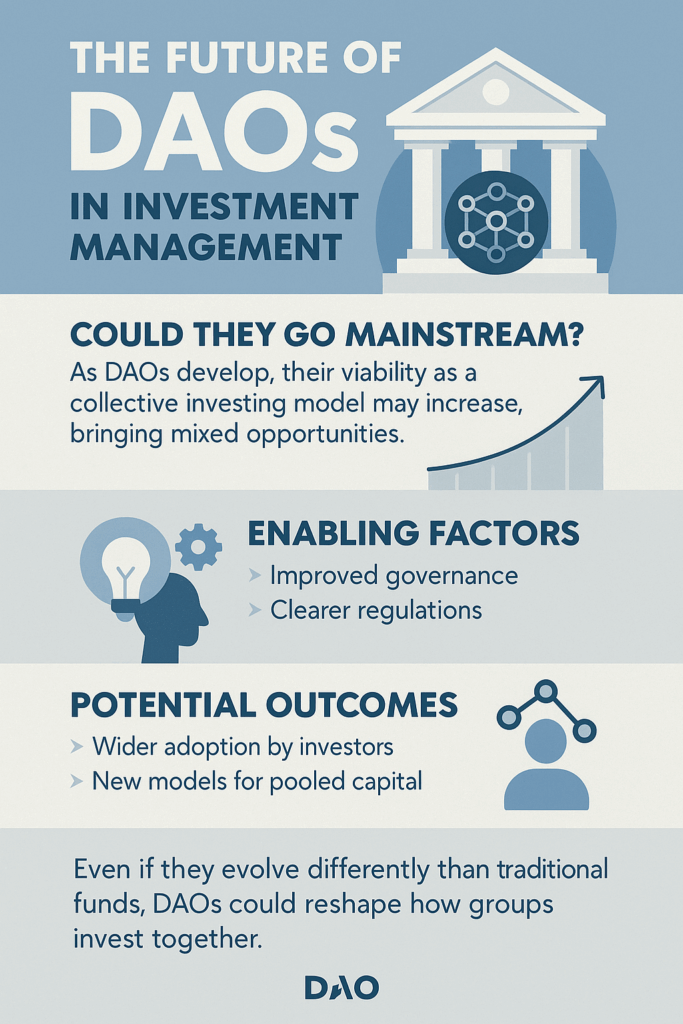
DAOs are still in their early stages, but they already challenge the idea that professional fund managers are the only way to pool capital. As regulations catch up and governance models improve, DAOs could become mainstream, offering both institutions and individuals new ways to invest collectively.
For now, they’re best seen as laboratories for the future of finance—part social experiment, part investment fund, and part technological innovation. Whether they succeed or fail, DAOs will leave a lasting mark on how we think about money and decision-making.