

This Content Is Only For Subscribers
When you hear about a startup raising “another round,” chances are it’s a follow-on round—funding that comes after the initial seed or Series A stage. For many novice investors, these subsequent rounds can feel like alphabet soup: Series B, C, D, and beyond. But beneath the jargon lies a crucial concept: dilution. Understanding how follow-on funding works, and how it impacts both founders and early investors, is key to making sense of venture capital.
What Are Follow-On Rounds?
Follow-on rounds are subsequent financings raised by a company after its initial venture investment. They serve to inject more capital into the business as it grows, scales, or faces new challenges.
- Seed round – The earliest capital, often used to build a product or test an idea.
- Series A – Funds to establish product-market fit and begin scaling.
- Series B and beyond – Larger sums used for market expansion, hiring, or international growth.

A follow-on round can occur at any stage after the seed. For instance, a Series B is a follow-on to Series A, and a Series C follows Series B, and so on.
Why Companies Raise Follow-On Funding
Startups rarely become profitable right away. They often need multiple injections of capital to fuel growth before reaching self-sustainability or exit. Common reasons for raising follow-on rounds include:
- Scaling operations – Hiring, expanding into new markets, or ramping up production.
- Product development – Building new features, expanding a product line, or investing in R&D.
- Marketing and customer acquisition – Capturing market share quickly before competitors catch up.
- Bridging to profitability – Covering operating costs until revenue growth takes over.
Follow-on rounds are not just about survival; they’re about accelerating growth to seize opportunities.
How Dilution Works
Here’s where things get tricky for early investors: every time a company issues new shares in a follow-on round, the ownership percentage of existing shareholders shrinks. This is called dilution.
Imagine you invest $10,000 in a startup’s seed round for 10% ownership. The startup later raises a Series A and issues new shares to new investors. Even if your stake remains the same number of shares, your percentage of ownership decreases because there are more total shares outstanding.
- Before Series A: You own 10% of the company.
- After Series A: You might own 7% (depending on how many new shares are issued).
Dilution isn’t inherently bad—it’s the cost of growth. If the company’s overall value increases significantly, your smaller percentage could still be worth much more in dollar terms.
Protective Mechanisms for Investors
Sophisticated investors negotiate terms to manage dilution risk. Some common mechanisms include:
- Pro-rata rights – Early investors have the right to invest more in future rounds to maintain their percentage ownership.
- Anti-dilution provisions – These protect investors in the case of a “down round” (raising money at a lower valuation than the previous round).
- Preferred shares – Many venture investors receive preferred stock with special rights that soften the impact of dilution.
For novice investors in angel deals or crowdfunding platforms, such protections may not always be available, which makes it important to understand the risks upfront.
The Significance of Valuation
Valuation plays a central role in how dilution unfolds. If a company raises at a high valuation, existing shareholders are diluted less. If the valuation is lower (as in a down round), the dilution impact can be much harsher.
Example:
- Company raises $5M at a $20M pre-money valuation. Investors buy 20% of the company.
- If next round is $10M at a $100M valuation, dilution is minimal for early investors.
- If instead the next round is $5M at a $10M valuation, existing investors see a much bigger hit to their ownership share.
This is why seasoned investors care deeply about valuations in every round—they affect not just percentage ownership, but also signaling to the market about the startup’s trajectory.
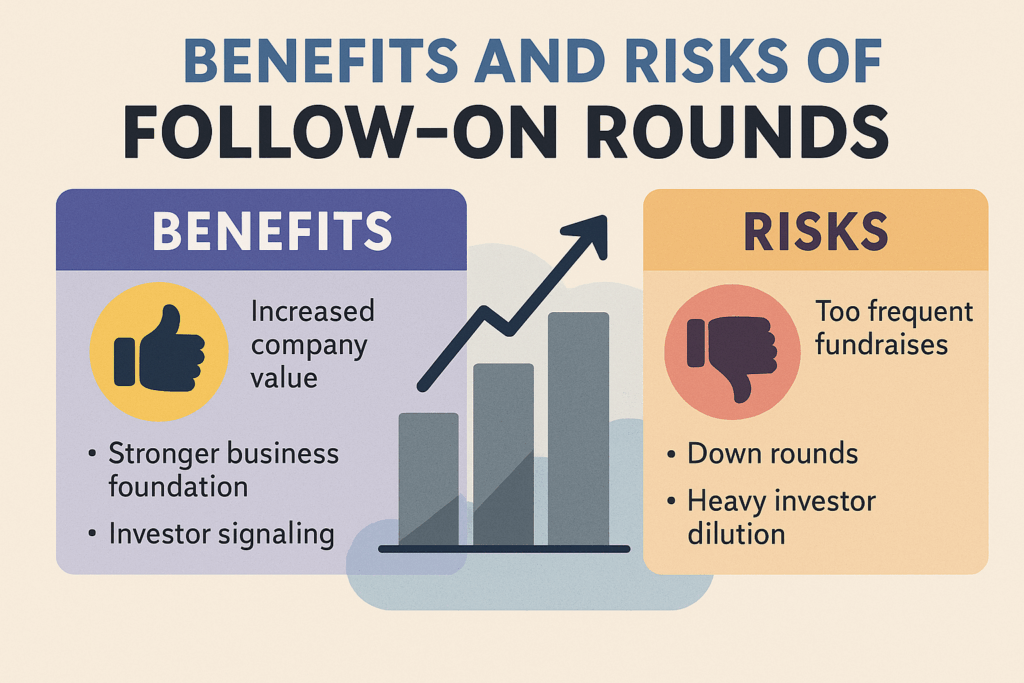
Benefits of Follow-On Rounds
While dilution can sound negative, follow-on rounds provide crucial benefits:
- Increased company value – Even with smaller ownership, the absolute value of shares often grows.
- Stronger business foundation – Capital helps the company survive and expand, boosting long-term success odds.
- Investor signaling – New investors joining at later stages (especially top-tier firms) can validate the startup’s potential.
Risks of Follow-On Rounds
For startups:
- Raising too often can signal inefficiency or unsustainable burn rates.
- Down rounds can damage morale, reputation, and founder control.
For investors:
- Heavy dilution without participation rights can erode meaningful ownership.
- Follow-on fatigue: if a company constantly needs cash, returns may diminish.
Famous Examples
- Facebook raised multiple follow-on rounds before going public, each time increasing its valuation and bringing in heavyweight investors like Accel and Microsoft.
- WeWork, on the other hand, raised billions across many rounds but ultimately saw valuation collapse, leaving late investors with losses and early ones diluted despite huge capital inflows.
These examples illustrate both the promise and pitfalls of follow-on financing.
What Novice Investors Should Watch
If you’re following startups or considering angel investments, pay attention to:
- The company’s burn rate (how fast it spends cash).
- Valuations at each round (are they going up or down?).
- Terms for early investors (do they protect against dilution?).
- Who joins future rounds (top-tier VCs, corporates, or less-known investors).
Even if you can’t participate in every follow-on round, knowing how they shape ownership and company health is vital.
Key Takeaways
- Follow-on rounds are subsequent funding stages after a seed or Series A.
- Dilution reduces percentage ownership but can increase total value if the company grows.
- Valuations and protective rights play a big role in how dilution impacts investors.
- Strong follow-on rounds can validate a company, while weak ones can raise red flags.
For novice investors, understanding follow-on financing and dilution is a window into how venture capital works in practice—helping you grasp not just how startups raise money, but how value shifts between investors over time.