

This Content Is Only For Subscribers
The world of digital assets has grown from a niche experiment into a global financial frontier. Bitcoin launched in 2009 as a cryptographic curiosity; today, cryptocurrencies and blockchain-based projects have attracted trillions in investment, created new asset classes, and sparked debates in boardrooms and governments worldwide.
But for many investors, especially novices, the idea of buying and holding digital tokens directly can be intimidating. Managing private keys, navigating volatile markets, and worrying about scams or hacks are daunting tasks. That’s where crypto funds come in.
Crypto funds are investment vehicles that package exposure to digital assets in more familiar, structured ways. Just as traditional investors might choose mutual funds or ETFs to avoid picking individual stocks, crypto investors can now choose from funds designed to simplify the process. The three most prominent models are:
- Crypto hedge funds, which mirror traditional hedge funds but focus on digital assets.
- Crypto ETFs, which package coins like Bitcoin or Ethereum into an exchange-traded format.
- DAOs (Decentralized Autonomous Organizations), which use blockchain technology to let communities pool resources and make investment decisions collectively.
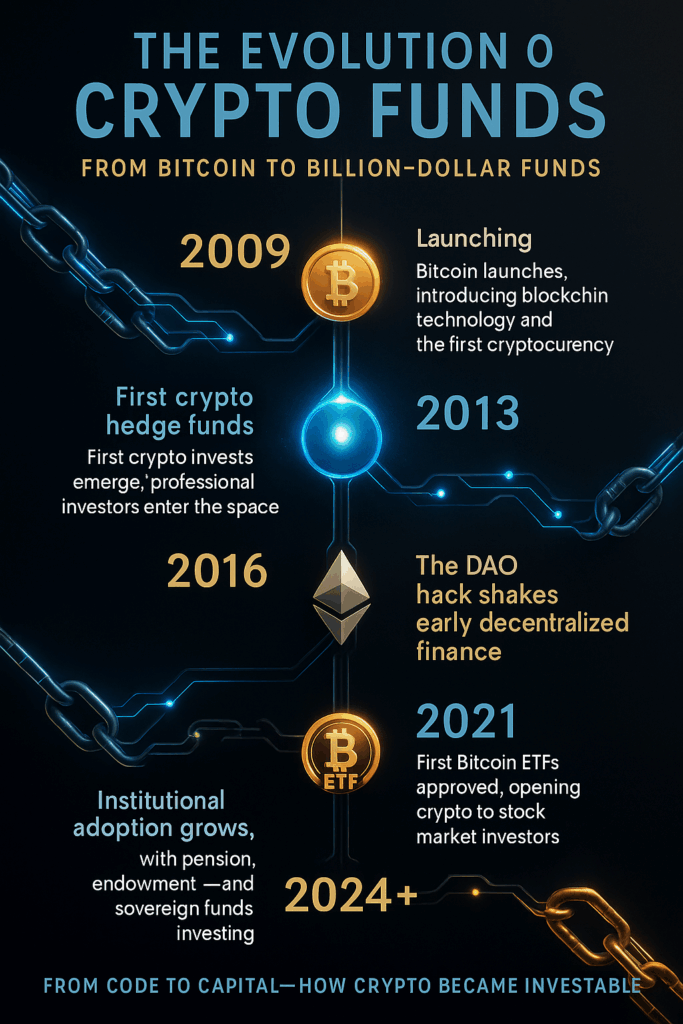
Each of these vehicles offers unique benefits, risks, and structures. Together, they represent the evolving toolkit for investors looking to enter the world of crypto without necessarily managing everything themselves.
This article will walk through each model in depth, explain why they exist, highlight real-world examples, and explore what the future might look like. Whether you’re new to investing or just new to crypto, by the end you’ll have a clear picture of how these funds work and how they differ.
Why Crypto Funds Exist
When Bitcoin first appeared, the only way to invest was to mine it yourself or buy coins on small, unregulated exchanges. In the early 2010s, platforms like Mt. Gox dominated trading—but they were plagued by hacks, poor security, and eventual collapse. Investors had to deal with technical hurdles, including setting up wallets and securing private keys.
As crypto prices rose and attracted more attention, it became clear that investors needed safer, more professional ways to participate. Just as traditional finance evolved from individual stock-picking to funds and index products, crypto began developing its own fund ecosystem.
Crypto funds exist because:
- Not everyone wants technical exposure – Handling wallets and private keys can be intimidating.
- Investors want diversification – Funds can spread risk across multiple assets or strategies.
- Institutions need structure – Pension funds and endowments can’t open accounts on random exchanges; they need compliance and custody.
- Demand for regulated products – Regulators are more comfortable approving funds than letting retail investors handle assets directly.
In short, crypto funds bring familiar structures to an unfamiliar asset class.
A Brief History of Crypto Funds
Early Hedge Funds
The first wave of crypto hedge funds appeared around 2013–2014, when Bitcoin was trading under $1,000. Pantera Capital, founded in 2013, was one of the pioneers, launching Bitcoin-focused funds for accredited investors. Other early players included Polychain Capital, which raised significant institutional backing in 2016.
These funds often focused on long-only strategies—simply buying and holding Bitcoin or Ether. Over time, they adopted more sophisticated approaches, from algorithmic trading to venture-style token investing.
ETF Milestones
Attempts to launch a Bitcoin ETF began as early as 2013, when the Winklevoss twins filed with the U.S. Securities and Exchange Commission (SEC). The SEC repeatedly denied applications, citing concerns about fraud, manipulation, and custody.
Canada became the first country to approve a spot Bitcoin ETF in 2021, offering direct exposure to Bitcoin prices. The U.S. lagged behind, initially approving only futures-based Bitcoin ETFs (like ProShares’ BITO in 2021). It wasn’t until 2024 that the SEC finally approved the first U.S. spot Bitcoin ETFs, a watershed moment for mainstream crypto adoption.
The DAO Experiment
DAOs emerged as a radical alternative. The most famous early attempt was simply called “The DAO”, launched in 2016 as a decentralized venture capital fund. It raised over $150 million in Ether—an enormous sum at the time—before a hack drained a large portion of the funds. The incident forced the Ethereum community to hard-fork the blockchain to restore the stolen money, splitting Ethereum into two chains (Ethereum and Ethereum Classic).
Despite this rocky start, DAOs have returned stronger. By the 2020s, organizations like The LAO, MetaCartel Ventures, and PleasrDAO were proving that decentralized investing could attract serious capital and community energy.
Part I: Crypto Hedge Funds
What They Are
A crypto hedge fund is a professionally managed investment vehicle that invests primarily in cryptocurrencies and blockchain-related projects. Like traditional hedge funds, they pool money from accredited investors or institutions and apply specific strategies to generate returns.
Common Strategies
- Arbitrage – Taking advantage of price differences across exchanges.
- Quantitative trading – Using algorithms and data models to make short-term trades.
- Venture-style investing – Taking early stakes in tokens or blockchain startups.
- Yield farming and staking – Locking up assets in decentralized finance protocols to earn returns.
- Market neutral – Balancing long and short positions to reduce exposure to market swings.
Who Can Invest
Because of regulatory restrictions, crypto hedge funds are usually only open to accredited investors—individuals with high income or net worth—or institutional players like family offices, pensions, or endowments.
Fund Mechanics
- Fees: Many follow a “2 and 20” model (2% management fee, 20% of profits).
- Liquidity: Investors often face lock-ups, meaning they can’t withdraw funds for months or years.
- Custody: Assets are held by specialized custodians with insurance and compliance frameworks.
Pros and Cons
- Pros: Access to sophisticated strategies, professional management, potential for high returns.
- Cons: High fees, limited liquidity, regulatory uncertainty, and risks tied to exchanges or custodians.
Part II: Crypto ETFs
What They Are
A crypto ETF is an exchange-traded fund that gives investors exposure to cryptocurrencies without requiring them to own the coins directly. Shares of the ETF trade on stock exchanges, just like shares of a regular ETF.
Types of Crypto ETFs
- Futures ETFs – Track Bitcoin futures contracts, not the spot price.
- Spot ETFs – Hold Bitcoin or Ethereum directly, providing a closer price correlation.
- Equity-based ETFs – Invest in companies tied to the crypto ecosystem, such as miners, exchanges, or payment providers.
Why They Appeal to Investors
- Easy to buy through existing brokerage accounts.
- Regulated by securities authorities.
- Held in familiar custodial systems.
Limitations
- Limited asset coverage (mostly Bitcoin and Ethereum).
- Management fees, though generally lower than hedge funds.
- Futures ETFs may not perfectly track spot prices.

Part III: DAOs
What They Are
A Decentralized Autonomous Organization (DAO) is a blockchain-based group governed by smart contracts. Instead of a CEO or board, decisions are made collectively by token holders who vote on proposals.
DAO Investment Models
- Investment DAOs: Pool funds to invest in startups or tokens.
- Collector DAOs: Buy and manage NFTs or art.
- Grant DAOs: Allocate funds to support ecosystem growth.
Strengths and Weaknesses
- Strengths: Transparent, global participation, no single point of failure.
- Weaknesses: Regulatory uncertainty, smart contract bugs, governance challenges.
Institutional vs. Retail Adoption
- Retail investors favor ETFs for simplicity, or DAOs for community-driven engagement.
- Institutions prefer hedge funds, which offer professionalism, risk controls, and larger allocation capacity.
Risk Myths vs. Reality
A common myth is that investing through a crypto fund eliminates risk. The truth is, risk shifts—it doesn’t disappear.
- Market risk remains: if Bitcoin drops 50%, so will a Bitcoin ETF.
- Operational risk: hedge funds depend on custodians and trading platforms that can fail.
- DAO risks: bugs in smart contracts can lead to catastrophic losses.
Funds add convenience and structure, but they can’t shield investors from crypto’s inherent volatility.
Custody and Security
Custody is one of the most critical issues for crypto funds. Unlike traditional assets, cryptocurrencies exist on blockchains, and control of the private keys equals control of the funds.
- Hedge funds rely on institutional custodians like Coinbase Custody or BitGo.
- ETFs use regulated custodians to safeguard holdings.
- DAOs depend on multi-signature wallets or smart contracts, which can be transparent but also risky.
Global Perspectives
- Asia: Singapore and Hong Kong are major hubs for crypto funds, with favorable regulation.
- Europe: Switzerland and Germany lead in crypto-friendly ETFs.
- Latin America: Brazil has seen strong adoption of Bitcoin ETFs.
- Middle East: Dubai is positioning itself as a regional crypto hub.
Case Studies
- Pantera Capital: Early hedge fund managing billions across hedge, venture, and token funds.
- ProShares BITO: First U.S. Bitcoin futures ETF, launched in 2021.
- ConstitutionDAO: Raised $40+ million to bid on a copy of the U.S. Constitution, highlighting both the power and quirks of DAOs.
The Future of Crypto Funds
Three possible scenarios:
- Mainstream Integration: ETFs proliferate, hedge funds grow, DAOs gain recognition. In this world, retirement accounts, sovereign wealth funds, and even 401(k) options might offer crypto exposure through regulated funds.
- Regulatory Crackdowns: Governments restrict crypto exposure, pushing DAOs underground. Hedge funds would face tighter compliance, and ETFs could be limited to futures products. Investors might see fewer options and higher costs.
- Hybrid Models: Funds combine centralized structures with DAO governance. Imagine a regulated ETF that allows token-holder voting on portfolio allocations, or a hedge fund that runs parts of its strategy transparently on-chain. This middle ground could define the next generation of investing.
Key Takeaways for Novice Investors
- Match structure to your needs: Hedge funds = sophistication, ETFs = accessibility, DAOs = community.
- Ask about custody: Who holds the keys?
- Understand risk: Crypto is volatile; funds don’t erase risk, they manage it differently.
- Do your homework: Check fees, transparency, and governance.

Conclusion
Crypto funds bring traditional structures to the new world of digital assets. Hedge funds cater to institutions, ETFs provide retail access, and DAOs experiment with decentralization. Together, they offer a spectrum of options for investors—from cautious newcomers to adventurous pioneers.
As the crypto market matures, these models will continue to evolve. Whether through greater regulation, hybrid models, or entirely new innovations, one thing is certain: crypto funds are here to stay.