

This Content Is Only For Subscribers
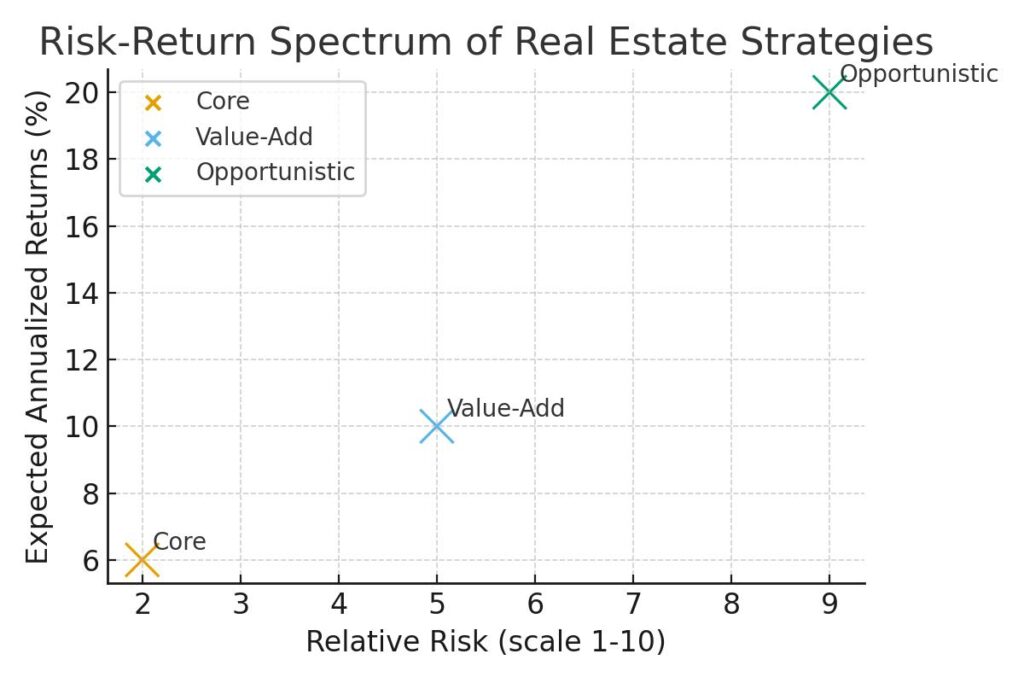
While core and value-add real estate funds focus on stability and moderate growth, opportunistic real estate fundstarget the highest-risk, highest-reward investments in the real estate spectrum. These funds pursue distressed properties, ground-up development, or unconventional investments that require active management, strategic insight, and often significant capital expenditure.
In this article, we’ll explore what opportunistic real estate investing entails, typical assets, potential rewards and risks, and how it fits into a diversified portfolio.

What Is Opportunistic Real Estate Investing?
Opportunistic real estate investing focuses on properties with high growth potential but significant risk factors. Unlike core or value-add strategies, opportunistic investments often involve:
- Distressed or underperforming properties in need of major renovations or repositioning.
- Ground-up development projects, including residential, commercial, or mixed-use construction.
- Emerging or secondary markets, which may offer higher growth but also greater uncertainty.
- Complex property types, such as hotels, resorts, or specialized industrial assets.
These investments are highly management-intensive, requiring strategic planning, project execution, and sometimes creative repositioning to unlock value.
Key Characteristics of Opportunistic Real Estate
- High Risk: Properties often face significant operational, construction, or market challenges.
- High Returns: Investors typically target 15–25% annualized returns, primarily through capital appreciation rather than steady rental income.
- Active Management Required: Fund managers oversee development, renovations, leasing strategies, and sometimes rezoning or repurposing.
- Higher Leverage: Opportunistic funds may use substantial debt to amplify potential returns, increasing financial risk.
Typical Opportunistic Assets
Opportunistic real estate funds invest across multiple sectors, often in complex or high-growth projects:
- Distressed Commercial Properties: Buildings with high vacancy, deferred maintenance, or financial distress.
- Ground-Up Developments: New office towers, apartment complexes, or mixed-use projects.
- Specialized Properties: Hotels, resorts, or niche industrial facilities.
- Emerging Markets: Properties in developing cities or regions with strong population or economic growth.
Example: A fund may purchase an underutilized downtown warehouse district, redevelop it into modern office and retail space, and lease it to startups and small businesses. The property’s value increases substantially as occupancy rises and rents grow.
How Opportunistic Funds Work
Opportunistic real estate funds typically operate as private partnerships, pooling capital from investors to pursue high-risk, high-reward opportunities. The fund manager creates a plan for value creation, which may include:
- Acquisition of Distressed or Undervalued Properties: Identifying assets that are underperforming or mismanaged.
- Renovation or Redevelopment: Updating structures, improving layouts, or repurposing buildings for different uses.
- Operational Improvements: Implementing professional management to increase tenant satisfaction and reduce expenses.
- Market Timing Strategies: Capitalizing on growth trends, urban revitalization, or demographic shifts to maximize returns.
Because of the complexity and risk, opportunistic investments often require a longer time horizon, sometimes 5–10 years, to realize their full potential.
Advantages of Opportunistic Investing
- High Potential Returns: Successful redevelopment or repositioning can yield significant capital appreciation.
- Creative Value Creation: Managers can implement innovative strategies to maximize property value.
- Market Opportunity: Funds can acquire undervalued or distressed assets in emerging markets, taking advantage of market inefficiencies.
- Portfolio Diversification: Opportunistic real estate can provide a high-growth component to a diversified real estate allocation.
Example: A fund purchases a 20-year-old office building in a revitalizing urban area. Through renovations and tenant improvements, the property’s occupancy rises, rents increase, and the building is eventually sold at a significant profit.
Risks of Opportunistic Investing
While returns can be high, opportunistic real estate comes with substantial risks:
- Market Risk: Economic downturns or changing local demand can reduce property value.
- Execution Risk: Renovations or development projects may face delays or cost overruns.
- Financing Risk: High leverage can amplify losses if income projections are not met.
- Liquidity Risk: Opportunistic investments are often illiquid, with long lock-up periods.
Example: A hotel redevelopment project in a secondary market may face construction delays, insufficient bookings, or local regulatory hurdles, potentially reducing or delaying investor returns.
Historical Performance
Opportunistic funds historically deliver the highest returns in the real estate fund spectrum but with more volatility. During periods of economic recovery, such as post-2009 in the U.S., many opportunistic funds acquired distressed properties at discounted prices and executed redevelopment strategies, generating double-digit annualized returns.
Example: A mixed-use property purchased for $10 million in a declining urban district was redeveloped into modern offices and retail units, later selling for $25 million, delivering substantial returns for investors.
Global Opportunities
Opportunistic strategies are increasingly applied internationally, especially in emerging markets where rapid urbanization and infrastructure development create unique opportunities.
- Latin America: Urban redevelopment and hospitality projects in growing cities.
- Asia-Pacific: Mixed-use developments in fast-growing secondary cities.
- Europe: Revitalization of underutilized industrial or office space.
These markets offer potential high returns but carry additional political, regulatory, and currency risks.
Role in a Diversified Portfolio
Opportunistic funds are usually a “satellite” allocation in a diversified real estate portfolio. A typical allocation might look like:
- 50% Core: Stable, income-generating properties
- 30% Value-Add: Moderate risk and returns
- 20% Opportunistic: High-risk, high-reward projects
By allocating a portion of capital to opportunistic strategies, investors can pursue significant growth while balancing risk with core and value-add holdings.
Practical Tips for Investors
- Assess Risk Tolerance: Opportunistic real estate is not for conservative investors.
- Understand the Time Horizon: Expect multi-year lock-ups to realize returns.
- Review Manager Track Record: Experienced managers are critical for complex projects.
- Examine Market Conditions: Ensure the location supports redevelopment and growth.
- Factor in Leverage: High debt levels can magnify losses as well as gains.
Conclusion
Opportunistic real estate investing represents the highest risk and potential reward in the real estate spectrum. While these funds require careful management, long-term commitment, and sophisticated strategies, they can offer substantial capital appreciation for investors seeking growth opportunities.
For those willing to accept higher risk, opportunistic real estate funds provide a dynamic way to diversify a portfolio and capitalize on market inefficiencies, distressed assets, and redevelopment opportunities. Combined with core and value-add strategies, opportunistic investments can play a critical role in a well-rounded, high-performing real estate portfolio.