

This Content Is Only For Subscribers
If you’re new to crypto funds, two U.S. regulators show up again and again: the Securities and Exchange Commission (SEC) and the Commodity Futures Trading Commission (CFTC). They don’t do the same job, and they don’t always look at the same assets. This quick, plain-English guide explains who covers what, how that affects a fund’s day-to-day decisions, and what you should ask before you invest.
Who regulates what (the 60-second version)
- SEC → “Securities” world.
If a crypto asset or the fund’s interests are treated as securities, the SEC’s rules apply. That includes how the fund raises capital (private placements), how its adviser markets performance, and how it discloses fees, conflicts, custody, and valuation. - CFTC → “Derivatives” world (and spot anti-fraud).
The CFTC oversees futures, options, and swaps on digital assets. It also polices fraud and manipulation in spot crypto markets even though it does not comprehensively regulate spot exchanges the way it regulates futures venues.
Many crypto funds touch both worlds: they raise money and market performance (SEC lens), then run basis trades or hedges with futures (CFTC lens).
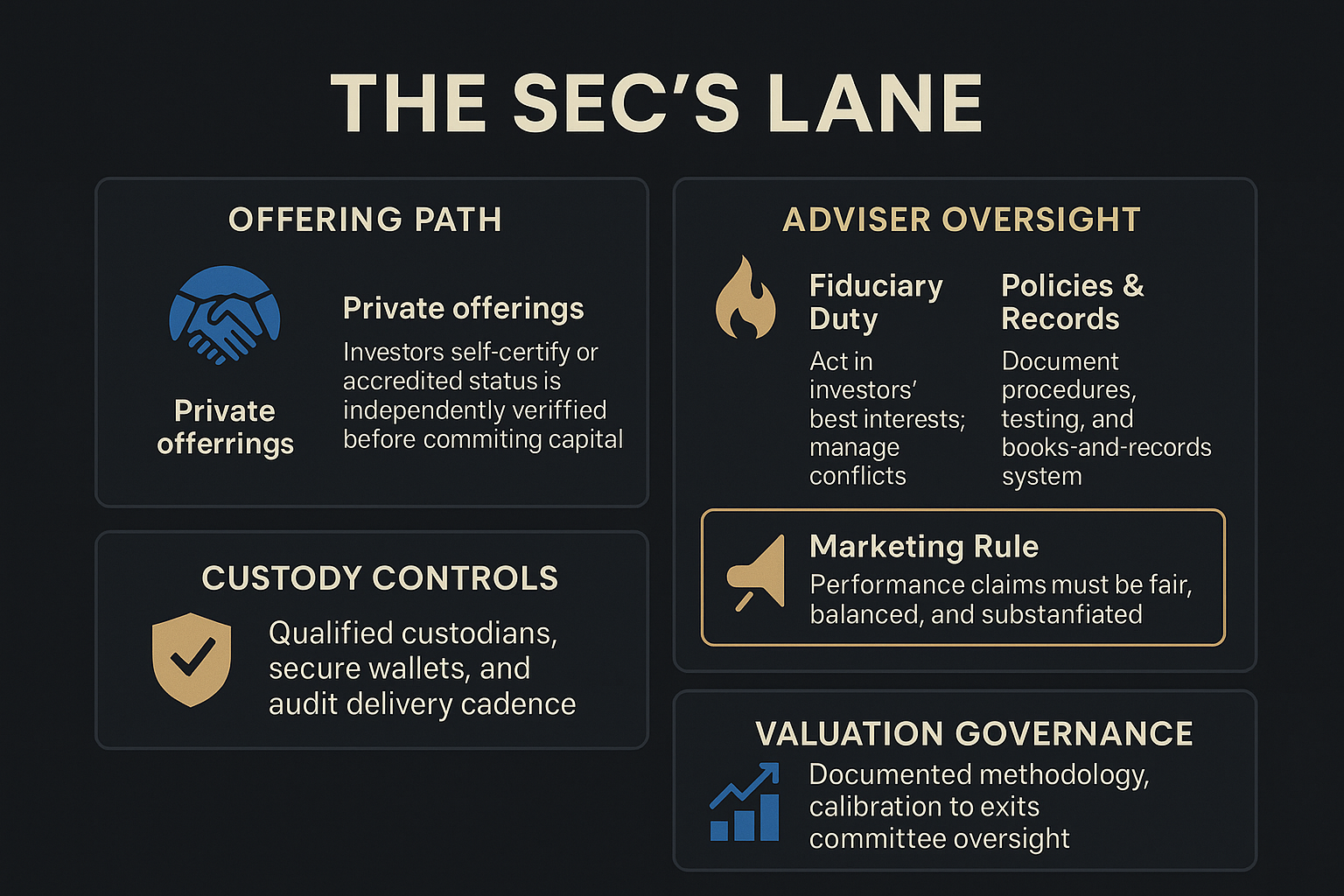
The SEC’s lane: fundraising, advisers, custody, and marketing
Private offerings.
Most crypto funds sell limited partnership interests through private placements. In practice, that means either a “quiet” raise (no public ads, investors self-certify eligibility) or a public-facing private raise that allows advertising only if investors’ accredited status is independently verified. Your experience—what documents you sign, what proof you provide—flows from which path the manager chose.
Adviser oversight.
The SEC focuses on the adviser (the management company behind the general partner), not just the fund. Core expectations:
- Fiduciary duty. Act in investors’ best interests; identify, disclose, and manage conflicts.
- Policies and a real CCO. Written procedures, testing, and records that match how the firm actually operates.
- Marketing rule. Performance claims must be fair, balanced, and substantiated; testimonials/endorsements require specific disclosures. If you see “top quartile,” ask to see the work behind it.
- Books and records. If it’s in the deck, there should be backup—calculations, benchmarks, and net-of-fee details.
Custody safeguards.
Crypto custody is special. The SEC expects robust controls around who can move assets, how keys are secured, and how records are kept. Many managers use qualified custodians, multi-party computation (MPC) or hardware-secured wallets, whitelists, and multi-approver transfers, then deliver annual audited financial statements to investors. When you diligence a fund, ask who the custodian is and how transfers are approved.
Valuation governance.
For liquid tokens, pricing is straightforward. For thinly traded assets, locked tokens, or side pockets, the SEC expects a documented valuation methodology, calibration to observable data, committee oversight, and back-testing(comparing realized exits to prior marks).
The CFTC’s lane: futures, options, and hedging
Registration triggers.
If a fund trades futures, options, or swaps on digital assets, the manager may need to register (or claim an exemption) as a commodity pool operator (CPO) and/or commodity trading advisor (CTA), and follow related reporting, disclosure, and business-conduct requirements. Futures-only strategies run through regulated venues; market-neutral crypto funds often use futures to hedge basis or directional beta.
Spot market policing.
Even in spot markets, the CFTC can bring cases against fraud and manipulation. That matters because a fund’s basis trade, liquidation risk, or slippage can be affected by misconduct at an exchange or OTC desk. Good managers document venue diligence, concentration limits, and an off-exchange settlement setup to reduce hot-wallet exposure.
Gray zones and how good funds handle them
- When is a token a “security”?
Classification can be fact-dependent. Strong managers design policies for trading tokens under legal review, restrict allocations until clarity improves, and avoid marketing claims that rely on disputed characterizations. - Stablecoins and yield.
Funds should spell out which stablecoins they use, how reserves and redemption are vetted, and whether any lending, staking, or rehypothecation moves assets out of cold custody. Yield is never free—there’s counterparty, smart-contract, or basis risk behind it. - DeFi exposure.
On-chain activity introduces smart-contract and oracle risk. Expect written limits, approved protocols, and an audit/process checklist (code audits, timelocks, governance monitoring, position caps).
What this means for your diligence
Use the SEC/CFTC split to organize your questions:
SEC-style questions (adviser, custody, marketing):
- Registration/exemption: Are you an RIA or exempt? When was your last exam and what changed afterward?
- Marketing support: Show the work behind this performance chart—benchmarks, net-of-fee math, and inclusions/exclusions.
- Custody controls: Who is the custodian? MPC or HSM? Who can move assets and how are transfers approved/whitelisted?
- Valuation: Give me an illiquid-position memo and a realized-vs-marked comparison from last year.
- Conflicts: Any affiliated market makers, validators, or OTC desks? How are those walled off?
CFTC-style questions (derivatives, venues, risk):
- CPO/CTA status: Do you trade crypto futures/options? If so, what registrations or exemptions apply?
- Venue framework: Approved exchanges and counterparties, exposure caps, stress withdrawal tests.
- Hedging discipline: Gross/net exposure limits, margin governance, and procedures for volatile weekends.
- DeFi policy: Which protocols are approved? What are the controls for smart-contract risk?
Bottom line
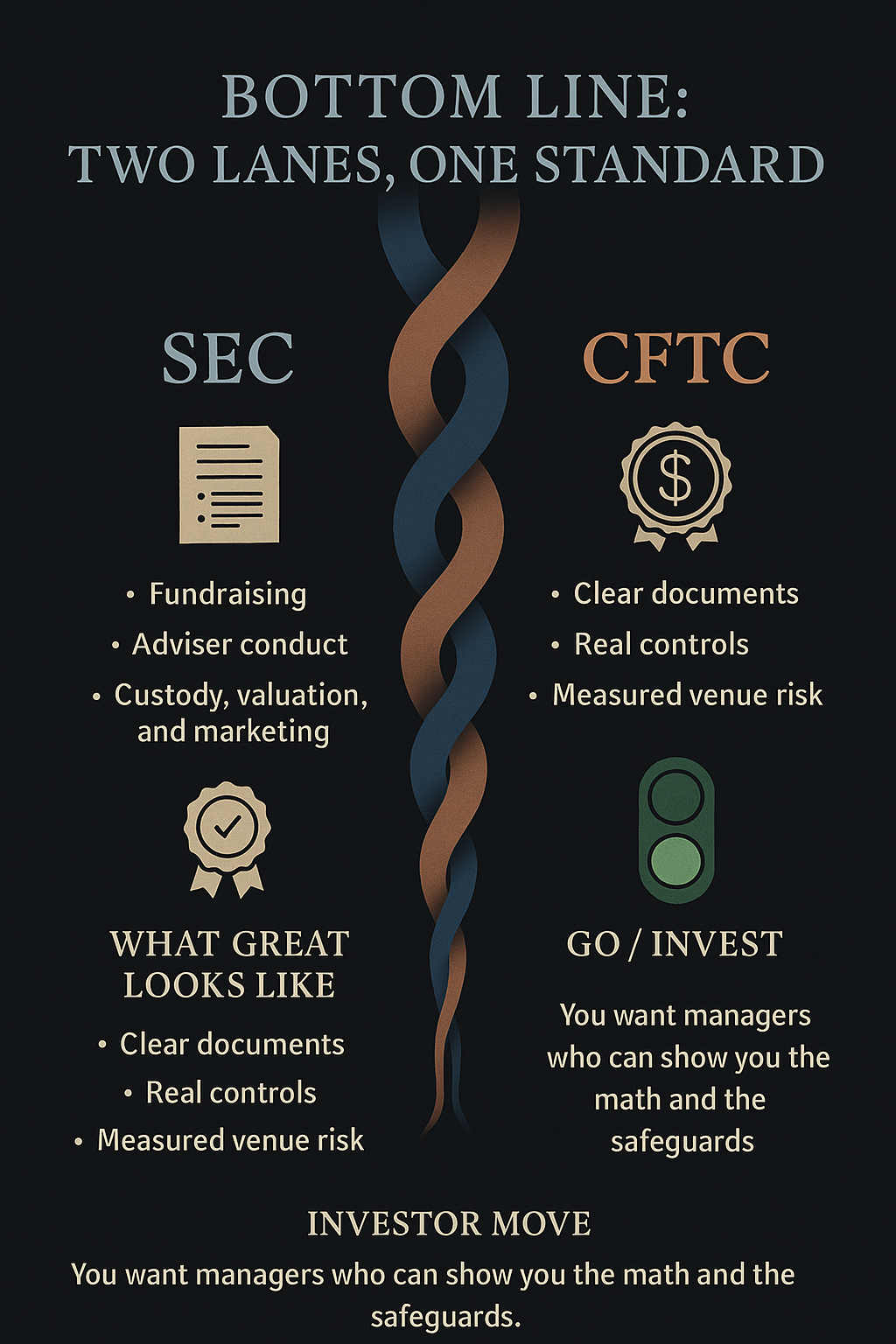
You don’t need to be a lawyer to navigate U.S. crypto-fund oversight. Remember the split: the SEC anchors fundraising, adviser conduct, custody, valuation, and marketing; the CFTC anchors derivatives and polices fraud in spot. The best managers operate comfortably in both lanes—clear documents, real controls, measured venue risk, and calm, specific answers to your questions. If they can show you the math and the safeguards, they’re treating regulation as part of their edge—which is exactly what you want when markets move fast.