

This Content Is Only For Subscribers
Private credit encompasses a broad spectrum of strategies, and among the most innovative is asset-backed and specialty finance. These strategies extend capital to companies, projects, or individuals by leveraging specific assets or cash flows, rather than relying on general corporate credit. For investors, this approach offers a combination of yield, diversification, and often lower correlation to traditional markets.
This article explores what asset-backed and specialty finance entails, the types of assets used, examples of fund structures, and the risks and rewards for investors.
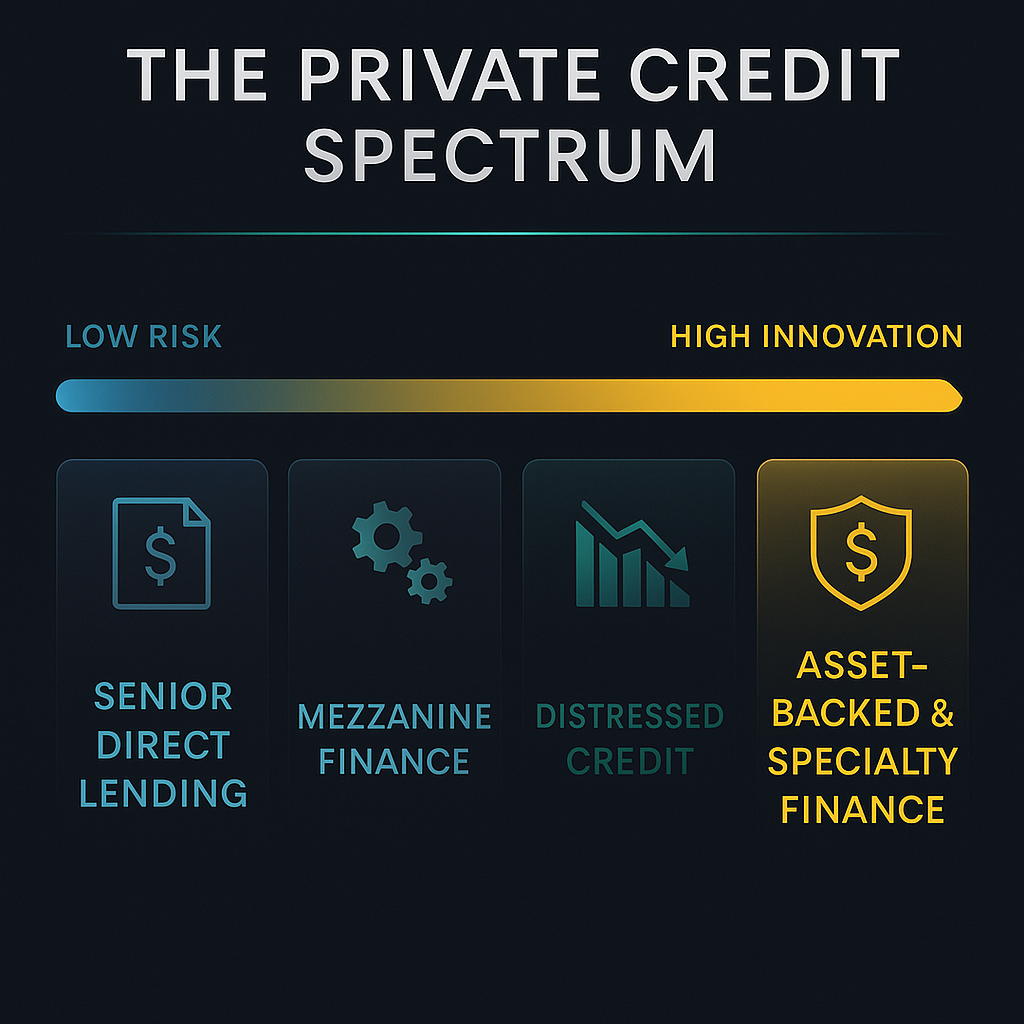
What Is Asset-Backed and Specialty Finance?
Asset-backed finance refers to loans or debt securities secured by specific assets or revenue streams. These assets might include equipment, accounts receivable, royalties, intellectual property, or even litigation proceeds.
Specialty finance often overlaps with asset-backed finance but typically refers to more niche or innovative lending arrangements. Examples include financing structured settlements, providing capital for intellectual property monetization, or funding litigation in exchange for a share of potential recoveries.
Unlike traditional corporate lending, these strategies focus on the asset as collateral, making cash flows more predictable and providing a different risk profile for investors.
Key Types of Asset-Backed and Specialty Finance
1. Consumer and Commercial Receivables
Funds may purchase pools of receivables—payments owed by consumers or businesses—and earn a yield from the repayments.
Example: A fund buys $50 million in credit card receivables from a fintech lender. Investors receive monthly cash flows as cardholders pay off balances, with the underlying accounts as collateral.
2. Equipment and Leasing Finance
Companies often need expensive equipment but prefer not to pay upfront. Funds provide loans secured by machinery, vehicles, or medical devices.
Example: A hospital purchases $20 million in MRI machines with financing from a specialty finance fund. The machines themselves act as collateral, ensuring repayment security.
3. Intellectual Property and Royalty Financing
Specialty funds may finance companies by advancing capital against royalties from drugs, patents, music, or other IP. This allows companies to fund operations or expansion without diluting equity.
Example: A biotech firm with an FDA-approved drug sells $30 million in royalty rights to a private credit fund. Investors receive a portion of future drug sales as cash flow.
4. Litigation or Legal Finance
Some funds provide capital to litigation plaintiffs or law firms in exchange for a share of the proceeds if the case is successful.
Example: A company involved in a patent infringement lawsuit receives a $5 million advance from a specialty fund. If the litigation is successful, the fund earns a pre-agreed portion of the settlement.
Why This Strategy Has Grown
Asset-backed and specialty finance has expanded due to several trends:
- Banks’ Reduced Risk Appetite: Traditional lenders are often unwilling to underwrite complex or non-traditional assets.
- Investor Demand for Yield: Structured loans offer attractive returns, often exceeding traditional fixed-income alternatives.
- Innovation and Technology: Fintech and data analytics enable accurate risk assessment of complex assets, from consumer loans to IP royalties.
The U.S. dominates this market, but Europe and Asia are increasingly adopting these strategies, particularly in equipment leasing and royalty finance.
Investor Benefits
Investing in asset-backed and specialty finance can provide:
- Diversification: Returns often have low correlation with equity and public bond markets.
- Higher Yields: These loans typically pay 8–15% interest or more, depending on asset quality and structure.
- Downside Protection: Collateral and cash-flow-based repayment reduce exposure to general credit risk.
- Flexibility: Fund managers can structure loans tailored to borrowers’ needs.
Example: A fund allocates $100 million across multiple specialty finance loans, including consumer receivables, equipment finance, and royalty advances. This diversification reduces the impact of any single default.
Risks to Consider
Despite their advantages, these strategies carry specific risks:
- Collateral Risk: The asset may lose value or become difficult to liquidate.
- Default Risk: If the underlying revenue stream fails, repayment may be jeopardized.
- Illiquidity: Many specialty loans are private, making early exit difficult.
- Regulatory and Legal Risk: Certain assets, like litigation proceeds, may involve complex legal considerations.
Mitigating risk requires careful due diligence, conservative structuring, and ongoing monitoring of asset performance.
How Funds Are Structured
Investors typically access these strategies through:
- Closed-End Private Credit Funds: Commit capital for multi-year investment cycles.
- Feeder Funds for Family Offices or Institutions: Provide access to specialized portfolios.
- Business Development Companies (BDCs): Offer retail investors exposure to asset-backed lending.
Funds earn management fees and often a performance fee tied to returns above a benchmark.
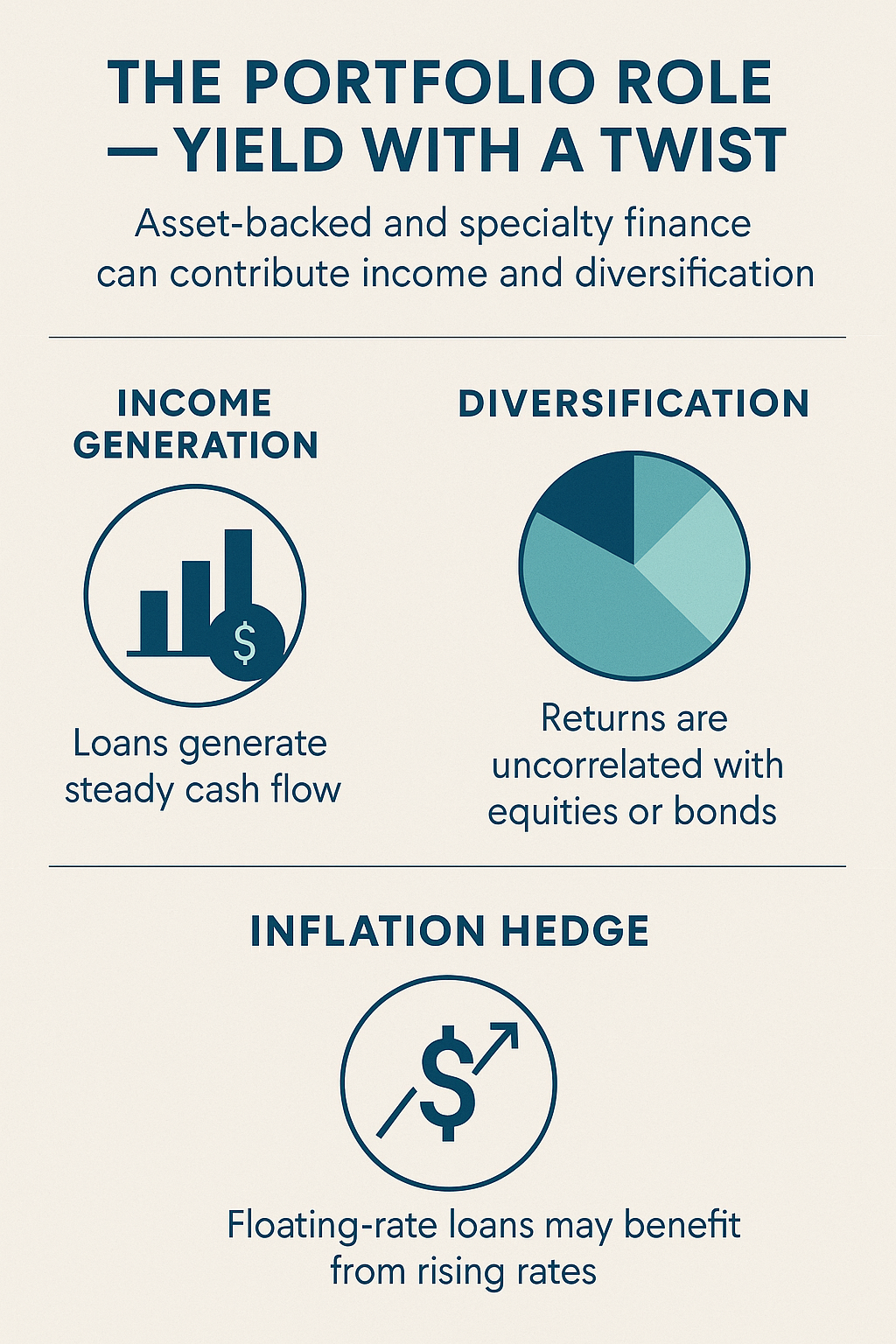
Portfolio Role
Asset-backed and specialty finance can serve as a satellite allocation within a broader portfolio:
- Income Generation: Cash flows from loans provide steady yield.
- Diversification: Returns are often uncorrelated with equities or traditional bonds.
- Inflation Hedge: Certain loans, particularly floating-rate structures, benefit from rising interest rates.
Investors should match allocations with risk tolerance, liquidity needs, and investment horizon.
Conclusion
Asset-backed and specialty finance represents a dynamic frontier in private credit. By leveraging specific assets or revenue streams, funds provide financing to borrowers outside traditional banking channels while offering investors attractive yields and diversification.
For novice investors, understanding the underlying collateral, cash flow reliability, and fund structure is critical. With careful selection, asset-backed and specialty finance can complement traditional fixed-income and equity holdings, enhancing portfolio income and resilience.