

This Content Is Only For Subscribers
When most people think about venture capital, they picture independent firms like Sequoia Capital or Andreessen Horowitz backing startups in exchange for equity. But there’s another powerful player in the VC ecosystem: corporate venture capital (CVC). This form of investing is carried out by large companies that set up their own venture arms to invest in startups. Think Google Ventures (GV), Intel Capital, or Salesforce Ventures.
Corporate venture capital combines the financial objectives of traditional VC with the strategic goals of a parent corporation. For novice investors, understanding how CVC works can shed light on why big businesses often sit at the forefront of innovation.
What Is Corporate Venture Capital?
Corporate venture capital refers to equity investments made by established companies in early- or growth-stage startups. Unlike independent VC firms, which mainly seek financial returns, corporations often invest to gain access to new technologies, expand into adjacent markets, or stay ahead of potential disruptors.
For example, when Google Ventures invests in health-tech companies, it’s not just chasing profits—it’s also gathering insights into industries that could shape Google’s future business lines.
Why Companies Launch Venture Arms
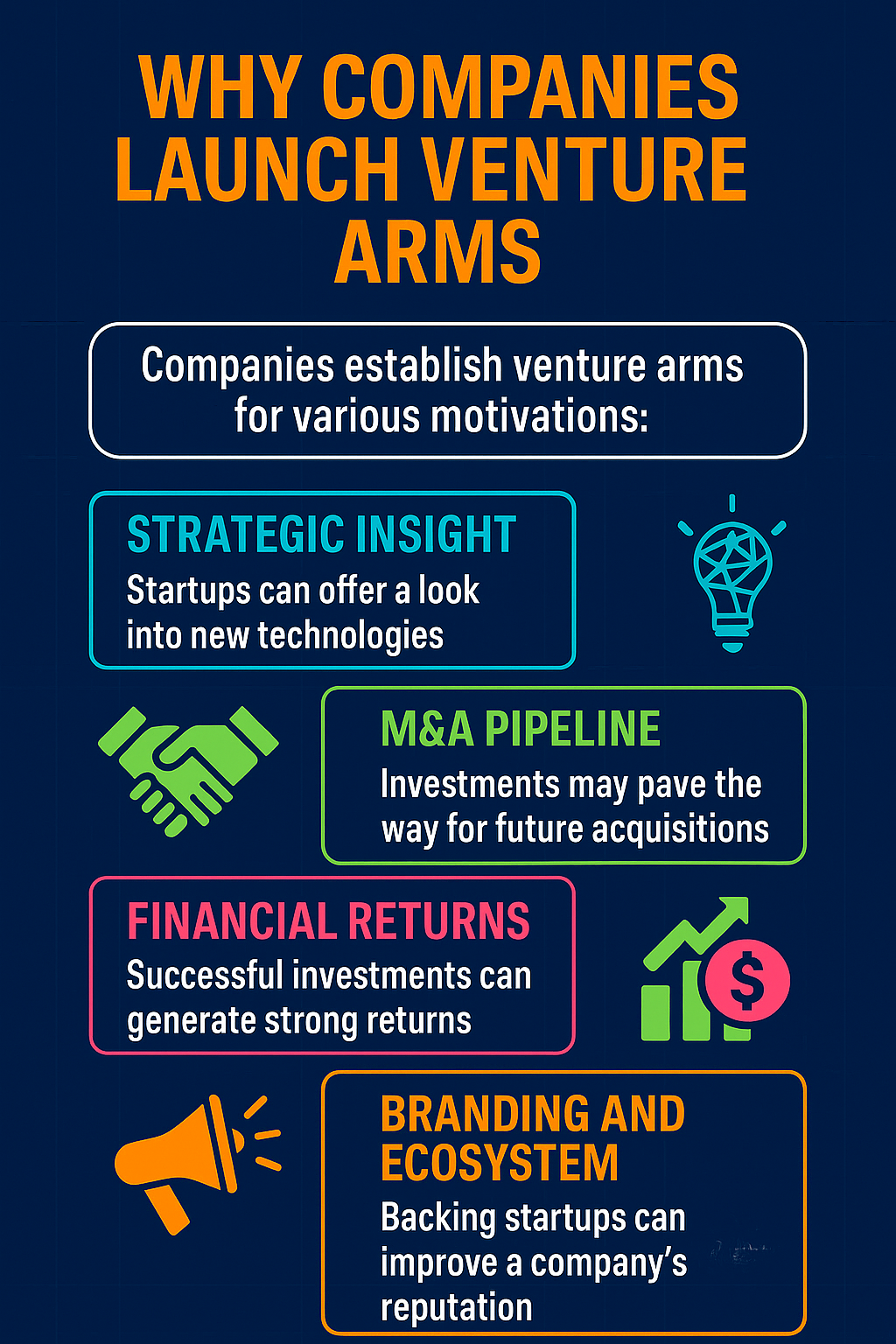
CVC has exploded in popularity over the last decade. According to CB Insights, corporate investors now participate in over a quarter of global VC deals each year. Why? There are several key motivations:
- Strategic insight – Startups often operate at the edge of innovation. By investing early, corporations can monitor and learn from new technologies before competitors.
- M&A pipeline – A corporate investment can serve as a “toe in the water” before an acquisition. Many startups acquired by tech giants were first portfolio companies.
- Financial returns – While not the primary motive, successful CVC programs can generate strong returns, just like traditional VC.
- Branding and ecosystem – Supporting startups can enhance a company’s reputation as innovative and entrepreneur-friendly.
How CVC Differs From Traditional VC
At first glance, corporate and traditional venture capital look similar. Both involve investing in startups, taking equity stakes, and aiming for big wins when companies exit through IPOs or acquisitions.
But there are notable differences:
- Objectives – Traditional VCs focus almost exclusively on returns. Corporates balance returns with strategic benefits.
- Investment horizon – Independent VCs raise funds with a 10-year lifecycle. Corporates may be more flexible, though subject to shifts in internal priorities.
- Decision-making – VCs typically have investment committees staffed by seasoned investors. In CVCs, corporate strategy teams may play a heavier role.
- Reputation with startups – Some entrepreneurs worry about conflicts of interest. For instance, giving a potential competitor insight into their business can be risky.
Famous Examples of Corporate Venture Capital
- Intel Capital – One of the largest and longest-running CVC arms, with over $12 billion invested since 1991. Intel Capital helped fund transformative companies in semiconductors, cloud computing, and AI.
- Google Ventures (GV) – Launched in 2009, GV backs everything from life sciences to consumer apps, with financial returns as a strong motivator alongside strategic learning.
- Salesforce Ventures – This CVC focuses on enterprise software startups that can integrate into Salesforce’s ecosystem, strengthening its platform.
These examples show how CVCs often align closely with the parent company’s core business while still supporting innovation more broadly.
Benefits and Risks of Corporate Venture Capital
Benefits for Corporations
- Access to cutting-edge ideas.
- Opportunity to partner with or acquire startups.
- Ability to position themselves as leaders in innovation.
Benefits for Startups
- Access to a powerful customer or distribution partner.
- Validation of credibility (“If Google invested, others will pay attention”).
- Potential for long-term strategic collaboration.
Risks for Startups
- Potential conflicts of interest if the corporate parent is a competitor.
- Corporate venture programs may be less stable; if budgets are cut, the venture arm could be scaled back suddenly.
- Alignment of goals can be tricky: startups want independence, while corporates may push for integration.
The Future of Corporate Venture Capital

CVC is only becoming more important. Today, corporate investors participate not just in tech deals but in sectors like healthcare, energy, mobility, and climate tech. As companies face pressure to innovate in rapidly changing markets, expect more of them to set up venture arms.
At the same time, entrepreneurs are becoming savvier about working with corporates. Many startups now bring in corporate VCs alongside traditional firms, balancing strategic and financial backing.
For novice investors, it’s worth watching this space—not because individuals can directly invest in CVC programs, but because the presence of corporate backers often signals confidence in a startup’s potential.
Key Takeaways
- Corporate venture capital (CVC) is when established companies invest in startups, often for strategic reasons.
- CVC differs from traditional VC by balancing financial returns with corporate objectives.
- Major players like Intel, Google, and Salesforce use CVC to stay ahead of innovation.
- For startups, CVC can be a blessing or a challenge—offering resources and credibility but sometimes raising strategic conflicts.
As innovation cycles accelerate, corporate venture capital will remain a key force in shaping the future of industries. For investors trying to understand the venture landscape, recognizing the role of CVC provides a fuller picture of how capital fuels innovation.