

This Content Is Free After You Enter Your Email
When people hear the word “hedge fund,” they often think of elite Wall Street firms managing billions for ultra-wealthy clients. Now imagine that model transplanted into the fast-moving world of digital assets. That’s essentially what crypto hedge funds are — professional investment vehicles that specialize in cryptocurrencies, tokens, and blockchain-related assets.
For novice investors, crypto hedge funds can seem mysterious, even intimidating. But once you understand how they’re structured and what strategies they use, the concept becomes far clearer.
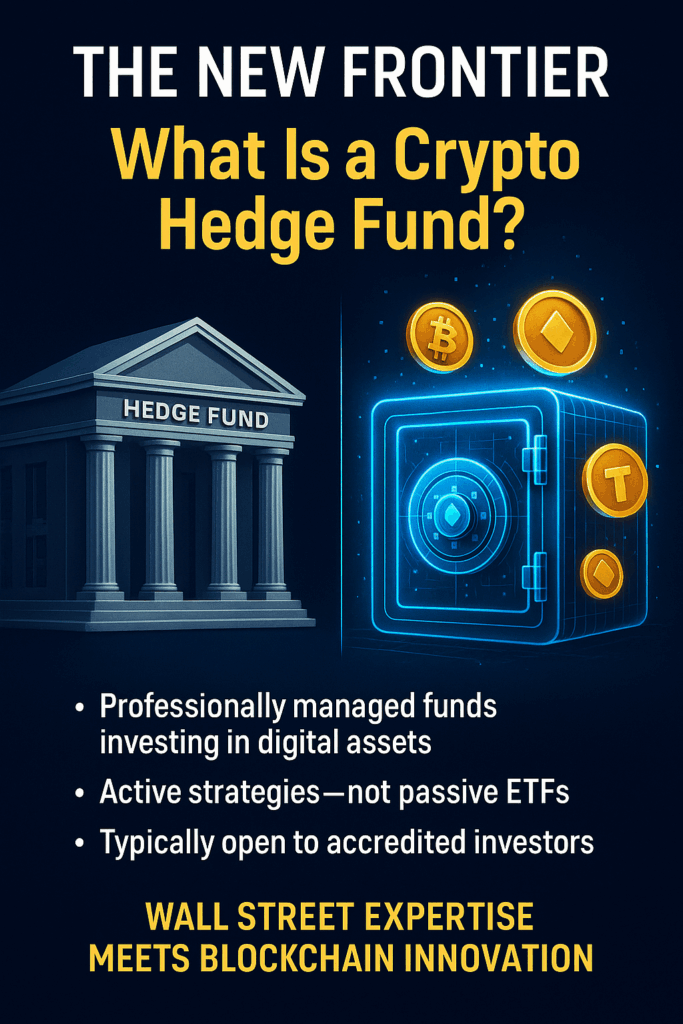
What Is a Crypto Hedge Fund?
A crypto hedge fund is a pooled investment fund managed by professionals who buy, sell, and sometimes trade digital assets on behalf of investors. Like traditional hedge funds, they are generally open only to accredited or institutional investors due to the risks and regulatory requirements involved.
Unlike ETFs, which passively track the price of Bitcoin or Ethereum, crypto hedge funds take an active approach. Their managers aim to generate returns through trading, arbitrage, yield farming, staking, and even venture-style bets on early-stage tokens.
How They’re Structured
Most crypto hedge funds resemble their traditional counterparts in structure:
- General Partner (GP): The management team or fund manager, responsible for making investment decisions.
- Limited Partners (LPs): The investors who commit capital, often high-net-worth individuals, family offices, or institutions.
- Fee Model: Many follow the “2 and 20” model (2% annual management fee + 20% of profits), though crypto funds sometimes adjust this depending on strategy.
Funds may be domiciled in global financial hubs such as the Cayman Islands, Luxembourg, or Singapore, where regulations are more flexible for alternative investments.
Common Strategies
Crypto hedge funds deploy a wide range of strategies, often far more experimental than those used in traditional finance. Some of the most common include:
Long/Short Trading
- Buying assets expected to rise, while shorting those likely to fall.
- Allows managers to profit in both bull and bear markets.
Arbitrage
- Exploiting price differences between exchanges or regions.
- For example, buying Bitcoin on one exchange at $29,900 and selling on another at $30,100.
Quantitative/Algorithmic Trading
- Using bots and algorithms to trade rapidly based on signals.
- Particularly suited to crypto, which trades 24/7.
Yield Farming & Staking
- Generating returns by lending crypto or locking it into blockchain networks.
- Can be lucrative but carries “smart contract” and platform risks.
Venture-Style Investing
- Taking early positions in promising tokens or blockchain startups.
- High risk but potentially high reward if the project succeeds.
Benefits of Crypto Hedge Funds
For investors who qualify, crypto hedge funds offer several potential benefits:
- Professional Management: Expert teams handle the complexity of trading across dozens of exchanges and protocols.
- Access to Opportunities: Hedge funds can participate in private token sales, DeFi projects, and strategies unavailable to retail investors.
- Diversification: Exposure to a basket of crypto assets, rather than betting on just Bitcoin or Ethereum.
- Risk Management: Sophisticated funds use hedging tools, derivatives, and stop-loss strategies to mitigate volatility.
Risks to Consider
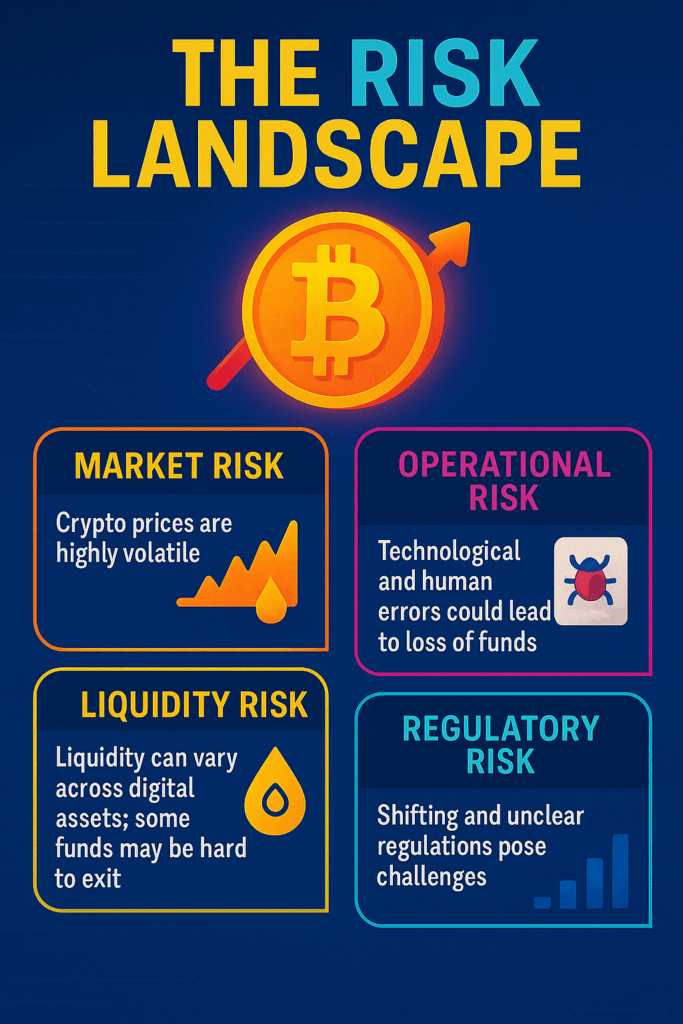
Crypto hedge funds are not for everyone. Even accredited investors should weigh the risks carefully:
- Volatility: Crypto remains one of the most volatile asset classes.
- Liquidity: Some funds lock up investor capital for months or years.
- Counterparty Risk: Funds rely on exchanges, custodians, and DeFi platforms that may fail or be hacked.
- Regulatory Uncertainty: Rules governing crypto hedge funds are still evolving in most jurisdictions.
- High Fees: Hedge funds typically charge more than ETFs or index funds, which can erode returns.
The Growth of the Sector
Despite risks, crypto hedge funds have grown rapidly. According to PwC and Alternative Investment Management Association surveys, the number of crypto hedge funds has increased steadily since 2018. Many now manage hundreds of millions in assets, with some exceeding $1 billion.
As traditional hedge funds dabble in crypto, the line between “crypto-native” funds and mainstream finance is blurring. In fact, several major asset managers have built dedicated digital asset teams, signaling that crypto hedge funds are becoming part of the broader hedge fund ecosystem.
Who Invests in Crypto Hedge Funds?
Because of regulations, most investors in these funds are institutions or wealthy individuals. Examples include:
- Family offices seeking diversification.
- Pension funds cautiously experimenting with digital assets.
- High-net-worth investors with an appetite for risk.
For everyday investors, hedge funds remain largely out of reach. ETFs and DAOs provide more accessible alternatives.
The Road Ahead
The future of crypto hedge funds will depend heavily on regulation and market maturity. If governments establish clear frameworks, more institutions may allocate to these funds. On the flip side, tighter rules could increase costs or limit strategies.
What’s clear is that as long as crypto markets remain dynamic and volatile, there will be a demand for professional managers who can navigate the chaos. Crypto hedge funds may not be the entry point for novice investors, but they are shaping the way capital flows through the digital asset ecosystem.
Key Takeaways
- Crypto hedge funds are actively managed investment vehicles focused on digital assets.
- They use a variety of strategies — from arbitrage to staking — to generate returns.
- Investors gain professional management and access to unique opportunities but face high risks, high fees, and regulatory uncertainty.
- Growth has been steady, and institutions are beginning to take notice.
Final Word:
Crypto hedge funds represent the meeting point of Wall Street sophistication and crypto experimentation. They aren’t designed for everyone, but they play a critical role in legitimizing digital assets as an institutional-grade investment class.