

This Content Is Only For Subscribers
If you invest in crypto funds that trade in Europe—or use European exchanges, custodians, or stablecoins—MiCA (the Markets in Crypto-Assets Regulation) is now part of your world. MiCA’s goal is simple: give crypto markets rules that look more like traditional finance, without killing innovation. Here’s a clear, investor-friendly walkthrough of what MiCA does, what it doesn’t, and how it changes the questions you should ask a manager.
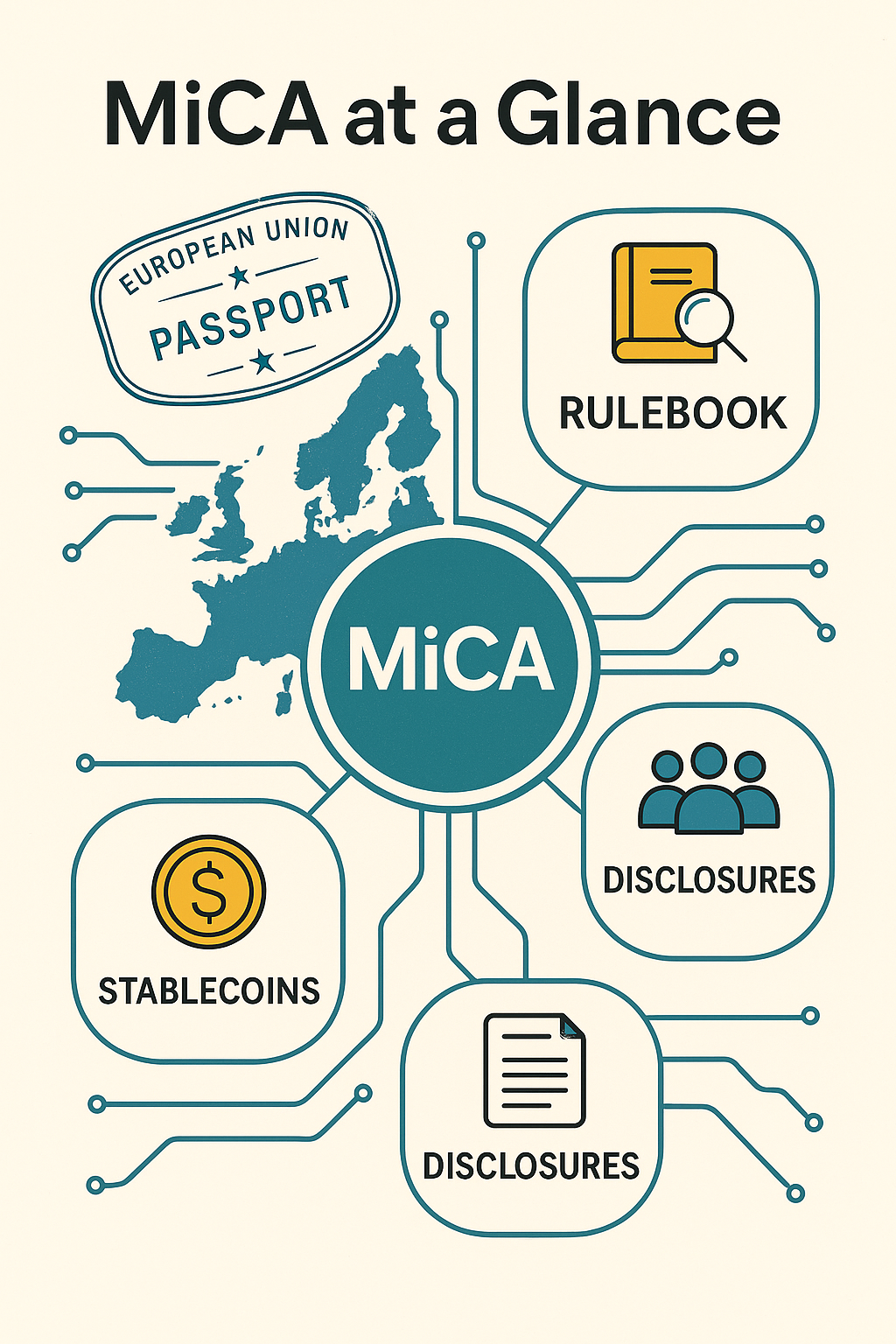
What MiCA actually covers
MiCA splits the universe into three buckets:
- Asset-Referenced Tokens (ARTs): “Basket-backed” tokens that aim for stability by referencing several assets (fiat, commodities, crypto).
- E-Money Tokens (EMTs): Stablecoins tied to a single official currency (e.g., a euro-pegged token).
- “Other” crypto-assets: Everything that isn’t an ART/EMT—utility tokens and most fungible tokens issued to raise capital or power a network.
What’s not squarely in scope?
- Security tokens that already fall under EU securities/ MiFID II rules.
- Many NFTs (case-by-case; collections that are effectively fungible can fall back into MiCA).
- DeFi protocols with no identifiable intermediary (regulators are still studying how to handle these).
- Pure Bitcoin/Ether trading is in scope for service providers (exchanges/custodians) but those assets aren’t “issued” under MiCA, so the white-paper rules don’t attach to them.
The big shift: licenses and passporting for service providers
Under MiCA, firms that provide crypto services—exchanges, brokers, custodians, portfolio managers, and advisors—must hold a CASP (Crypto-Asset Service Provider) authorization. Once authorized in one EU member state, they can passport across the entire bloc, just like investment firms do under MiFID.
What it means for you as an LP or allocator:
- Stronger operational baselines. CASPs must meet requirements on governance, capital, segregation of client assets, IT/security, conflict management, complaints handling, and incident reporting.
- One badge, many countries. Passporting reduces the “patchwork risk” and should make counterparty selection easier—though national supervisors still matter.
- Marketing rules. CASPs have to be truthful, balanced, and consistent with white-paper disclosures for tokens they list or distribute.
Action item: Ask your manager for a list of EU-facing venues and custodians they use and whether those entities hold (or are in the process of obtaining) a CASP license. Prefer CASPs with a clear authorization and named competent authority.
White papers, disclosures, and liability
If a team issues a new crypto-asset in the EU (other than ARTs/EMTs), MiCA requires a white paper with standardized risk and project information, pre-notified to regulators (not pre-approved). Issuers—and in some cases CASPs that admit the asset—face civil liability for misleading or incomplete disclosures.
Why that matters to funds:
- You get more comparable data when underwriting new tokens.
- There’s an accountability hook if promotional claims don’t match reality.
- For legacy tokens without white papers, exchanges must still provide key information before admitting them.
Stablecoins: higher bar, closer supervision
MiCA puts ARTs and EMTs under stricter rules than other tokens:
- Reserves and redemption. Full-reserve backing, custody and investment limits for reserves, and clear, timely redemption rights for holders.
- Governance and capital. Issuers need solid governance, own funds, and risk management proportional to scale.
- “Significant” tokens. Very large stablecoins face extra supervision (including by EU-level authorities) and tougher requirements. Regulators also have intervention powers if a stablecoin’s use threatens financial stability or payment systems.
Investor lens: If a fund relies on stablecoins for settlement or yield, ask which tokens it uses, where reserves are held, how redemption works in stress, and whether any caps or supervisory conditions could affect liquidity.
Market integrity and abuse: crypto gets the public-markets treatment
MiCA grafts public-market concepts onto crypto trading platforms:
- Market abuse rules (insider dealing, unlawful disclosure, manipulation) now apply to crypto-assets admitted to trading on a platform.
- Surveillance expectations for venues and clear reporting of suspected abuse.
- Conflicts and transparency obligations for CASPs that operate multiple services (e.g., trading plus custody).
For managers, this elevates the importance of MNPI controls, wall-crossing procedures, and clean-team diligence when evaluating private token deals.
Timelines and status (where we are now)
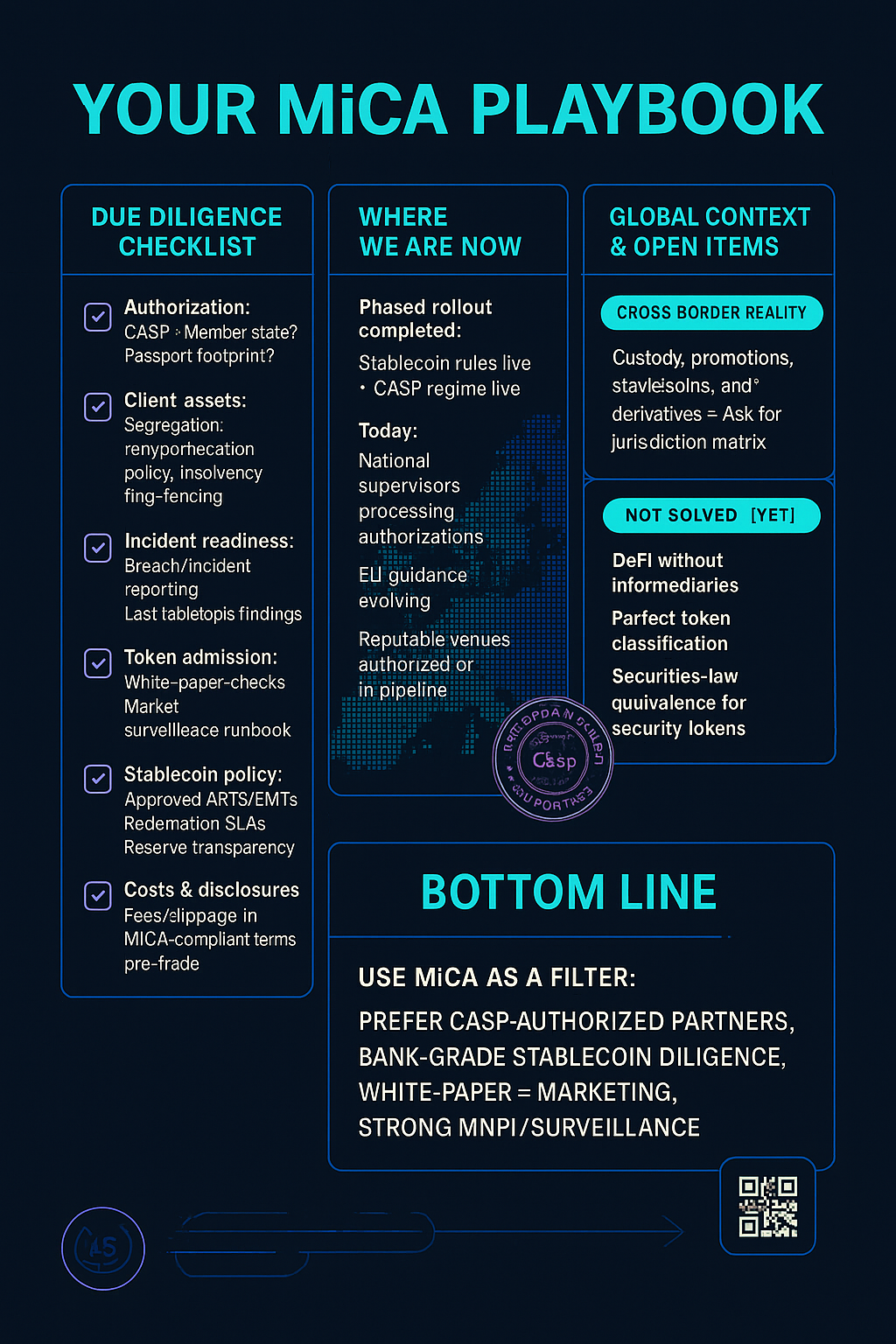
MiCA rolled out in phases: stablecoin rules took effect first; service-provider (CASP) licensing followed shortly after. As of now, both stablecoin and CASP regimes are live across the EU, with national supervisors processing applications and EU-level guidance continuing to evolve. In practical terms, reputable European exchanges, brokers, and custodians are either authorized or in the authorization pipeline.
How MiCA changes fund due diligence
Use MiCA to sharpen your counterparty questions:
- Authorization: Is the exchange/custodian a CASP? In which member state? What’s the passporting footprint?
- Client-asset safeguards: How are client assets segregated? Can the CASP rehypothecate? What’s the insolvency ring-fencing?
- Incident readiness: What’s the breach/incident reporting process? Ask for the last tabletop test and findings.
- Token admissions: For new listings, what white-paper checks does the venue perform? How is market surveillance run?
- Stablecoin policy: Which ARTs/EMTs are approved for settlement? What are the issuer’s redemption SLAs, and are reserves transparent?
- Costs and disclosures: Are fees and slippage estimates disclosed in MiCA-compliant terms before execution?
Cross-border reality check
MiCA harmonizes the EU, but it doesn’t cover the world. UK, Switzerland, UAE, Singapore, and U.S. frameworks differ on custody, promotions/marketing, stablecoins, and derivatives. If your manager runs a global book, ask for a jurisdiction matrix showing which rules apply to which counterparties—and how conflicts (for example, a token allowed in one place but restricted in another) are handled.
What MiCA doesn’t solve (yet)
- DeFi without intermediaries. Rules for fully decentralized protocols remain an open policy question; expect more guidance in coming waves.
- Perfect token classification. Some NFTs and hybrid tokens still require case-by-case analysis.
- One-click equivalence with securities law. Security tokens still sit under separate EU securities frameworks, and the boundary can be nuanced.
Bottom line
MiCA gives Europe a single rulebook for most crypto activities that touch investors: licensed service providers, standardized disclosures, stronger stablecoin safeguards, and public-market-style integrity rules. For allocators, that means cleaner counterparty selection, better information when underwriting tokens, and clearer recourse when things go wrong.
Your playbook is straightforward:
- Favor CASP-authorized exchanges/custodians with real segregation and incident reporting.
- Treat stablecoin due diligence like bank counterparty analysis.
- Expect white-paper consistency with marketing claims.
- Ask managers to show MNPI controls and surveillance readiness.
Do that, and you’ll use MiCA as it was intended: not as red tape, but as a filter that helps you find crypto funds and counterparties built to last.