

This Content Is Only For Subscribers
Hedge funds can feel mysterious—exclusive strategies, unusual fee structures, and lots of jargon. But the rules that shape how these funds operate are more straightforward than they look. If you’re a novice investor, understanding the regulatory basics will help you ask sharper questions, recognize red flags, and focus your due diligence on what matters.
This guide breaks down who regulates hedge funds, what they must report, and how a strong compliance program works in practice. Think of it as a map to a private neighborhood: high fences (exemptions), a guarded gate (who can invest), and a homeowners’ association (the regulators) that checks everyone’s lawn.
Why Hedge Funds Are “Private”
Most hedge funds avoid registering as mutual funds by relying on exemptions in the Investment Company Act of 1940—most commonly 3(c)(1) and 3(c)(7):
- 3(c)(1) funds limit the number of investors and sell interests via private placements.
- 3(c)(7) funds accept only “qualified purchasers” (a higher wealth threshold) and can have more investors than 3(c)(1) funds.
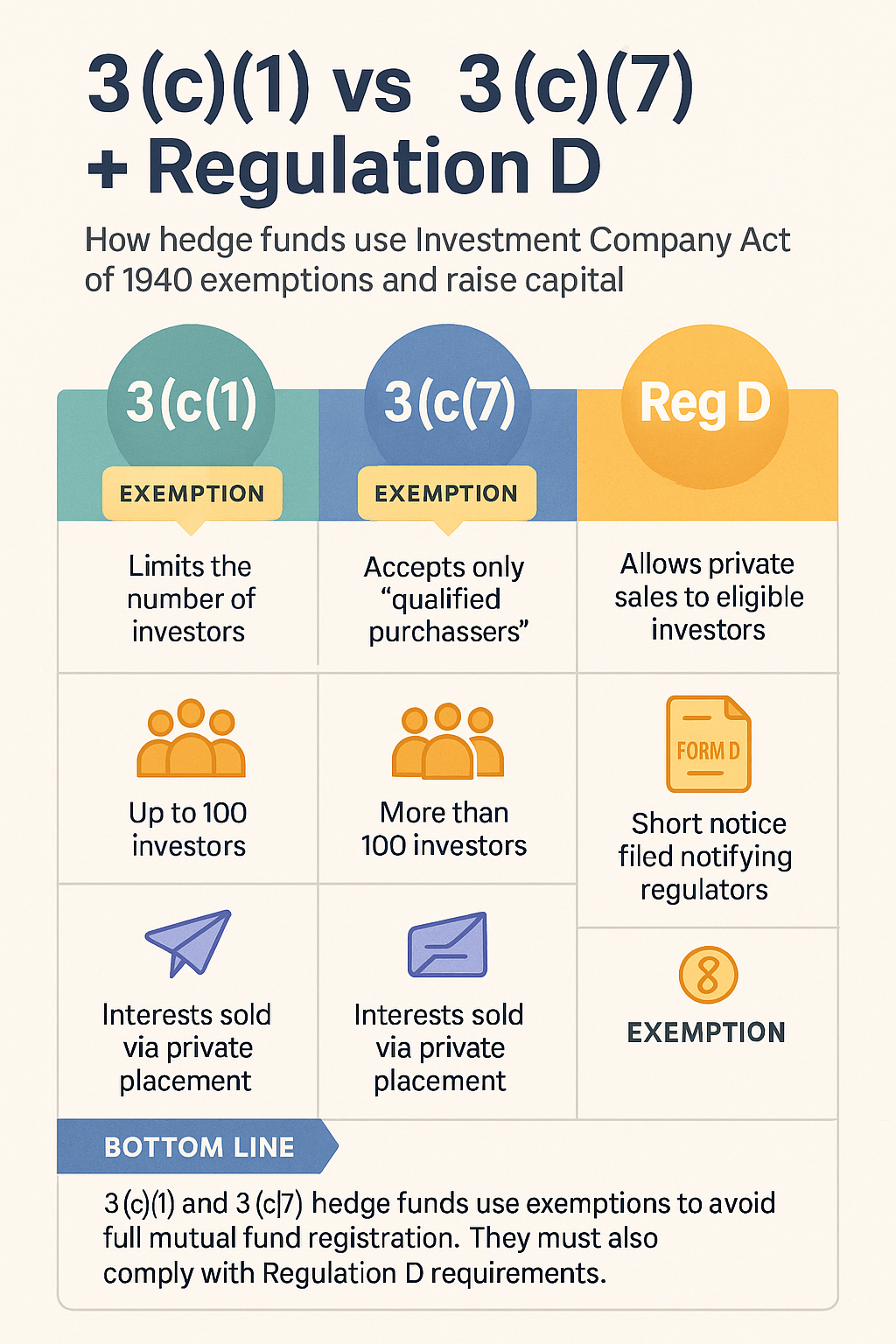
They also raise capital under the Securities Act of 1933, typically using Regulation D, which allows private sales to eligible investors. Managers file a short Form D to notify regulators about the offering. In exchange for that flexibility, funds restrict who can invest and how they market.
Bottom line: Hedge funds are private, not unregulated. They swap one rulebook for another.
Who Regulates Hedge Funds?
Several regulators touch the hedge fund ecosystem, depending on strategy and footprint.
- SEC (Securities and Exchange Commission)
The SEC oversees investment advisers to hedge funds under the Advisers Act of 1940. Many managers register as investment advisers and must maintain written policies, appoint a chief compliance officer (CCO), keep detailed books and records, follow marketing rules, safeguard client assets (custody), and submit to exams. - State Regulators (“Blue Sky” rules)
Smaller advisers may register with states rather than the SEC. Even SEC-registered advisers must comply with state notice filings when offering interests to residents there. - CFTC and NFA (for commodities and swaps)
If a fund trades futures, swaps, or certain derivatives, the manager may need to register as a commodity pool operator (CPO) or commodity trading adviser (CTA) with the CFTC and become a member of the NFA, unless an exemption applies. - Foreign Regimes
Marketing to investors in Europe, the UK, or Asia can trigger local rules (e.g., AIFMD national private placement regimes in the EU). Funds with non-U.S. investors or offshore structures face added tax reporting (FATCA/CRS) and sometimes local filings.
Investor takeaway: The SEC is the main cop on the beat for U.S. hedge fund advisers, with CFTC/NFA and foreign regulators in the mix as strategies and investor bases expand.
Registration Status: RIA, State-Registered, or ERA
Most hedge fund managers fall into one of three buckets:
- SEC-Registered Investment Adviser (RIA):
Advisers above certain asset thresholds (or that choose to register) must follow the full Advisers Act rule set, including a CCO, annual compliance reviews, custody safeguards, marketing rules, and regular exams. - State-Registered Adviser:
Smaller managers may register at the state level. Requirements vary but often mirror SEC themes. - Exempt Reporting Adviser (ERA):
Some managers qualify for lighter filing obligations (e.g., solely advising private funds below certain thresholds). ERAs still face anti-fraud rules and typically file abbreviated ADV information.
Nuance: “Exempt” does not mean “no rules.” Anti-fraud obligations, truthful marketing, and other requirements still apply.
The SEC’s Core Expectations
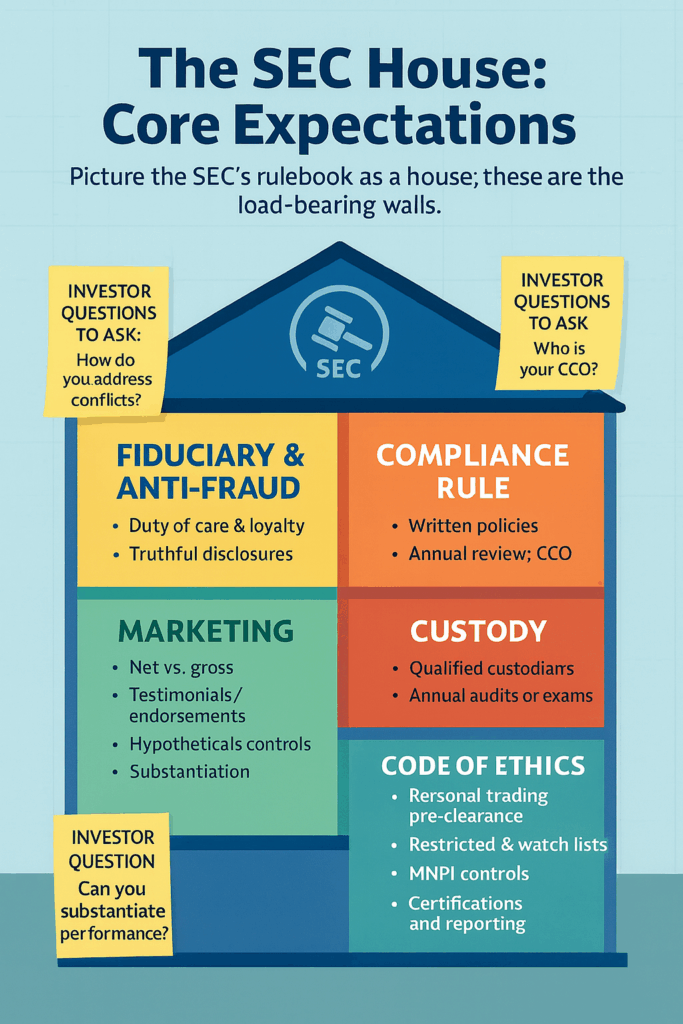
Picture the SEC’s rulebook as a house; these are the load-bearing walls.
Fiduciary Duty and Anti-Fraud
Advisers owe clients a fiduciary duty—a duty of care (act in clients’ best interests) and duty of loyalty (identify, disclose, and manage conflicts). The Advisers Act’s anti-fraud provisions sit on top of everything: performance claims, fee practices, and disclosures must be accurate and fair.
Written Policies and Procedures (the “Compliance Rule”)
RIAs must adopt written policies reasonably designed to prevent violations, review them annually, and appoint a CCOwith authority and resources. Typical coverage includes:
- Trading and best execution
- Trade allocation and error handling
- Conflicts of interest
- Valuation methodologies and governance
- Custody controls and auditor engagement
- Marketing and performance presentation
- Insider trading/MNPI controls
- Privacy, cybersecurity, and vendor oversight
- Books and records retention
Code of Ethics
Policies must address personal trading by employees, including pre-clearance, restricted lists, and periodic reporting. The aim is to prevent front-running and misuse of material nonpublic information (MNPI).
Marketing and Performance
Modern marketing rules emphasize fairness and substantiation. Key themes:
- Show performance accurately (net vs. gross), with relevant timeframes and context.
- Handle testimonials/endorsements/ratings with required disclosures and oversight.
- Hypothetical performance (including backtests and models) demands strict controls, targeted audiences, and clear limitations.
- Keep backup files; if you say it, you should be able to prove it.
Custody
If an adviser has custody of client assets (common in pooled vehicles), safeguards apply: using qualified custodians, obtaining annual audits for the fund and distributing financials to investors, or undergoing surprise exams where applicable.
Books and Records
If it isn’t documented, it didn’t happen. Advisers must maintain extensive records—trades, communications, marketing materials, policies, and calculation workpapers—for defined periods.
What Hedge Funds Report
Even private funds leave regulatory footprints. The most common:
- Form ADV: Public brochure describing the adviser’s business, fees, conflicts, strategies, and disciplinary history. Part 1 is structured; Part 2 is plain-English. ERAs file limited portions.
- Form PF: Confidential filing for many private fund advisers, especially above size thresholds. It provides regulators with risk-related data (leverage, liquidity, exposures, and counterparty concentrations) to monitor systemic risk.
- Form D: Short public notice that a private offering under Regulation D has occurred.
- Ownership and Holdings Filings:
- Schedule 13D/13G when crossing ownership thresholds in public companies.
- Form 13F for certain U.S. equity holdings above specified levels.
- CFTC/NFA Forms:
For CPOs/CTAs, filings such as CPO-PQR and additional disclosure requirements. - State Notices:
Blue Sky filings when selling interests to residents of certain states.
What investors typically receive: Offering documents (PPM, LPA, subscription), quarterly letters and statements, and audited annual financials. Many managers also provide exposure and risk summaries, especially for institutions.
The SEC Exam Playbook
Even strong firms brace themselves when the SEC calls. A typical exam:
- Document Request: Policies, marketing, performance support, trade records, valuation memos, personal trading data, vendor diligence, cybersecurity tests, and more.
- Interviews and Walkthroughs: CCO, portfolio managers, operations, and IT explain how policies work in real life, not just on paper.
- Sampling and Testing: The staff reviews examples of trades, marketing pieces, and investor communications for accuracy and consistency.
- Deficiency Letter: Most exams end with a list of issues—some minor, some serious. The adviser must remediate and document fixes. Severe matters can be referred to Enforcement.
Investor angle: Ask when the last exam occurred, key findings, and what changed afterward. Openness and remediation speed are good cultural indicators.
Common Risk Areas (and What Good Looks Like)
Valuation
For illiquid or hard-to-price assets, policies should include independent pricing sources, escalation procedures, valuation committee oversight, and back-testing realized exits against prior marks. Since fees often tie to NAV, robust valuation controls are essential.
Fees and Expenses
Who pays for what—research, data, broken deals, legal bills—should match disclosures and be fairly allocated between funds and the adviser. Look for “no surprises” practices, expense caps, and investor advisory committees where appropriate.
Conflicts of Interest
Conflicts are inevitable: cross-trading, affiliated service providers, allocation of scarce opportunities, principal transactions. The standard isn’t “no conflicts ever”; it’s identify, disclose, monitor, and mitigate.
MNPI Controls
For strategies near corporate events, loans, or private placements, controls should include restricted/watch lists, wall-cross procedures, expert network oversight, and documented decisions on data permissibility (including alternative data).
Marketing and Performance
Expect net-of-fee presentation, fair benchmarks, and clear limits on hypothetical results. Testimonials and ratings require structured disclosures and oversight. Substantiation files should exist for claims and statistics.
Cybersecurity and Vendor Risk
Managers rely on administrators, prime brokers, and cloud providers. Strong programs enforce multi-factor authentication, periodic access reviews, vendor diligence (e.g., SOC reports), incident response testing, and change management logs.
Liquidity Management
Funds promising periodic liquidity need alignment between the liquidity of assets and investor redemption terms. Tools like gates, lockups, and side pockets are acceptable when disclosed and applied fairly.
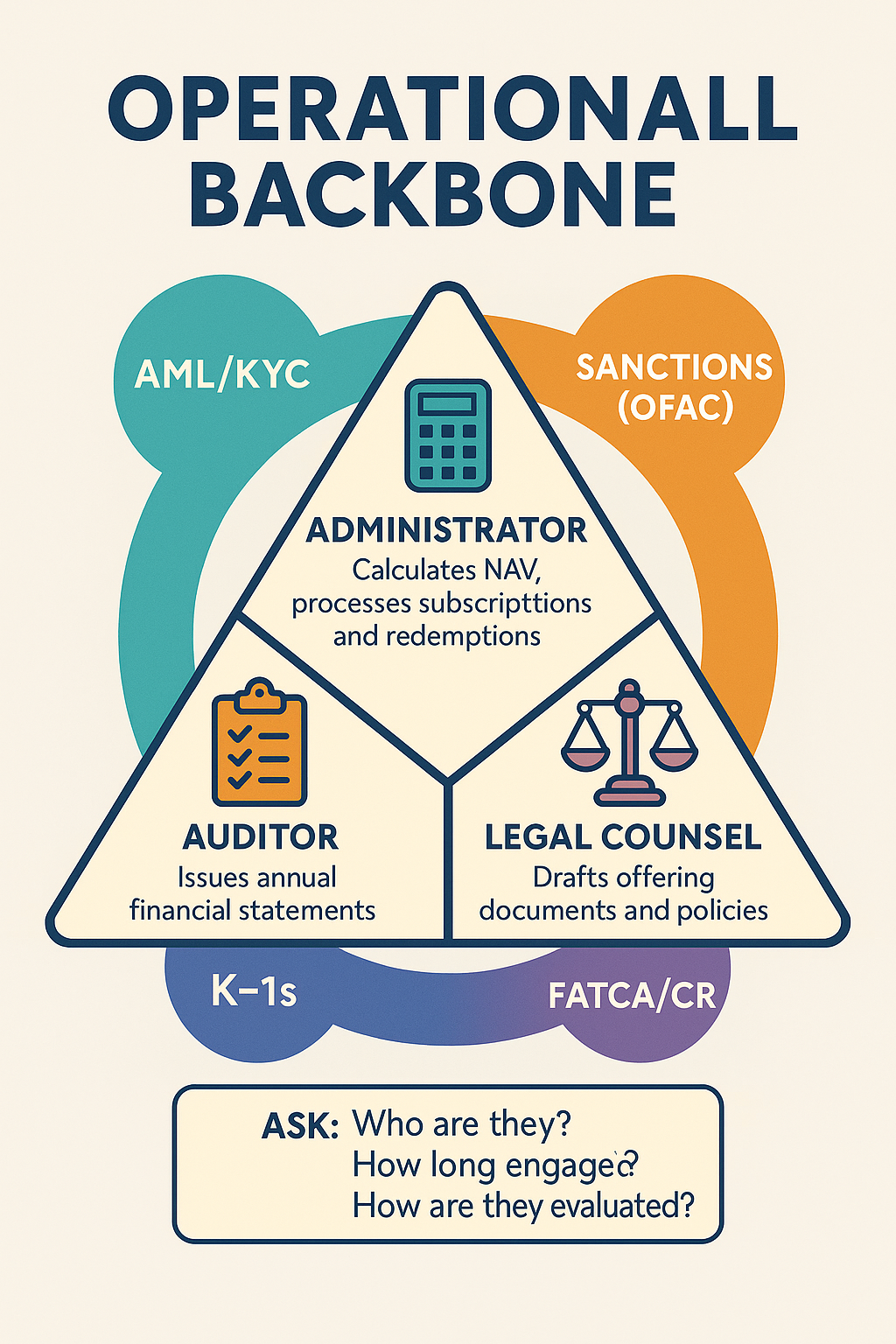
The Service Provider Triangle: Administrator, Auditor, Counsel
A hedge fund’s external partners say a lot about quality:
- Administrator: Calculates NAV, processes subscriptions/redemptions, maintains the investor register, and often assists with AML/KYC. Independent fee and performance calculations provide a crucial check.
- Auditor: Issues annual audited financials. Many custody pathways rely on timely audited statements delivered to investors.
- Legal Counsel: Drafts offering documents and policies, and helps navigate marketing, conflicts, and regulatory changes.
Ask who they use, how long they’ve used them, and how they evaluate performance.
AML, KYC, Sanctions, and Tax
While not identical to banks, hedge funds and administrators commonly implement AML/KYC programs: collecting investor identification, screening sanctions lists (e.g., OFAC), and monitoring for suspicious activity. Tax reporting is also significant:
- FATCA for U.S. tax compliance and non-U.S. reporting on U.S. investors.
- CRS for global information sharing across jurisdictions.
- K-1s for U.S. investors in partnership structures.
These aren’t “SEC rules,” but they’re critical parts of the risk and regulatory footprint.
What Happens When Things Go Wrong?
Enforcement actions often focus on a few themes:
- Misleading performance/marketing (cherry-picking, mislabeling hypothetical results, burying risks).
- Improper fees/expenses (charging the fund for costs that belong to the adviser; unfair allocations).
- Valuation abuses (inflating marks to boost NAV or performance fees).
- Trading misconduct (late allocations, misuse of MNPI, ignoring restricted lists).
- Books and records failures (incomplete or missing records).
Outcomes range from deficiency letters and remediation to penalties, disgorgement, independent monitors, or industry bars. As an investor, the red flag isn’t that a firm made a mistake; it’s when they can’t explain it, didn’t detect it, or failed to fix it.
From First Meeting to First Capital Call: A Plain-English Walkthrough
Here’s a simple roadmap of the investor experience with a hypothetical equity long/short fund:
- Intro and Materials
You receive a deck and due diligence questionnaire (DDQ). The deck explains strategy and risk; the DDQ covers compliance, operations, and service providers. - Regulatory Snapshot
The adviser is SEC-registered, files Form PF, and publishes 13F. The supplied Form ADV shows conflicts, fees, and no disciplinary history. - Policies in Practice
The firm shares a compliance calendar: quarterly email and trade surveillance, annual policy reviews, vendor diligence, and employee attestations. Marketing goes through compliance with performance backup files. - Operational Controls
An independent administrator calculates monthly NAV; a reputable auditor issues annual financials. The firm uses two prime brokers, monitors counterparty risk, and conducts annual cyber tabletop exercises. - Offering Terms
The PPM outlines eligibility, fees (e.g., “2 and 20” or a variant), liquidity (quarterly with 60-day notice), and tools like gates for unusual markets. Expense allocation and potential conflicts are spelled out. - Onboarding
You complete AML/KYC and provide tax forms. The fund has filed Form D for the private offering. Your capital is called on the first business day of the month. - Ongoing Communications
Monthly statements arrive; quarterly letters discuss performance, positioning, and risk; annually you receive audited financials. Material changes—key-person departures, policy updates, new gates—are disclosed promptly.
At each step, regulation influences what you see: standard disclosures in ADV, accurate marketing presentations, and audited financials tied to custody safeguards.
Due Diligence for Novices: A Practical Checklist
Use these questions to gauge a manager’s regulatory health and culture:
Registration and Exams
- Are you SEC-registered, state-registered, or an ERA?
- Any CFTC/NFA status?
- When was your last SEC/NFA exam, what were the key findings, and how did you remediate?
People and Culture
- Who is the CCO? What’s their experience and authority?
- How do senior leaders talk about compliance—burden or advantage?
Policies and Testing
- Do you conduct an annual compliance review?
- What surveillance runs pre-trade and post-trade? Any automated exception reports?
Valuation and Liquidity
- How are hard-to-value positions priced? Who sits on the valuation committee?
- Do investor redemption terms match asset liquidity? What lockups/gates exist?
Fees and Expenses
- Beyond management and performance fees, what fund expenses recur?
- How are shared costs and broken-deal expenses allocated? Any caps?
Marketing and Performance
- Are returns shown net of fees with relevant benchmarks?
- Do you use hypothetical results? If so, how are audiences restricted and disclosures handled?
Service Providers and Vendors
- Who are the administrator and auditor? How long have they been engaged?
- What vendor due diligence do you perform (e.g., SOC reports, access controls)?
Cybersecurity and BCP
- Do you require MFA? How often are access rights reviewed?
- When was the last incident response or business continuity test?
Investor Reporting
- Frequency and content of letters and statements?
- Are audited financials delivered on time?
Clear, specific answers with documentation are a hallmark of a healthy compliance culture.
Limits of Regulation (and Why They Matter)
Regulation can’t guarantee great returns or eliminate risk. Three realities to remember:
- Flexibility Cuts Both Ways
Hedge funds can short, use leverage, and invest in complex markets. That’s a strength—but it magnifies errors and liquidity mismatches if risk isn’t managed. - Private Doesn’t Mean Opaque
While you won’t get daily NAVs, reputable managers provide decision-useful transparency: exposures, risk summaries, and thoughtful commentary. “We can’t say” without a good reason is a yellow flag. - The Rulebook Evolves
Marketing standards, reporting thresholds, and cybersecurity expectations change. Strong firms adapt early and retrain staff, treating compliance as process, not paperwork.
Quick Glossary
- Adviser (Investment Adviser): The management company making portfolio decisions for the fund.
- Administrator: Third party that calculates NAV and keeps investor records.
- Auditor: Independent firm that audits annual financial statements.
- CCO: Chief Compliance Officer responsible for the compliance program.
- Form ADV: Public brochure describing the adviser’s business, conflicts, and fees.
- Form PF: Confidential systemic risk report for many private fund advisers.
- Form D: Notice of a private offering under Regulation D.
- 13D/13G/13F: Public ownership/holdings reports triggered by thresholds.
- 3(c)(1)/3(c)(7): Investment Company Act exemptions used by private funds.
- PPM/LPA: Offering and governing documents describing terms and risks.
- Lockup/Gate/Side Pocket: Tools to manage investor liquidity versus asset liquidity.
- MNPI: Material nonpublic information subject to strict handling rules.
Final Thoughts
You don’t need to memorize every rule to invest confidently in hedge funds. You do need a framework: understand why funds are private, who regulates the adviser, what must be reported, and how a real compliance program operates. Use this guide to focus your questions on the areas that matter—registration status, culture, policies, valuation, fees, service providers, cybersecurity, and investor reporting.
In the end, regulation sets the floor. The best managers treat that floor as a foundation for discipline and repeatability. When markets are choppy and headlines loud, that quiet, process-driven edge is part of what you’re paying for—and a key reason many investors sleep better at night.