

Private equity (PE) is often described as a high-potential, long-term investment strategy. Unlike public equities, which can be traded daily on stock markets, PE involves direct investments in private companies, typically held for several years. Investors are drawn to private equity for the potential of above-market returns, portfolio diversification, and exposure to companies and strategies unavailable in public markets. Understanding typical return expectations, the factors that influence performance, and the inherent risks is crucial for investors considering PE.
How Returns Are Measured
In private equity, returns are most commonly measured using:
- Internal Rate of Return (IRR): This metric represents the annualized rate of growth an investment generates over its holding period. It accounts for the timing of cash flows, making it more accurate for multi-year, illiquid investments.
- Multiple on Invested Capital (MOIC): MOIC measures the total value returned relative to the capital invested. For example, a MOIC of 2.0x means investors doubled their original investment.
Unlike public markets, where short-term volatility can dominate perceptions of performance, PE returns focus on long-term, realized outcomes from carefully managed investments.
Historical Returns
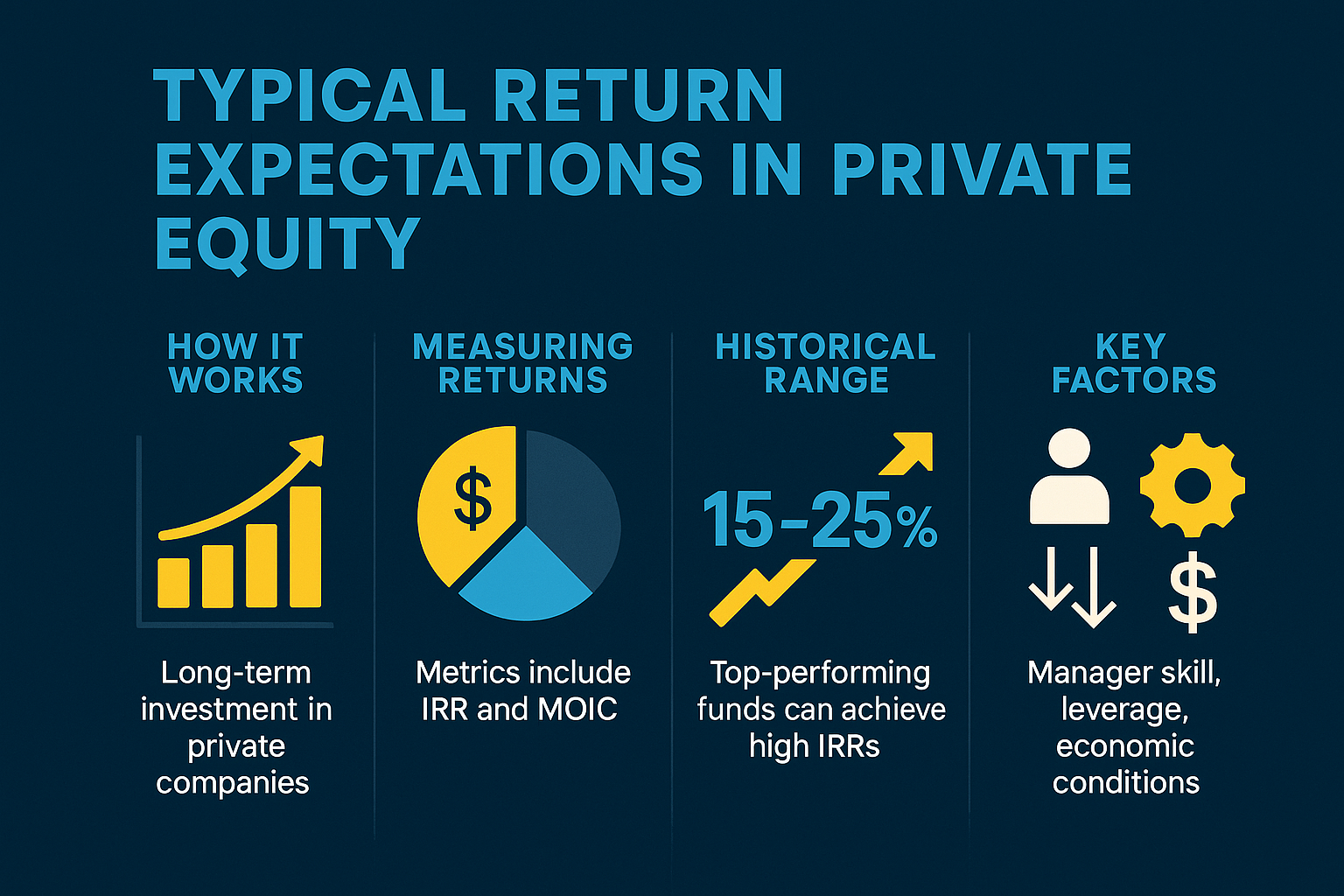
Historically, top-performing private equity funds have delivered IRRs in the 15–25% range over their life cycles. Growth depends on the type of investment strategy, the expertise of the fund manager, and broader market conditions.
Factors Influencing Returns
Several factors shape the returns an investor can expect from private equity:
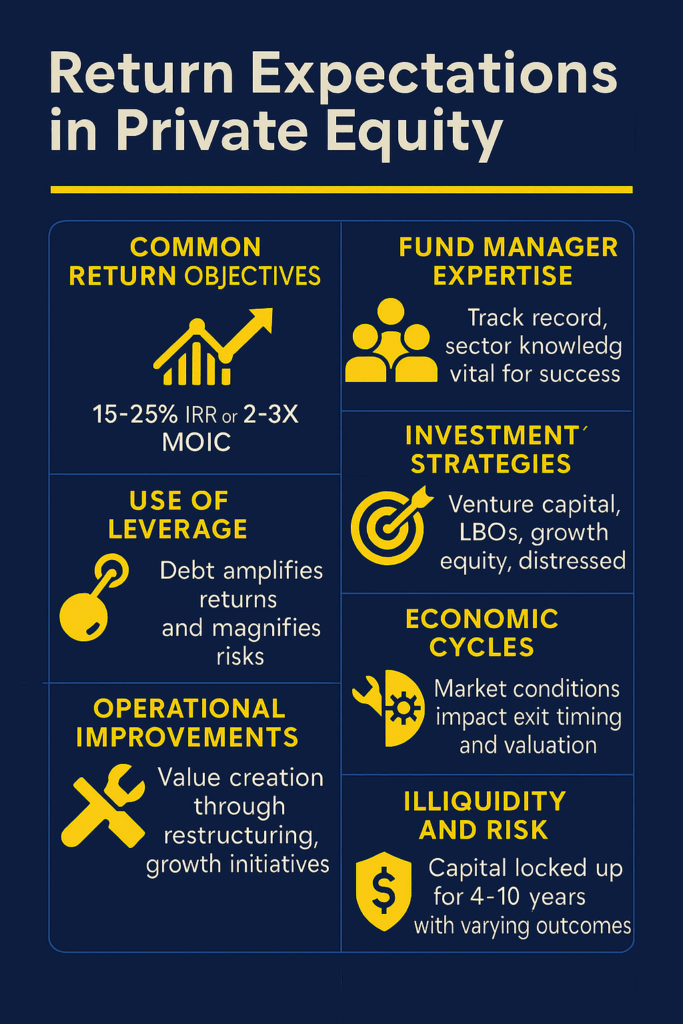
- Fund Manager Expertise: The general partner (GP) plays a crucial role in sourcing deals, structuring investments, and implementing value creation strategies. Experience, track record, and operational insight heavily influence performance.
- Investment Strategy: Different strategies carry distinct risk-return profiles. Venture capital is high-risk/high-reward; growth equity and buyouts tend to offer steadier, more predictable returns.
- Leverage: Many PE deals, particularly LBOs, use debt to increase returns. While leverage can magnify gains, it also increases the risk of losses if company performance falters.
- Market Conditions: Economic cycles, interest rates, and sector trends can affect exit opportunities and valuations, influencing overall fund performance.
- Operational Improvements: Value creation initiatives such as cost optimization, revenue expansion, or strategic acquisitions can significantly enhance returns.
The Role of Fees
Private equity returns are reported gross and net of fees. Fees include:
- Management Fees: Typically 1.5–2% of committed capital annually, covering operational costs of running the fund.
- Carried Interest: Usually around 20% of profits earned by the GP once the LPs receive their capital back.
High fees can reduce net returns, making careful fund selection critical. Experienced investors evaluate GP track records, fund strategy, and fee structure before committing capital.
Volatility and Risk Considerations
Private equity is less liquid than public markets, meaning investments are locked for 4–10 years. Investors should be prepared for:
- Illiquidity: Capital is tied up until the firm exits investments via sales or IPOs.
- Manager Risk: The success of a fund heavily depends on GP skill.
- Market and Economic Risk: Downturns can affect valuations, exit timing, and profitability.
- Leverage Risk: Debt magnifies both upside and downside, especially in leveraged buyouts.
While the risks are significant, they are balanced by the potential for long-term returns that often exceed public equity benchmarks.
Realistic Expectations
Investors should approach private equity with long-term horizons and an understanding of variability in outcomes. Top-performing funds deliver substantial returns, but not every fund meets expectations. Diversifying across strategies, sectors, and vintage years helps manage risk and smooth performance over time.
Portfolio Implications
Even modest allocations to private equity—typically 5–15% of a diversified portfolio—can enhance overall portfolio returns and provide access to uncorrelated assets. By combining PE with public equities, bonds, and other alternative investments, investors can balance risk, liquidity, and growth potential.
The Bottom Line
Private equity offers investors the opportunity to generate strong long-term returns through active management, operational improvements, and strategic growth initiatives. While returns vary based on fund type, market conditions, and GP expertise, well-executed PE investments historically outperform public markets over extended periods. Understanding IRR, MOIC, fund fees, risk factors, and time horizons is essential for setting realistic return expectations. For investors willing to commit capital long-term, private equity remains a compelling way to diversify portfolios and access high-growth opportunities unavailable in traditional public markets.