

In What Is a Hedge Fund? Breaking Down the Basics for Investors, we explored what hedge funds are and why they occupy a unique corner of the financial world. For investors, the next question is: what role can hedge funds play in a diversified portfolio?
Hedge funds are often seen as exotic or high-risk, but when properly understood, they can complement traditional investments like stocks, bonds, and mutual funds. The key lies in how they approach risk, return, and correlation with broader markets.
Diversification Beyond Traditional Assets
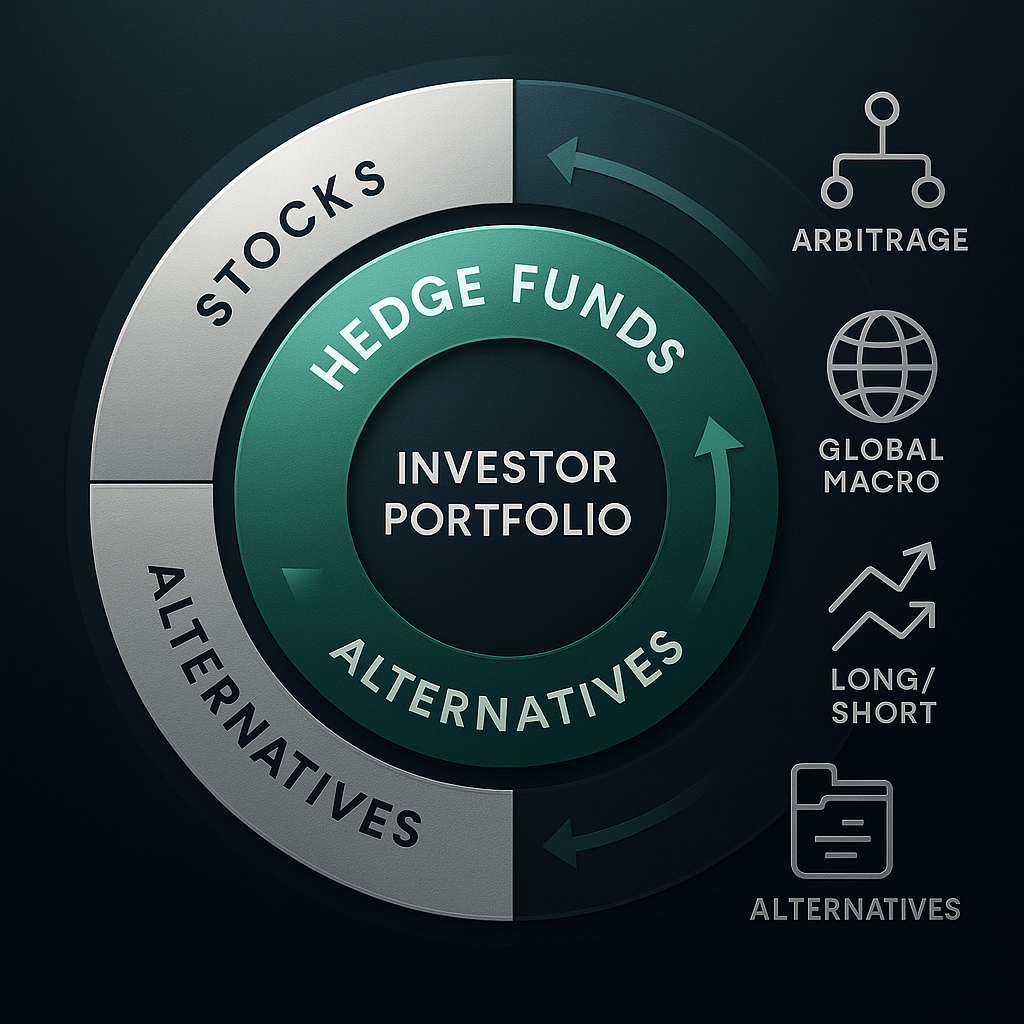
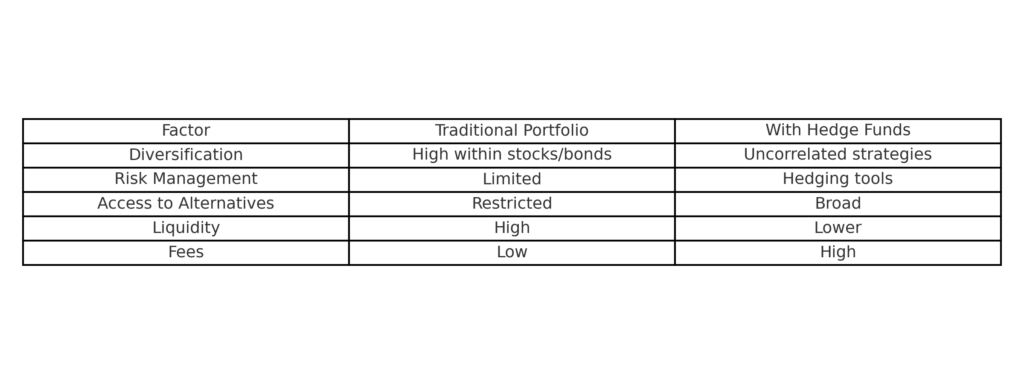
Diversification spreads investments across assets to reduce risk. Hedge funds contribute to diversification in ways that traditional equities and bonds often cannot.
Unlike mutual funds, which track stock or bond indices, hedge funds employ strategies such as long/short equity, global macro, event-driven, and relative value arbitrage. Each behaves differently under market conditions, meaning a downturn in one area might not impact hedge-fund returns the same way.
For example, a long/short equity fund can potentially generate returns even in a declining market by shorting stocks expected to fall. A global macro fund might benefit from currency or commodity moves that are uncorrelated with equities. This uncorrelated performance is particularly valuable for investors seeking to smooth overall portfolio volatility and reduce dependency on any single market.
Risk Management Tools
Hedge funds aren’t just about chasing returns—they also manage risk. Many funds use derivatives, options, and other hedging techniques to protect against downside exposure.
Consider a portfolio heavy in equities: a market correction could wipe out value. A hedge fund in the same portfolio may use short positions or volatility strategies to offset losses, smoothing overall performance. This is why pension funds, endowments, and insurance companies often allocate a portion of their capital to hedge funds, despite higher fees and less liquidity.
Access to Alternative Opportunities
Hedge funds often invest in areas unavailable to typical investors, including distressed debt, private-equity-like opportunities, and corporate-event-driven trades.
For a diversified portfolio, this access can be invaluable. Alternative investments offer returns not tied to public markets. When traditional markets are volatile, hedge funds can provide a stabilizing effect or independent alpha. For example, a fund investing in distressed corporate debt may perform well during a stock market downturn, offsetting losses in traditional holdings. The trade-offs: higher risk, less transparency, and sometimes long lock-up periods.
Balancing Returns and Fees
Hedge funds typically charge higher fees, often “2 and 20”—2% management plus 20% of profits. While fees have come down in some cases, they remain higher than mutual funds.
Portfolio diversification works best when investors weigh potential benefits against costs. Hedge funds shouldn’t replace core holdings; a modest allocation can improve risk-adjusted returns by providing uncorrelated exposure to alternative strategies. Investors also need to consider the impact of fees on long-term performance and whether the hedge fund strategy complements their existing investments.
Allocation Considerations
Advisors often recommend smaller allocations to hedge funds—typically 5–15% of a diversified portfolio. Exact amounts depend on risk tolerance, investment horizon, and liquidity needs.
Smaller allocations can reduce volatility, offer access to alternative strategies, and potentially generate alpha. Since hedge funds are less liquid, allocated capital should be considered long-term. Investors should also review the hedge fund’s strategy and historical performance to ensure alignment with overall portfolio goals.
Hedge Funds and Portfolio Performance
When integrated correctly, hedge funds can stabilize returns across market cycles. In bull markets, they may lag equities, but in downturns, they can offset losses and reduce drawdowns.
The value lies not just in absolute returns but in risk-adjusted performance—how the investment behaves during turbulence. Understanding each fund’s correlation with other assets helps investors build portfolios that are more resilient to market swings.
The Bottom Line
Hedge funds occupy a strategic niche in diversified portfolios. They provide alternative strategies, reduce correlations with traditional assets, and offer sophisticated risk management.
As highlighted in What Is a Hedge Fund? Breaking Down the Basics for Investors, hedge funds are complex, exclusive, and higher-cost investments. Yet, even a modest allocation can improve portfolio resilience, reduce volatility, and potentially enhance long-term risk-adjusted returns.
Hedge funds should not replace equities, bonds, or mutual funds. Instead, they complement traditional investments—diversifying, managing risk, and exploring strategies beyond conventional markets. Understanding their role, strategy, and correlation with other assets is the first step in deciding whether hedge funds belong in your portfolio and how they can help achieve long-term financial goals.