

This Content Is Only For Subscribers
When planning for retirement, two of the most common tax-advantaged accounts are the Traditional IRA and the 401(k). Both offer opportunities to grow your savings while reducing your current tax bill, but they have distinct features, rules, and limitations. Understanding the differences is crucial to deciding which option — or combination of both — works best for your financial goals.
Basic Overview
Traditional IRA:
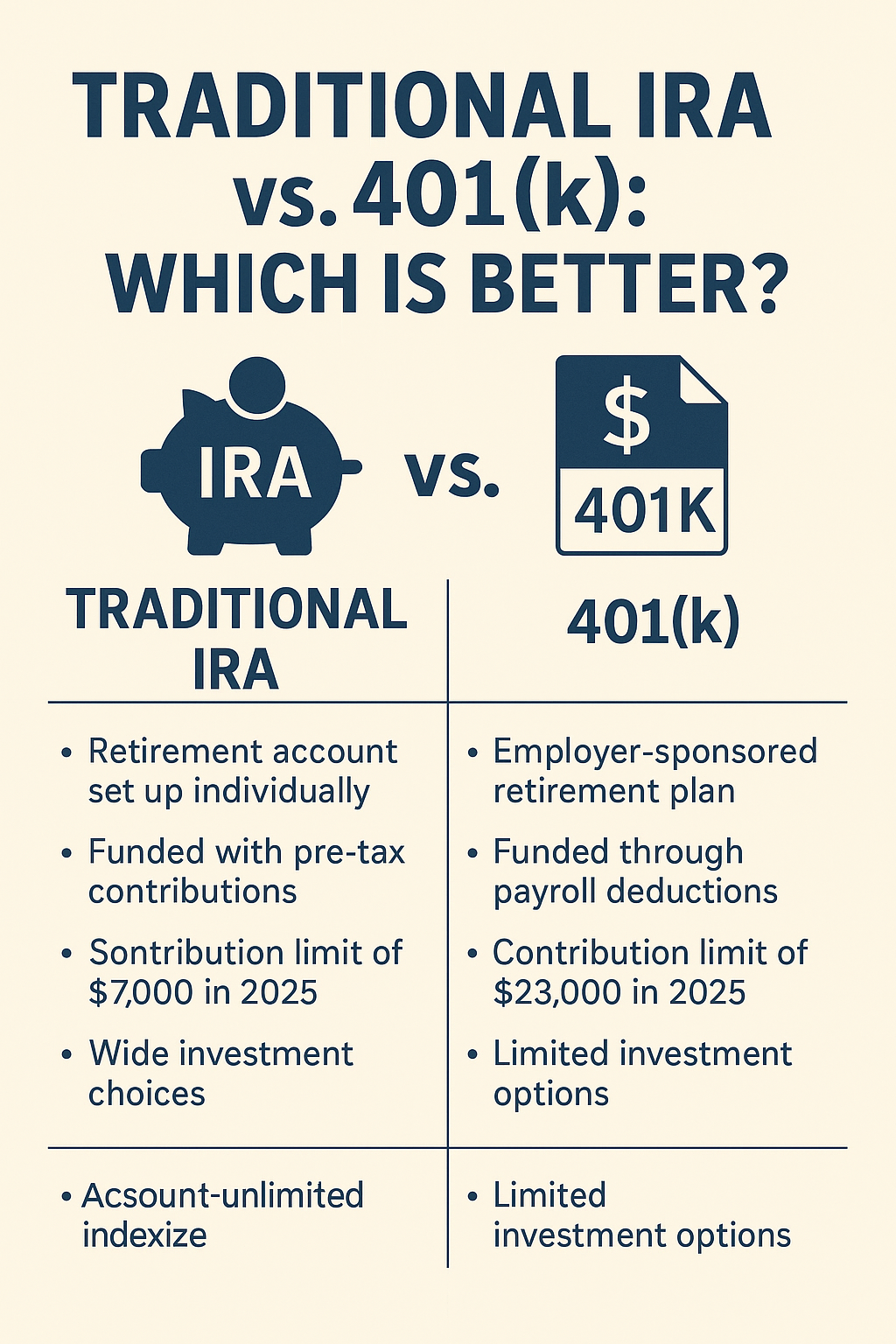
- A retirement account you set up individually.
- Funded with pre-tax contributions (potentially tax-deductible depending on income).
- Contributions are capped at $7,000 per year in 2025 (or $8,000 if you’re 50 or older).
- Investment choices are wide, including stocks, bonds, mutual funds, ETFs, and in some cases, self-directed assets like real estate.
401(k):
- Employer-sponsored retirement plan.
- Funded through payroll deductions, often with pre-tax contributions, though some plans offer Roth 401(k) options.
- Contribution limits are much higher: $23,000 for 2025, with a catch-up contribution of $7,500 if you’re 50 or older.
- Investment choices are usually limited to the options provided by the plan’s administrator.
Key Differences
1. Contribution Limits
- Traditional IRA: $7,000 ($8,000 if 50+)
- 401(k): $23,000 ($30,500 if 50+)
- Impact: If your goal is to save aggressively, a 401(k) allows you to contribute more each year.
2. Employer Matching
- Traditional IRA: No matching.
- 401(k): Many employers offer matching contributions, typically 3–6% of salary.
- Impact: Employer matching is effectively “free money,” making a 401(k) highly advantageous if available.
3. Investment Options
- IRA: Almost unlimited; choose from any eligible investment offered by the provider.
- 401(k): Limited to the plan’s fund menu, which may have higher fees and fewer options.
4. Eligibility and Access
- IRA: Anyone with earned income can contribute, subject to income limits for deductibility.
- 401(k): Available only through your employer.
5. Required Minimum Distributions (RMDs)
- Both Traditional IRAs and 401(k)s require RMDs starting at age 73.
- Roth IRAs do not require RMDs, unlike Roth 401(k)s, which do.
6. Early Withdrawal Rules
- Both accounts impose a 10% penalty for withdrawals before age 59½, with some exceptions (medical expenses, first-time home purchase for IRAs, SEPP plans, etc.).
When a Traditional IRA Might Be Better
Flexibility in Investment Choices
- IRAs allow access to a broad range of investments, including low-cost index funds or alternative assets.
No Employer Plan
- If you don’t have access to a 401(k), an IRA is the primary way to get tax-advantaged retirement savings.
Lower Income or Tax Bracket Considerations
- You might benefit from immediate tax deductions if you are in a lower tax bracket and meet IRA eligibility rules.
When a 401(k) Might Be Better
Higher Contribution Limits
- Save more each year than is allowed in an IRA.
Employer Match
- Take full advantage of any matching contributions; not doing so is essentially leaving money on the table.
Payroll Deductions
- Automatic contributions reduce the temptation to spend and make saving effortless.
Using Both Together
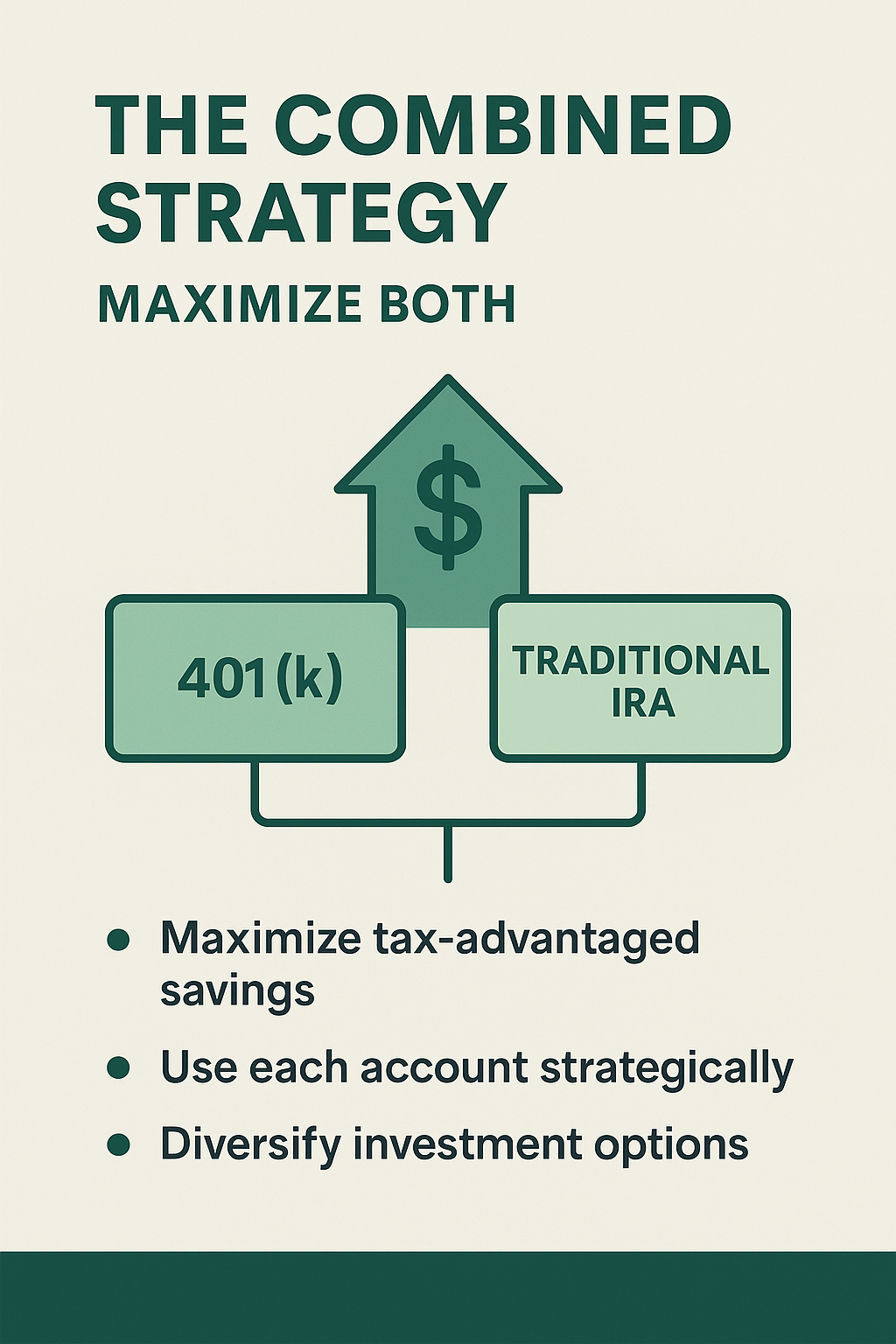
Many investors benefit from contributing to both a 401(k) and a Traditional IRA:
- Maximize tax-advantaged savings.
- Use the IRA for flexibility and additional contributions.
- Use the 401(k) for high contribution limits and employer matching.
Example:
- Alice earns $120,000 and has access to a 401(k) with a 5% employer match.
- She contributes $7,000 to a Traditional IRA and $19,000 to her 401(k).
- She maximizes both her personal contribution and her employer match while diversifying investment options.
Tax Considerations
- Traditional IRA: Contributions may be tax-deductible depending on your income and access to a workplace retirement plan. Withdrawals are taxed as ordinary income.
- 401(k): Contributions reduce taxable income for the year. Employer matches are pre-tax. Withdrawals are taxed as ordinary income.
Impact on Taxes:
- High earners might face IRA deduction limits but can still contribute to a 401(k).
- Balancing IRA and 401(k) contributions can optimize tax efficiency over time.
Accessibility and Portability
- Traditional IRA: You control the account and can roll it over to another IRA or employer plan.
- 401(k): Generally tied to your employer, but you can roll funds into an IRA or new employer’s 401(k) when changing jobs.
Fees
- IRAs often have low-cost index funds with minimal fees.
- 401(k) plans sometimes have higher administrative fees and limited fund choices.
- Fee differences can significantly affect long-term growth, so it’s worth comparing investment options carefully.
Final Thoughts
Deciding between a Traditional IRA and a 401(k) isn’t an either/or proposition. Each has advantages depending on:
- Your income level
- Access to employer-sponsored plans
- Contribution goals
- Investment preferences
- Desire for flexibility
For novice investors, the key takeaways are:
- Contribute at least enough to get any employer match in a 401(k).
- Use a Traditional IRA for additional savings and broader investment options.
- Combine both accounts strategically to maximize retirement savings, minimize taxes, and maintain flexibility.
By understanding the strengths and limitations of each account, you can craft a retirement plan that works for your current situation and long-term financial goals.