

For decades, real estate has been one of the most reliable pillars of wealth creation. From single-family homes and luxury apartments to sprawling commercial complexes and industrial warehouses, property ownership has provided investors with long-term appreciation, steady cash flow, and a tangible hedge against inflation. Yet, traditional real estate investment has always come with significant barriers: high capital requirements, geographic limitations, complex legal structures, and limited liquidity.
Enter blockchain technology. The emergence of tokenized real estate is transforming the investment landscape, allowing fractional ownership of properties, automated income distribution, and enhanced transparency. Tokenization not only makes real estate more accessible to a broader range of investors but also introduces new mechanisms for governance, liquidity, and portfolio diversification.
This article provides a comprehensive, investor-focused exploration of tokenized real estate. We’ll cover what it is, how it works, the structures of tokenized real estate funds, investor requirements, real-world examples, risks and rewards, technological infrastructure, regulatory considerations, and the future outlook of this emerging asset class.
Understanding Tokenized Real Estate
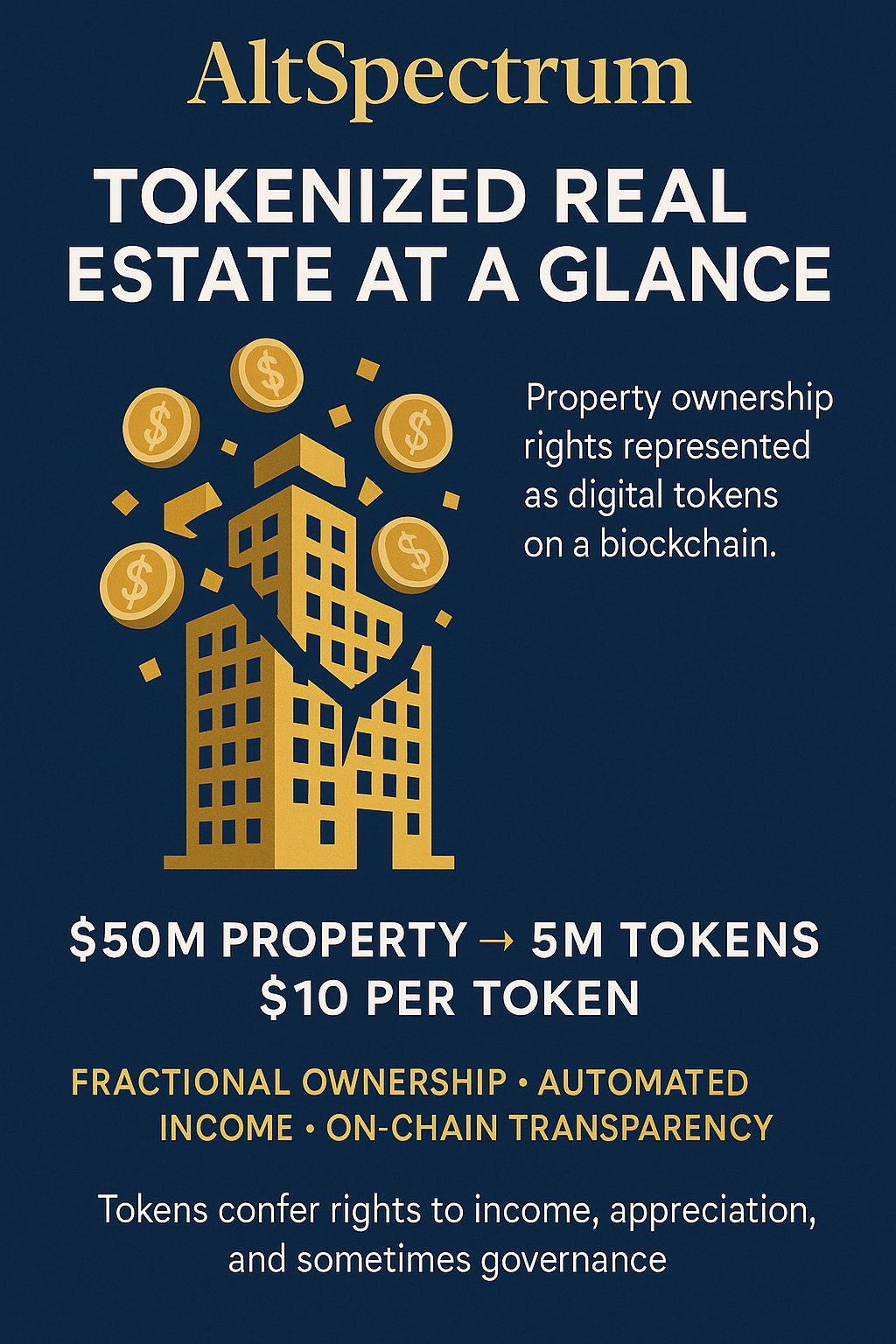
Tokenized real estate is the process of converting ownership rights of a physical property into digital tokens recorded on a blockchain. Each token represents a proportional stake in the underlying property, allowing investors to buy, sell, and trade fractions of a building, development, or portfolio without needing millions of dollars upfront.
For example:
- A $50 million commercial office building could be divided into 5 million tokens, with each token representing $10 of ownership.
- Token holders are entitled to a share of rental income, appreciation, and sometimes governance rights over property decisions.
Unlike Real Estate Investment Trusts (REITs) or traditional private syndications, tokenized real estate gives investors direct fractional ownership, transparency through blockchain, and automated cash flows via smart contracts. This combination enhances accessibility while preserving the economic benefits of property ownership.
Tokenized real estate democratizes an asset class that has traditionally been the domain of institutional investors and wealthy individuals. It allows smaller investors to participate in high-value projects that were previously out of reach, enabling them to diversify portfolios, access premium assets, and potentially achieve higher returns.
Historical Context: From Traditional Real Estate to Tokenization
The journey to tokenized real estate is rooted in decades of technological and financial innovation. Traditionally, real estate investments required significant capital, complex management, and local expertise. Syndications and REITs emerged to address some of these issues, offering pooled investments and professional management.
However, REITs and syndications often suffer from their own limitations: limited transparency, high management fees, and restricted global access. Investors cannot directly see the performance of the underlying properties or influence operational decisions. Liquidity is also constrained, as shares can only be sold on specific exchanges or in private secondary markets.
The blockchain era has introduced programmable digital ownership, where property rights are codified in tokens. This digital transformation aligns with broader trends in finance, including decentralized finance (DeFi), fractional investing, and global capital mobility. By merging real estate with blockchain technology, tokenized real estate addresses traditional barriers while creating new opportunities for innovation, transparency, and inclusivity.
How Tokenized Real Estate Works
Tokenized real estate typically involves several key stages:
Property Acquisition and Legal Structure
The first step is acquiring the property and placing it into a special purpose vehicle (SPV) or legal entity. SPVs isolate the asset, ensuring that each token accurately represents a portion of equity or income rights. They also simplify legal compliance, particularly when allowing investors from multiple jurisdictions to participate.
Token Issuance
Tokens are minted on a blockchain, most commonly Ethereum, Polygon, Solana, or Tezos. Tokens can represent equity, debt, or income rights, with smart contracts embedding rules for governance, voting, distributions, and transfers. The choice of blockchain affects transaction speed, fees, interoperability, and secondary market compatibility.
Investor Participation
Investors purchase tokens using fiat currency or cryptocurrency. Smart contracts automatically manage distributions of rental income, dividends, or capital gains. Investors can track performance in real time through digital dashboards, providing a level of transparency and immediacy previously unavailable in real estate investing.
Secondary Market Trading
Tokens can be traded on regulated marketplaces, crypto exchanges, or over-the-counter platforms. Secondary markets provide liquidity, allowing investors to rebalance portfolios or exit positions more efficiently than traditional real estate syndications. This feature introduces a novel element of market-driven pricing to an otherwise illiquid asset class.
Governance and Decision-Making
Some tokenized real estate platforms allow investors to participate in governance decisions, such as approving property improvements, approving refinancing strategies, or electing management committees. These rights are encoded in smart contracts, automating voting and ensuring secure, verifiable decision-making.
Advantages of Tokenized Real Estate
Enhanced Liquidity
Tokenization introduces liquidity to an asset class that is traditionally illiquid. Investors can trade fractions of properties, making it easier to adjust portfolio allocations or exit investments without waiting months or years for a full property sale.
Lower Entry Barriers
Tokenized real estate dramatically reduces minimum investment thresholds. Investors can enter premium markets with as little as $100–$1,000 per token, democratizing access to high-value assets and enabling broader portfolio diversification.
Global Market Access
Tokenized assets transcend geographic boundaries. A small investor in Asia can own a fraction of a New York City office building, a London hotel, or a Parisian residential complex. This global accessibility allows investors to diversify across countries, currencies, and regulatory environments.
Transparency and Auditability
Blockchain technology ensures immutable records of ownership, transactions, and distributions. Investors can independently verify token holdings, track rental income, and confirm capital appreciation without relying on intermediaries or manual reporting.
Programmable Governance and Returns
Smart contracts automate dividend payments, reinvestment programs, and voting procedures. This reduces administrative costs, minimizes human error, and ensures trustless execution of predefined rules.
Types of Tokenized Real Estate Funds
Tokenized real estate can be structured in various ways:
Single-Asset Token Funds
Investors gain exposure to one specific property, such as a luxury hotel, office building, or industrial warehouse. SPVs hold the property, while tokens represent proportional equity or income rights.
Multi-Asset Token Funds
These funds tokenize multiple properties within a single vehicle, offering diversification across sectors, geographies, or property types. This reduces exposure to underperformance in any single asset.
Hybrid Funds
Hybrid funds combine traditional fund management with tokenization. They provide professional oversight for due diligence, operations, and reporting while offering fractionalized, tradable ownership through tokens.
Sector-Specific Funds
Some funds specialize in niches like logistics, hospitality, renewable energy, or mixed-use developments. Sector expertise allows managers to optimize operations, leverage market knowledge, and capture higher returns.
Real-World Examples
- RealT Platform: Offers tokenized U.S. rental properties, distributing income via stablecoins.
- Aspen Digital Hotel: Fractional ownership allows global investors to participate in a luxury hotel.
- St. Regis Resort, Bahamas: Tokenization enabled investors worldwide to own a stake in a resort property.
- HoneyBricks: Provides tokenized access to commercial real estate with transparent reporting dashboards.
These cases illustrate how tokenization is applied in practice, demonstrating income generation, fractional ownership, and cross-border investor participation.
Investor Considerations and Strategies
Tokenized real estate appeals to a broad spectrum of investors:
- Retail Investors: Gain exposure to high-value assets with minimal capital.
- Accredited Investors: Access specialized, high-potential token offerings.
- Institutional Investors: Hedge funds, family offices, and pension funds integrate tokenized real estate into diversified portfolios for stable income and risk-adjusted returns.
Portfolio strategies may involve balancing tokenized real estate with traditional assets, incorporating geographic diversification, and managing allocation sizes according to liquidity and risk tolerance.
Regulatory and Legal Landscape
Regulation varies by jurisdiction:
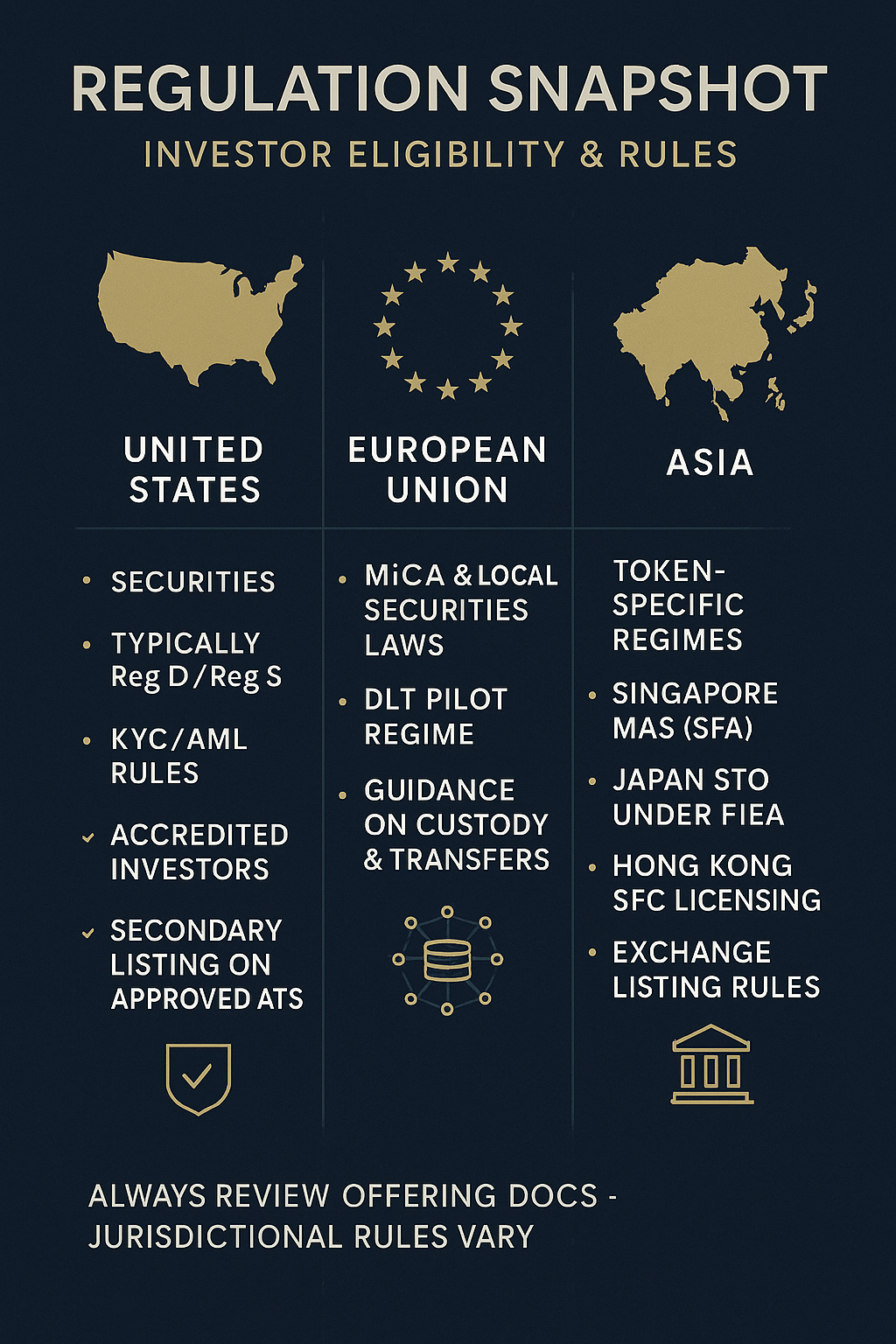
- United States: Many tokens qualify as securities under SEC regulations, requiring accredited investors or compliance with Regulation D.
- European Union: MiCA (Markets in Crypto-Assets) framework clarifies legal treatment of security tokens.
- Asia: Singapore, Japan, and Hong Kong are developing token-specific regulations, balancing innovation and investor protection.
- Emerging Markets: Regulatory frameworks are still evolving, presenting both opportunities and challenges for cross-border investment.
Compliance is critical to ensuring enforceability, investor protection, and access to secondary markets.
Technological Infrastructure
Blockchain protocols underpin tokenized real estate:
- Ethereum and Polygon: Popular for ERC-20 and ERC-721 tokens.
- Solana: Offers faster transactions and lower fees.
- Tezos: Known for energy efficiency and smart contract flexibility.
Smart contracts automate distributions, governance, and ownership verification. Security audits and robust technological due diligence are essential to mitigate risks like hacks or coding errors.
Risks and Challenges
Tokenized real estate carries traditional and novel risks:
- Regulatory Risk: Evolving laws may affect liquidity and enforceability.
- Liquidity Risk: Secondary markets are maturing; volumes can be limited.
- Technology Risk: Smart contract vulnerabilities or platform failures can result in loss of capital.
- Market Risk: Property value fluctuations, local economic conditions, and crypto volatility impact returns.
- Operational Risk: Fund management quality directly affects investor outcomes.
Investors must carefully assess platforms, underlying assets, and legal frameworks before participation.
The Future of Tokenized Real Estate
Tokenized real estate is expected to grow rapidly. Even a small fraction of the $300 trillion global property market could translate into trillions in tokenized assets over the next decade. Emerging trends include:
- DeFi Integration: Using tokens as collateral or for liquidity pools.
- ESG Focused Tokens: Transparent investment in sustainable properties.
- Global Access: Fractional ownership allows worldwide diversification.
- Portfolio Efficiency: Smaller allocations can be spread across multiple assets, reducing risk and improving yield.
The combination of accessibility, transparency, and liquidity positions tokenized real estate as a disruptive force in the investment world.