

Private equity (PE) and venture capital (VC) are two of the most prominent ways investors gain exposure to private companies. Both involve deploying capital to help businesses grow and generate returns, yet they differ in strategy, risk, investment size, and target companies. Understanding these distinctions is critical for investors exploring private markets, as outlined in What Is Private Equity? Understanding the Foundations of PE Investing.
Defining the Two Asset Classes
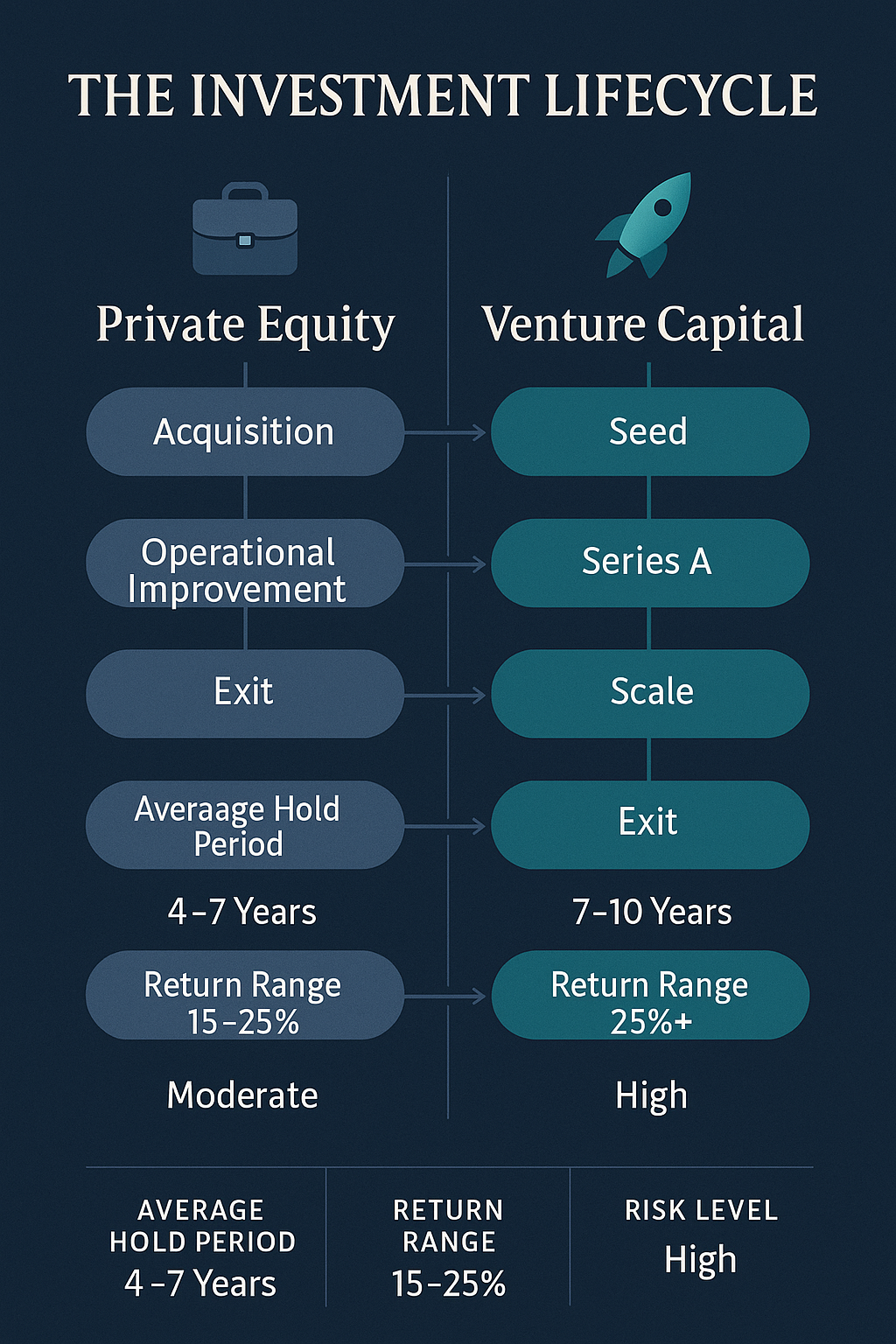
Private equity invests in established, non-public companies. PE firms often acquire controlling stakes or significant minority positions and actively manage the business to enhance value. Strategies may include operational improvements, strategic growth initiatives, or financial restructuring. PE investments are generally held for 4–7 years, sometimes longer, before exit via sale or IPO.
Venture capital, by contrast, focuses on early-stage companies with high growth potential but limited operating history. VC investors take minority stakes, providing capital and guidance while founders manage daily operations. Because the companies are unproven, VC is higher risk but carries the potential for outsized returns.
Investment Stage and Size
One of the most significant differences is the stage of the companies:
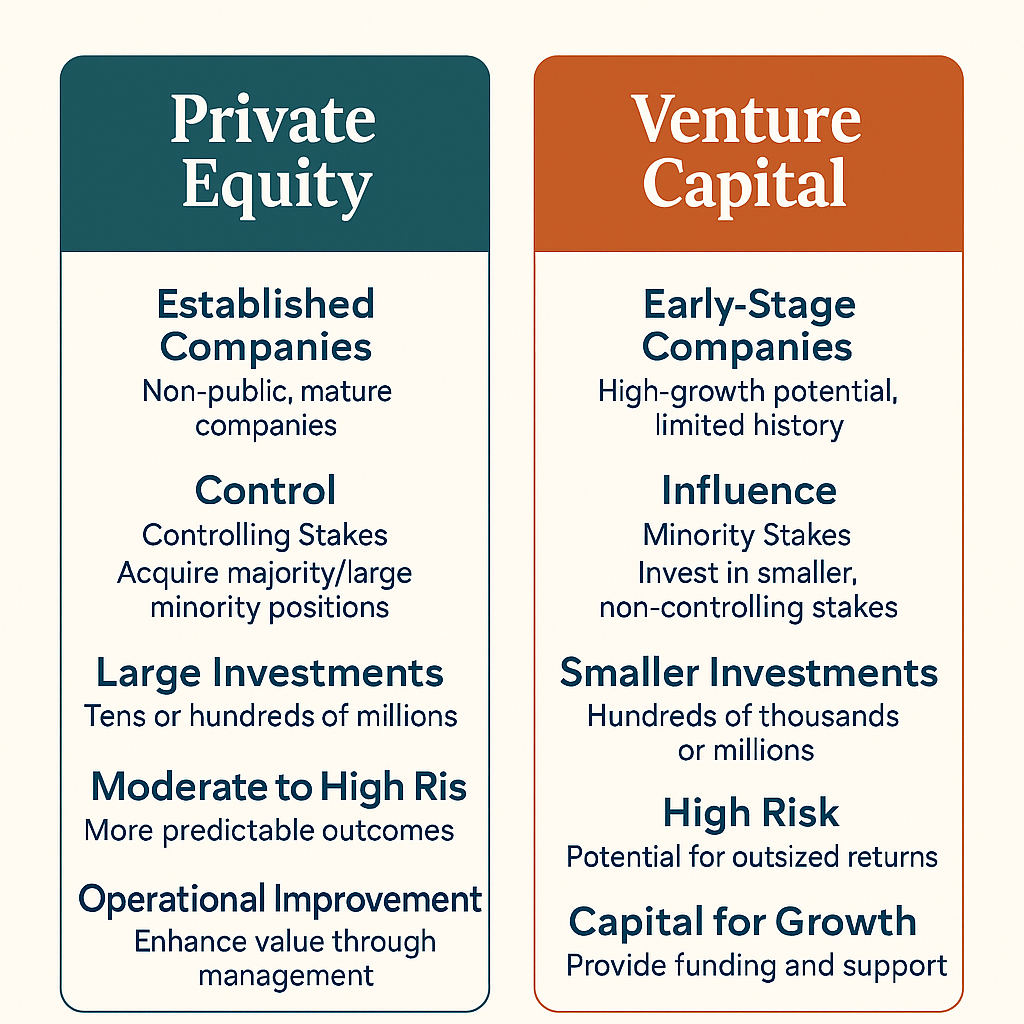
- Private Equity: PE deals involve mature companies with predictable cash flows. Deal sizes are large, often tens or hundreds of millions of dollars. PE firms may use leverage, which amplifies both returns and risk.
- Venture Capital: VC deals are smaller, usually hundreds of thousands to a few million dollars per investment. Startups may be pre-revenue or early revenue, requiring capital to scale. VC funds spread risk across multiple startups, expecting that only a few will succeed.
Control and Influence
- Private Equity: Controlling stakes give PE firms authority to implement operational changes, restructure finances, and execute strategic initiatives.
- Venture Capital: Minority stakes focus on mentorship, board guidance, and network access; founders retain operational control.
Risk and Return Profiles
- Private Equity: Returns are typically 15–25% IRR. Risks include leverage, market fluctuations, and manager execution, but mature companies offer more predictable outcomes.
- Venture Capital: High-risk, high-reward; many startups fail, but a few generate exceptional returns. Successful VC deals can exceed 30% IRR.
Fund Structure and Economics
Both PE and VC use limited partnerships:
- General Partners (GPs): Manage the fund, source deals, execute strategies, and earn carried interest, often 20% of profits.
- Limited Partners (LPs): Provide most of the capital and enjoy limited liability.
PE funds usually have fewer, larger investments requiring hands-on oversight. VC funds hold diversified portfoliosto mitigate startup failure risk.
Time Horizon
- Private Equity: 4–7 years per investment; 10–12 years for the fund lifecycle.
- Venture Capital: Often 7–10 years for startups to scale and exit.
Sector Focus
- Private Equity: Targets industries where operational improvements and financial restructuring drive value—healthcare, industrials, consumer goods, technology.
- Venture Capital: Focuses on innovation-driven sectors like software, biotech, and fintech, targeting potential disruptors rather than stable cash flows.
Key Takeaways for Investors
- Stage and Risk Profile: PE offers operationally-driven growth; VC provides high-risk, high-reward exposure.
- Control vs. Guidance: PE allows active control; VC relies on mentoring and strategic influence.
- Diversification: PE deals are large and fewer; VC deals are smaller and spread across multiple startups.
- Time Commitment: Both require long-term capital; VC may take longer for exits.
- Returns: PE returns are steadier; VC returns are volatile but can be transformative.
Both PE and VC can complement a diversified portfolio. PE provides operationally-driven growth with more predictable outcomes, while VC offers exposure to early-stage innovation with the potential for outsized gains. Understanding stage, control, risk, return, and sector focus allows investors to align private investments with their financial goals and risk tolerance.