

In our feature What Is a Hedge Fund? Breaking Down the Basics for Investors, we looked at what hedge funds are and why they occupy such a distinct corner of the financial world. But one of the biggest questions investors have after learning the basics is this: what exactly do hedge funds do with all that money?
The answer lies in strategy. Hedge funds aren’t a single type of investment—they’re a category of funds that use a variety of approaches to generate returns. While managers have wide latitude, most strategies fall into a handful of well-known groups. Understanding these gives investors a clearer picture of what drives hedge-fund performance and risk.
Long/Short Equity
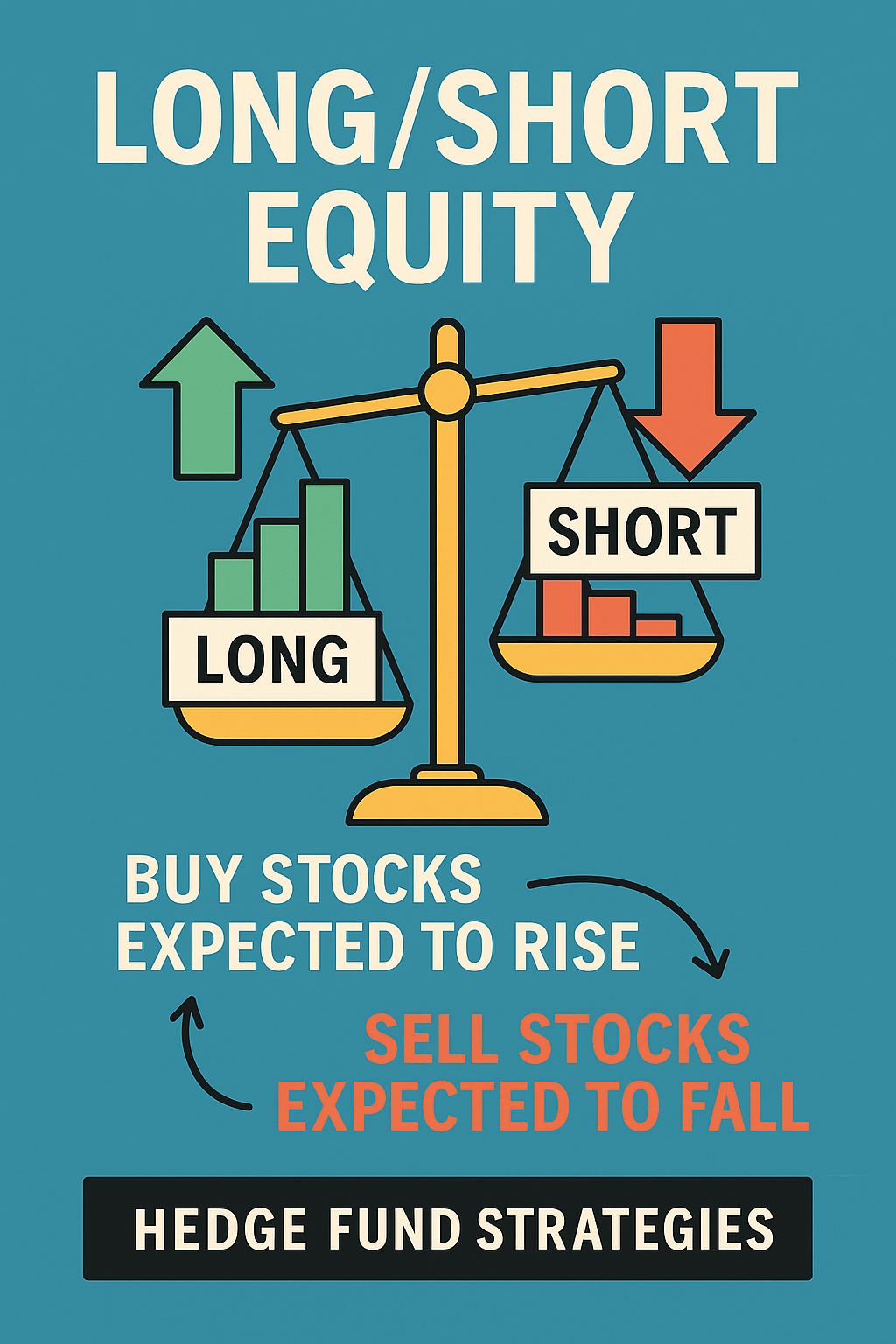
Perhaps the most classic hedge fund strategy, long/short equity is straightforward. Managers buy stocks they expect to rise (going long) and sell short stocks they believe will fall. The goal is to profit on both sides—capturing gains from winners while cushioning losses with shorts.
This strategy allows funds to generate returns in rising and falling markets. But shorting carries the risk of unlimited losses if prices climb, and consistent success requires sharp research. Long/short equity remains the bread and butter for many hedge funds, particularly those focused on specific sectors like tech or healthcare.
Global Macro
If long/short equity zooms in on companies, global macro zooms out. This strategy bets on economic trends—interest rates, currencies, commodities, or geopolitics.
Managers take positions across asset classes based on their read of the global economy. A fund might short the yen while buying U.S. Treasuries if it expects policy divergence. Global macro thrives on flexibility but depends heavily on the manager’s ability to read complex signals. Big wins are possible, but so are dramatic missteps.
Event-Driven
Event-driven funds focus on corporate actions—mergers, bankruptcies, or spin-offs.
A subset is merger arbitrage: if Company A offers $50 per share for Company B, but B trades at $47, a fund might buy B, betting the deal closes. At the same time, it might short A if it expects the acquirer’s stock to dip. These strategies can generate steady returns, but deals can collapse, creating losses.
Relative Value Arbitrage
Relative value arbitrage exploits small mispricings between related securities. For example, buying one bond while shorting another with similar traits, betting the spread narrows.
Because the returns per trade are small, these funds often use leverage. That amplifies gains in stable markets but magnifies losses if prices move unexpectedly.
Distressed Securities
Some funds specialize in distressed securities—buying debt or equity of companies near bankruptcy. The idea is that recovery or restructuring will unlock value.
The upside can be significant if the company rebounds, but the risks are equally high. These funds require deep legal and financial expertise.
Multi-Strategy Funds
Not every hedge fund sticks to one lane. Multi-strategy funds combine several approaches—long/short equity, event-driven, macro, and arbitrage—under one roof.
The advantage is diversification: when one strategy struggles, another may shine. But execution is complex, requiring large teams and careful risk controls.
Why Strategies Matter to Investors
For investors, understanding strategy is essential. Not all hedge funds behave the same way, and risks vary.
A long/short equity fund may rise and fall with stocks, while a global macro fund might look uncorrelated. Event-driven strategies can offer steadier returns until a deal collapses. Knowing the approach helps investors align hedge funds with their portfolio goals—whether diversification, downside protection, or higher risk/reward.
The Bottom Line
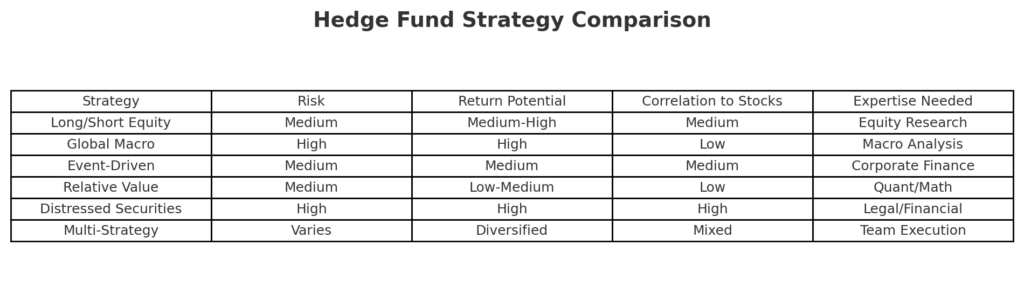
Hedge funds are defined less by structure than by strategy. From long/short equity to global macro and distressed-debt plays, the methods differ, but the goal is the same: returns that can’t be easily replicated by traditional funds.
As explored in What Is a Hedge Fund? Breaking Down the Basics for Investors, hedge funds are exclusive and complex by design. But peel back the layers, and the core comes down to strategy—the blueprint managers use to pursue returns.
For those who qualify to invest, understanding these strategies is the first step to deciding whether hedge funds deserve a place in their portfolios.