

This Content Is Only For Subscribers
Real estate isn’t just about your backyard anymore. Capital flows, supply chains, demographics, and technology are reorganizing the world map—and with it, the opportunity set for investors. Whether you’re buying public REITs, allocating to private funds, or exploring direct deals abroad, looking beyond your home market can improve diversification and, in many cases, returns. The trick is knowing where to look and how to manage the added risks.
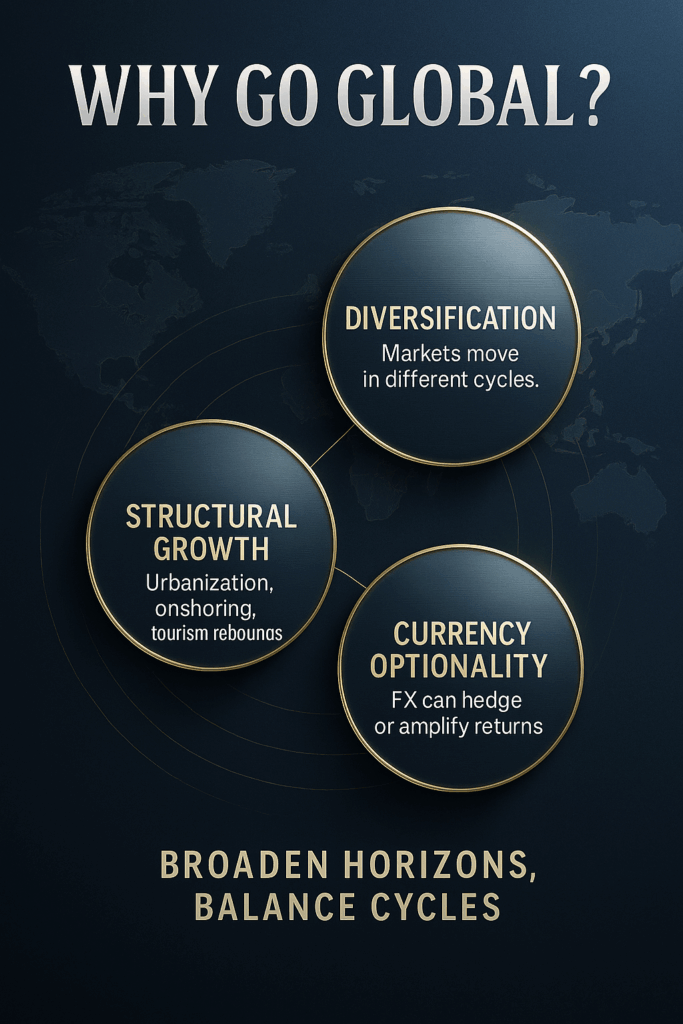
Why Go Global?
- Diversification: Different regions cycle at different times. A slump in U.S. offices doesn’t mean the same for German logistics or Japanese multifamily.
- Structural Growth: Urbanization in Asia, onshoring in North America, and tourism rebounds in Southern Europe create long-duration demand.
- Currency Optionality: Foreign exposure isn’t just a return driver—it’s also a hedge (or a risk) depending on how you manage FX.
A Simple Framework
Before picking markets, answer three questions:
- Demand Driver: Is growth powered by demographics, income gains, supply shortages, or policy tailwinds?
- Institutional Maturity: Are title systems, lender bases, and property data reliable?
- Exit Paths: Can you sell to local institutions, global core buyers, or public markets?
Regional Snapshots
North America
- United States: Still the deepest, most liquid market. Current bright spots include industrial/logistics (near ports and intermodal hubs), data centers, select Sun Belt multifamily, and life sciences in Boston/San Diego. Office remains bifurcated: top-tier (“trophy”) assets vs. challenged B/C stock.
- Canada: Tight multifamily fundamentals in Toronto/Vancouver and resilient industrial. Development economics are tougher as financing costs rise, which can support existing assets.
Investor angle: If you’re new to global real estate, North America’s legal clarity and REIT depth make it a practical starting point.
Europe
- Core EU/UK: Logistics corridors (Netherlands, Germany, Northern Italy) benefit from e-commerce and reshoring. Build-to-rent apartment platforms are scaling in the UK and Ireland. Southern Europe (Spain, Portugal, Greece) has tourism-led demand for hospitality and short-stay assets.
- Risks: Energy and regulatory costs (e.g., building efficiency mandates), plus fragmented tax regimes.
- Office note: Prime, green-certified assets in gateway cities can still lease; older stock faces capex cliffs.
Investor angle: Lean into green-certified assets and logistics, and be ready for heavier ESG capex.
Asia-Pacific
- Japan: Ultra-low rates, deep debt markets, and a large REIT ecosystem. Tokyo/Osaka multifamily offers stable occupancy and professional management.
- Australia: Institutional-quality logistics near Sydney/Melbourne and strong student housing tied to international education.
- Southeast Asia: Urbanization in Vietnam, Indonesia, Philippines fuels housing, last-mile logistics, and data infrastructure—but markets can be less transparent.
- China: Policy cycles and developer deleveraging require caution; logistics and data infrastructure backed by strong sponsors remain the more resilient niches.
Investor angle: APAC offers growth but demands sponsor selection and careful structuring.
Latin America
- Mexico: Beneficiary of nearshoring—industrial parks along the U.S. border and Bajío region are in demand.
- Brazil/Chile/Colombia: Institutional real estate is growing; expect higher yields and higher volatility. Currency swings can dominate returns.
Investor angle: Pair strong local partners with USD-linked leases where possible; hedge FX when feasible.
Middle East & Africa
- Gulf (UAE, Saudi): Government-backed economic diversification is driving mixed-use, tourism, and logistics. Yields can be attractive with modern stock expanding quickly.
- Africa (select markets): Population growth and urbanization create long-term housing and retail demand, but execution depends on political stability and financing depth.
Investor angle: Opportunities are often sponsor-led and policy-driven; diligence and governance are paramount.
Sectors to Watch (Cross-Border)
- Industrial & Logistics: The globalization of e-commerce and nearshoring/friend-shoring is a multi-year theme. Look for sites near ports, airports, rail, or last-mile nodes.
- Multifamily / Build-to-Rent: Institutional apartment platforms are scaling outside the U.S.—notably the UK, Ireland, Germany, Japan, and Australia. Shorter leases allow quicker mark-to-market in inflationary periods.
- Data Centers & Digital Infrastructure: AI and cloud demand drive power- and fiber-adjacent sites. Barrier is power availability as much as land.
- Student Housing: Global university hubs (UK, Australia, Canada, Netherlands, Spain) show durable demand with professional operators.
- Life Sciences: Lab space needs specialized HVAC, floor loading, and proximity to research hospitals; opportunities concentrated in a handful of global clusters.
- Hospitality & Leisure: Europe’s Mediterranean belt and parts of APAC benefit from the tourism super-cycle; operational skill matters as much as the real estate.
Vehicles: How to Invest Globally
- Public REITs: Easiest way to gain diversified country/sector exposure with daily liquidity. Volatile, but transparent.
- Private Funds (Core/Core-Plus/Value-Add/Opportunistic): Professional management and scale; your due diligence is on the manager’s track record, fees, and alignment.
- Direct / Club Deals: Highest control and potential alpha, but requires local expertise, legal structuring, and asset management bandwidth.
- Secondaries: Buying fund interests on the secondary market can improve entry pricing and shorten duration.
Risk Management (The Part Pros Sweat)
- Currency (FX): FX can add or subtract more than asset performance itself. Decide whether to hedge (reduces volatility, costs money) or run unhedged (adds variability, potential upside).
- Leverage & Debt Terms: Local interest-rate regimes and covenants vary. Favor long-dated, fixed debt where policy is hawkish; consider caps/swaps for floating exposure.
- Tax & Structuring: Withholding taxes, VAT, and REIT regimes differ widely. Use experienced counsel; avoid leakage that quietly erodes returns.
- Political/Regulatory: Zoning changes, rent caps, or green mandates can alter underwriting overnight. Build capex reserves for efficiency upgrades.
- Transparency & Data: In less-institutional markets, valuation and leasing data can be thin. Work with top-tier local partners; insist on audited reporting.
Due Diligence Checklist (Quick Hit)
- Sponsor Quality: Balance sheet, local relationships, prior exits, governance.
- Demand Test: Can the tenant base pay and grow? What’s the replacement cost and pipeline?
- Capex Reality: ESG retrofits, deferred maintenance, and compliance timelines (e.g., energy standards).
- Exit Liquidity: Who buys from you? Global core funds, locals, public markets?
- FX & Tax: Hedging plan, holding structure, expected leakage.
Example Strategies
- Core Income: Japanese multifamily or German logistics with low vacancy and modest leverage; hedge FX to smooth cash yield.
- Value-Add: UK build-to-rent or Iberian hospitality conversions, upgrading to green standards to capture rental and valuation premia.
- Opportunistic: Mexican nearshoring industrial parks or Southeast Asian last-mile warehouses with development risk—and higher return targets.
- Thematic Basket (Public): A mix of global logistics REITs, data center REITs, and residential REITs across regions for a liquid, diversified bet on secular growth.
Final Thoughts
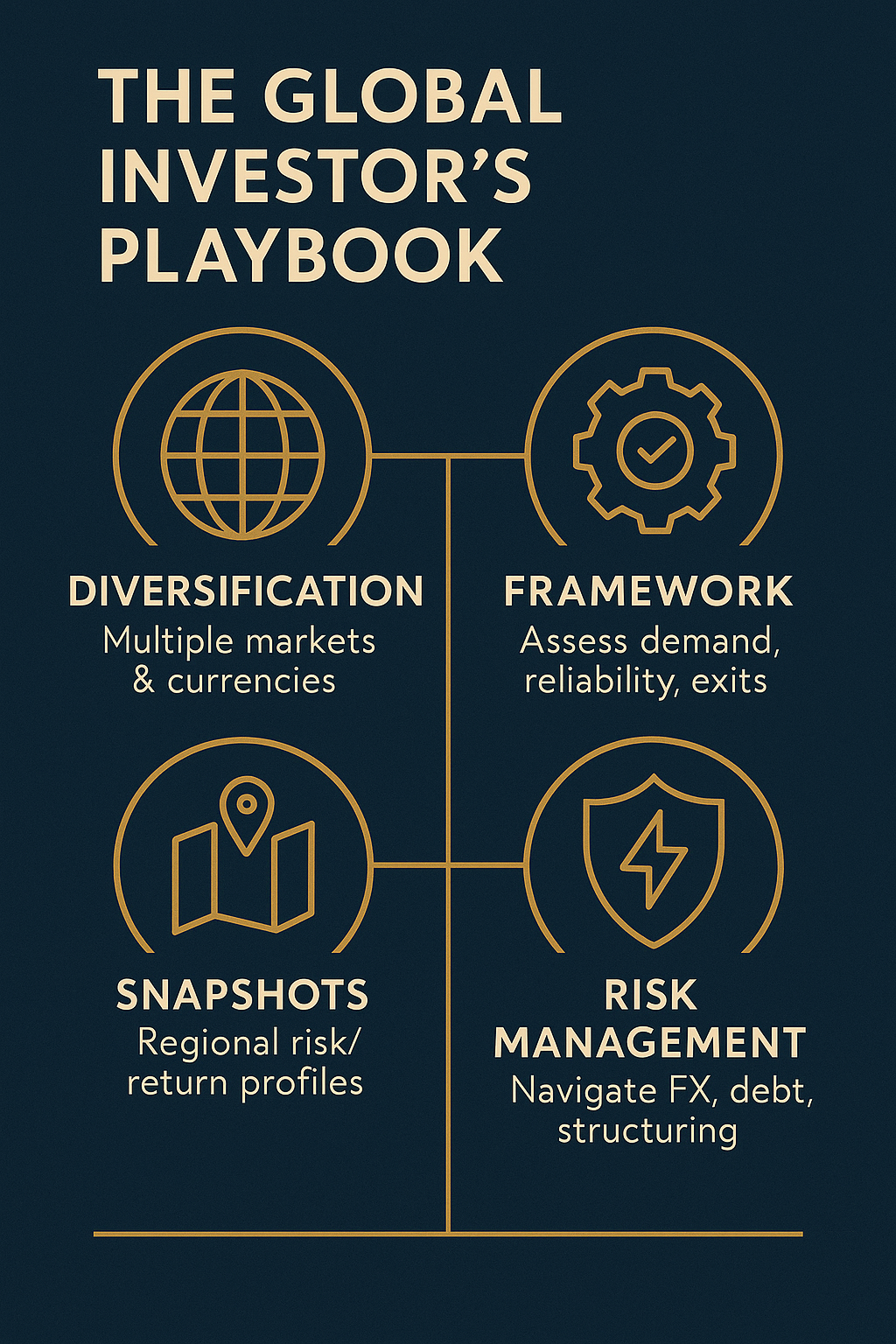
Going global expands your opportunity set from one market cycle to many. That can smooth returns and uncover growth you’d never find at home. But global real estate isn’t a postcard; it’s a playbook. Choose strong sponsors, respect FX and policy risk, budget for ESG capex, and match your vehicle to your tolerance for volatility and illiquidity. Do that, and the global market stops being intimidating—and starts looking like exactly what it is: a bigger, richer grid of possibilities for long-term investors.