

This Content Is Only For Subscribers
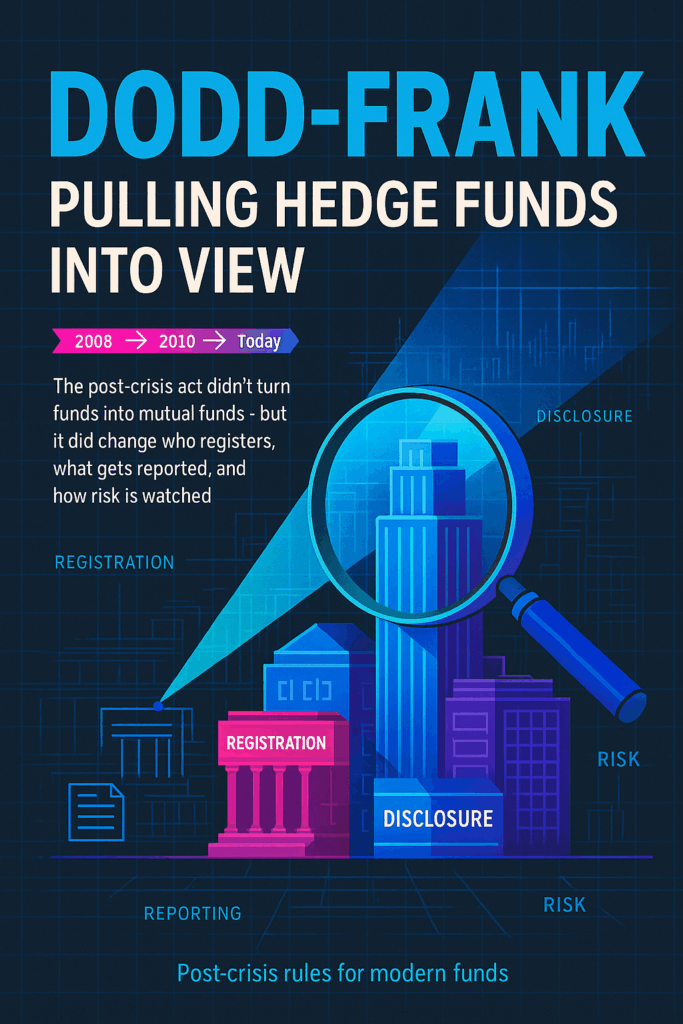
When people talk about “post-crisis rules,” they’re usually talking about the Dodd-Frank Act. Passed after the 2008 financial crisis, Dodd-Frank didn’t turn hedge funds into mutual funds, but it did change who needs to register, what gets reported, and how regulators watch risk. If you’re a newer investor, think of Dodd-Frank as the blueprint that pulled hedge funds further into view—still private, but far less obscure than before.
The big shift: who must register (and with whom)
Before Dodd-Frank, many private fund advisers avoided SEC registration by relying on a now-repealed “private adviser” exemption. The Act flipped that script. Most hedge fund and private equity managers either register with the SEC or fall into narrower carve-outs with lighter reporting.
In practical terms, advisers tend to sort into three buckets:
- SEC-registered investment advisers (RIAs): Generally those with larger regulatory assets under management. Registration brings a full compliance program, a chief compliance officer (CCO), books-and-records obligations, marketing rules, and periodic exams.
- State-registered advisers: Typically smaller or “mid-sized” firms register with one or more states. The themes are similar—policies, supervision, exams—though details vary state by state.
- Exempt Reporting Advisers (ERAs): Some advisers solely to private funds under certain thresholds can file abbreviated reports and avoid full registration. “Exempt” doesn’t mean “hands off”—anti-fraud rules, truthful marketing, and core controls still apply.
For investors, this shift matters because registration forces managers to formalize what used to be informal: conflicts disclosures, valuation methods, expense policies, and how performance is presented.
The regulator’s dashboard: Form ADV and Form PF
Two filings became much more important after Dodd-Frank:
- Form ADV (public): the adviser’s brochure. You can read it to learn about strategies, fees, conflicts, disciplinary history, and the people in charge. It’s not marketing; it’s meant to be straight talk.
- Form PF (non-public): a confidential report for regulators that maps risks across private funds—leverage, liquidity, exposures by asset class, and counterparty concentrations. You won’t see it, but it gives regulators a better early-warning system when markets get stressed.
The net result: investors get clearer baseline disclosure (ADV), and regulators get deeper risk-monitoring data (PF).
Derivatives and swaps: the Title VII effect
Dodd-Frank also built a modern framework for swaps. At a high level, the derivatives world was split so that most swaps fall under one regulator and security-based swaps under another. For hedge funds, this cascades into requirements around central clearing, margin, reporting, and business-conduct rules, depending on the instruments and counterparties involved.
What should you ask a manager? Three simple questions go a long way:
- Which types of derivatives do you trade most?
- How do you handle clearing and margin?
- What systems or vendors support trade reporting and compliance?
You’re not trying to audit them; you’re looking for fluency and a clear, repeatable process.
The Volcker Rule: indirect but influential
Dodd-Frank’s Volcker Rule doesn’t directly regulate hedge funds. Instead, it limits banks from proprietary trading and from owning or sponsoring hedge and private equity funds (with carved-out exceptions). Why should you care? Because it changed the ecosystem. Banks pulled back from seeding and sponsoring funds, and prime brokerage relationships evolved. Over time, that nudged the industry toward more independent capital formation and a more arms-length feel between banks and funds.
Life inside a post-Dodd-Frank hedge fund
Registration didn’t just add paperwork; it changed daily routines.
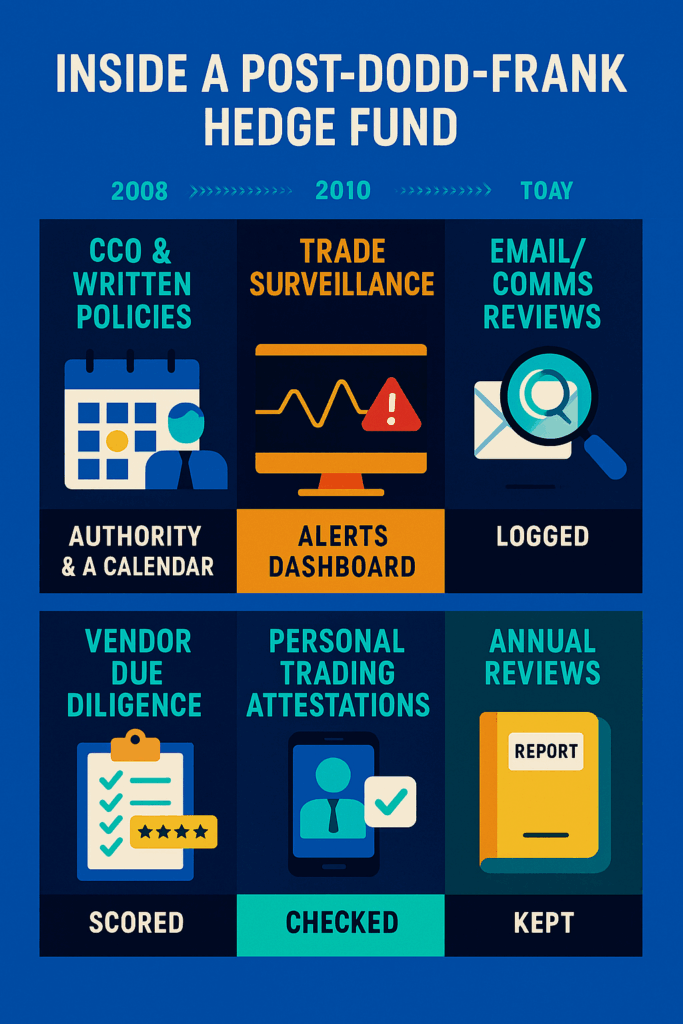
- Written policies and a real CCO. Compliance moved from “someone’s side job” to a function with authority, testing, and a calendar of tasks—trade surveillance, email reviews, vendor due diligence, personal trading attestations, and annual program reviews.
- Valuation governance. If a portfolio includes hard-to-price assets, managers are expected to have methodologies, independent price checks where possible, escalation procedures, and a valuation committee that actually meets and keeps minutes.
- Fees and expenses discipline. Who pays for what—research, data, travel, broken-deal costs—must match the offering documents. Allocations between funds and the manager should be fair, consistent, and documented.
- Marketing with substantiation. If performance or statistics are presented, the manager needs the backup. Hypothetical or model results, if used at all, come with added guardrails and audience limits. Testimonials and third-party ratings are permissible in certain ways, but only with specific disclosures and oversight.
- Custody and audits. Pooled vehicles often fall under “custody” rules, which commonly push funds toward annual audits delivered to investors or surprise exams—controls designed to safeguard assets.
- Books and records. From trade files to performance workpapers, if it happened, it needs to be documented and retrievable. Examiners will test this.
All of this sounds bureaucratic, but the investor benefit is real: tighter processes, clearer disclosures, and evidence trails that can be checked.
What didn’t change (and what to watch)
Dodd-Frank didn’t make hedge funds simple, low-fee, or daily-liquid. Managers can still short, use leverage, and concentrate positions. That flexibility is part of the appeal—but it amplifies the importance of alignment between asset liquidity and investor liquidity. If a fund invests in illiquid situations, quarterly redemptions might be too generous unless there are gates, lockups, or side pockets clearly disclosed up front.
Also, the rulebook evolves. Some later private-fund rule attempts have been narrowed or struck down in court. Rather than memorize the headlines, focus your diligence on durable pillars that are very much alive: registration status, Form ADV contents, custody/audit pathways, marketing rule compliance, and derivatives oversight.
How to use Dodd-Frank as a due-diligence lens
Here’s a quick, practical checklist you can take into a manager meeting:
- Registration & exams: Are you SEC-registered, state-registered, or an ERA? When was your last exam, and what changed afterward?
- Form ADV clarity: What conflicts are disclosed? How are fees and expenses described versus what’s actually charged?
- Valuation controls: For hard-to-value assets, what’s the policy? Who’s on the valuation committee? How often are methodologies reviewed?
- Liquidity match: Do redemption terms align with the underlying assets? What tools (lockups, gates, suspensions) are disclosed and when would you use them?
- Derivatives governance: How do you manage clearing, margin, and reporting for swaps or other derivatives?
- Service providers: Who are your administrator and auditor? How long have you worked with them, and how do you evaluate their performance?
- Marketing substantiation: If you show performance or statistics, can you provide the supporting calculations and assumptions?
Good managers answer these questions plainly and produce documents without drama. That confidence usually reflects a program that works under the hood.
Bottom line
Dodd-Frank’s real impact on hedge funds is about structure and visibility. More advisers are registered and examined. Investors can read standardized disclosures. Regulators receive risk data that didn’t exist in the same form before. Hedge funds remain private, flexible, and varied—but the scaffolding around them is sturdier.
As a novice investor, use that scaffolding. Read Form ADV, ask about audits and valuation, and test for operational fluency around derivatives and reporting. You’re not trying to be your own regulator—you’re trying to confirm the manager treats process as part of the edge. In a world where markets surprise and strategies evolve, that mindset is one of the most durable protections you have.