

This Content Is Only For Subscribers
Interest rates may sound like the domain of economists and central bankers, but for real estate investors, they’re as important as location. Whether you’re buying a rental property, investing in a REIT (real estate investment trust), or allocating capital to a private real estate fund, interest rates influence the value of assets, the cost of financing, and ultimately, the returns you can expect.
Over the past few years, we’ve seen dramatic swings in rates—from the rock-bottom lows of the 2010s and pandemic era to the rapid hikes of 2022–2023 aimed at fighting inflation. These shifts have reshaped property markets and investment strategies across the globe. To understand how real estate funds operate—and where they may be headed—you need to grasp the role interest rates play.
The Basics: Why Rates Matter
Real estate is a capital-intensive business. Very few properties are purchased outright in cash. Instead, debt financing—mortgages and commercial loans—is the backbone of the industry.
- Higher interest rates → Borrowing costs rise, reducing cash flow and returns.
- Lower interest rates → Borrowing costs fall, encouraging more investment and development.
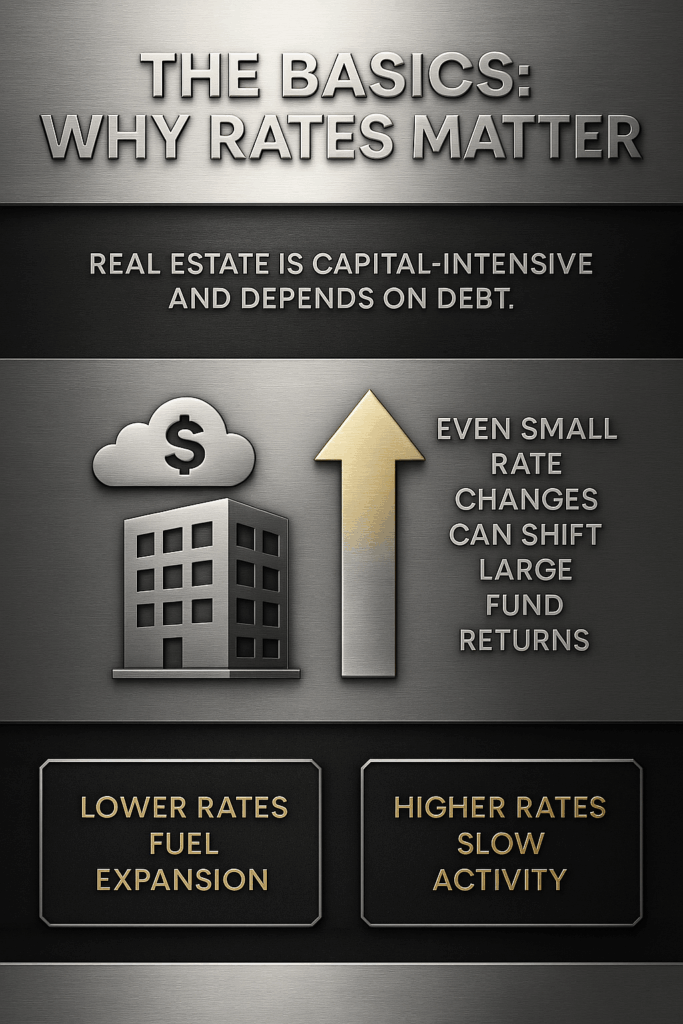
For funds that manage large portfolios, even small changes in rates can significantly shift performance.
Interest Rates and Property Values
Property values are often tied to what’s called the capitalization rate (cap rate)—a ratio that reflects expected income relative to property value.
- When interest rates rise, investors demand higher cap rates to compensate for risk.
- Higher cap rates mean lower property values, all else equal.
- When rates fall, cap rates compress, and values tend to rise.
This relationship isn’t always perfect—supply, demand, and market sentiment matter too—but the link is strong enough that rate changes ripple quickly through valuations.
Impact on Real Estate Funds
1. REITs (Real Estate Investment Trusts)
Publicly traded REITs are especially sensitive to interest rates.
- Dividend yields vs. bonds: When rates rise, bonds and savings accounts look more attractive relative to REIT dividends, which can depress REIT stock prices.
- Cost of capital: REITs that rely on debt face higher borrowing costs, squeezing margins.
- Performance history: REITs often underperform in rapid tightening cycles, but historically, they’ve rebounded strongly once rates stabilize.
2. Private Real Estate Funds
Private equity real estate funds typically hold assets for 5–10 years. Interest rates influence:
- Acquisition pricing: Rising rates can lead to “repricing” events where deals are paused or renegotiated.
- Exit strategies: Funds rely on selling or refinancing assets; higher rates can delay these timelines.
- Debt structures: Funds using variable-rate loans may see debt service costs jump unless they’ve hedged with interest-rate swaps or caps.
3. Development-Oriented Funds
For funds that finance new construction:
- Higher rates = higher financing costs → Some projects become uneconomical.
- Lower supply: Ironically, this can reduce new inventory, helping stabilize or lift rents for existing assets.
Inflation and Real Estate
Interest rates often rise in response to inflation. Real estate has historically acted as an inflation hedge:
- Leases (especially in multifamily and industrial sectors) can reset annually, allowing landlords to raise rents with inflation.
- Hard assets like real estate tend to retain intrinsic value even when currency weakens.
For funds, this means that while higher rates can pressure financing and valuations, income growth from inflation can offset some of the pain.
Global Considerations
Interest rate dynamics vary by region:
- U.S.: Fed policy dominates; the 2022–2023 hikes cooled housing and commercial transactions sharply.
- Europe: The European Central Bank’s rate decisions affect cross-border capital flows, with logistics and multifamily often proving resilient.
- Emerging Markets: Higher U.S. rates can draw capital away from riskier markets, slowing development funding abroad.
Global real estate funds must navigate not just one country’s rates but the interplay of multiple central banks.
Case Studies: Rates in Action
- 2020–2021 (Near-Zero Rates): Cheap debt fueled a boom in housing, industrial, and logistics real estate. Funds expanded aggressively.
- 2022–2023 (Rapid Hikes): Interest rates surged to levels not seen in decades. Transaction volumes dropped, office values fell sharply, and funds became more selective.
- 2024 and beyond: With inflation cooling, central banks slowed hikes, but uncertainty about “higher-for-longer” rates remains, keeping investors cautious.
How Funds Manage Rate Risk
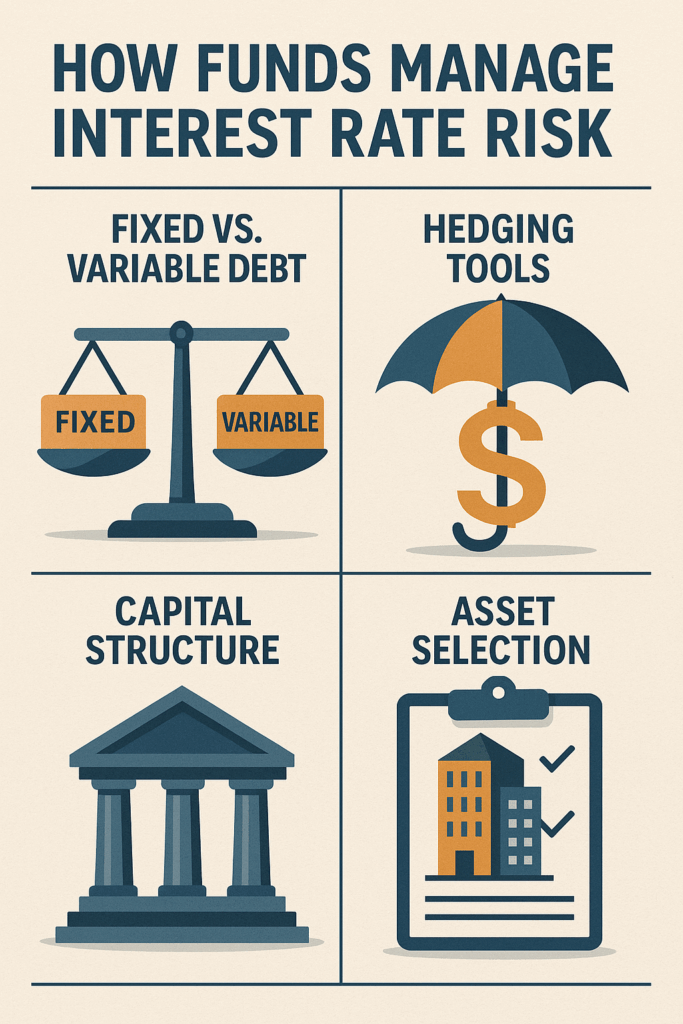
Real estate fund managers don’t just sit back and accept rate swings—they actively manage exposure:
- Fixed vs. Variable Debt: Locking in long-term fixed debt protects against rising rates.
- Hedging Tools: Interest-rate swaps, caps, and collars reduce volatility in financing costs.
- Capital Structure: Conservative leverage (lower debt ratios) makes portfolios more resilient.
- Asset Selection: Sectors with shorter leases (multifamily, self-storage) adjust rents more quickly to offset inflation-driven rate hikes.
What This Means for Novice Investors
If you’re considering real estate funds, here are key lessons:
- Watch the Fed (and central banks): Monetary policy decisions will shape fund performance.
- Understand leverage: Funds with high debt are more vulnerable to rising rates.
- Look at sector focus: Multifamily and industrial often weather hikes better than long-lease office or retail.
- Think long-term: Rate cycles come and go; real estate has historically recovered strongly after periods of adjustment.
The Future Outlook
Looking forward:
- Volatility may persist. With inflation pressures and geopolitical uncertainty, rates could remain elevated longer than expected.
- Winners and losers will diverge. Funds focused on resilient sectors and prudent leverage will outperform those chasing aggressive growth.
- Innovation will help. More funds are using PropTech to manage costs and ESG to attract capital—both can offset some rate pressures.
Final Thoughts
Interest rates are like gravity in real estate investing—they affect everything, from valuations to borrowing costs to investor appetite. For real estate funds, navigating rate cycles is both a challenge and an opportunity.
For novice investors, the lesson is to stay rate-aware. Understanding how central bank decisions ripple into fund performance helps you make smarter choices—whether that’s buying a REIT, investing in a private fund, or simply evaluating your exposure to property markets.
Interest rates will always rise and fall. What matters is how investors and fund managers adapt. Those who understand the dynamics won’t just survive—they’ll thrive.