

This Content Is Only For Subscribers
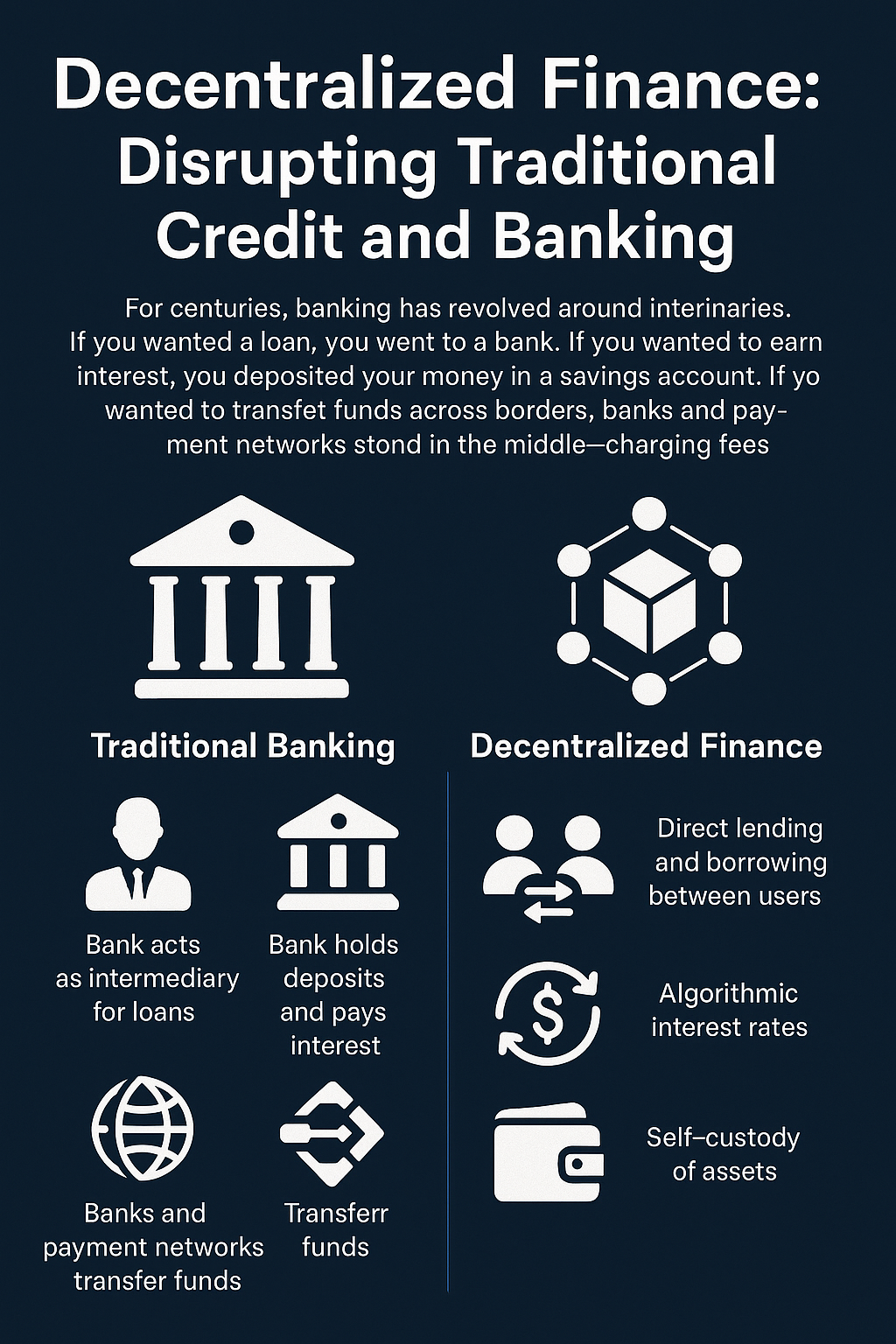
For centuries, banking has revolved around intermediaries. If you wanted a loan, you went to a bank. If you wanted to earn interest, you deposited your money in a savings account. If you wanted to transfer funds across borders, banks and payment networks stood in the middle—charging fees and setting the rules.
Then came blockchain. Out of it has grown a parallel ecosystem called Decentralized Finance (DeFi)—a set of protocols and platforms that aim to recreate, and in many ways reimagine, traditional banking functions without intermediaries.
DeFi promises direct lending and borrowing between users, algorithmic interest rates, borderless stablecoins, and self-custody of assets. To some, it looks like the future of finance: transparent, programmable, and inclusive. To others, it’s risky and untested. For novice investors, understanding DeFi is essential—not because everyone should dive in headfirst, but because it illustrates how digital assets are pushing the boundaries of what “banking” can mean.
What Is DeFi?
Decentralized Finance refers to financial applications built on public blockchains, primarily Ethereum, though newer networks like Solana, Avalanche, and Polygon also play key roles. These applications replace centralized intermediaries with smart contracts—self-executing code that lives on the blockchain.
- Instead of a bank holding your deposit, a smart contract does.
- Instead of a loan officer approving your application, an algorithm automatically matches lenders and borrowers.
- Instead of SWIFT or Visa moving money, transactions settle directly on-chain.
The idea is to build an open financial system where anyone with an internet connection can participate.
The Evolution of DeFi
Though the term “DeFi” only entered the mainstream around 2018, its roots go back further.
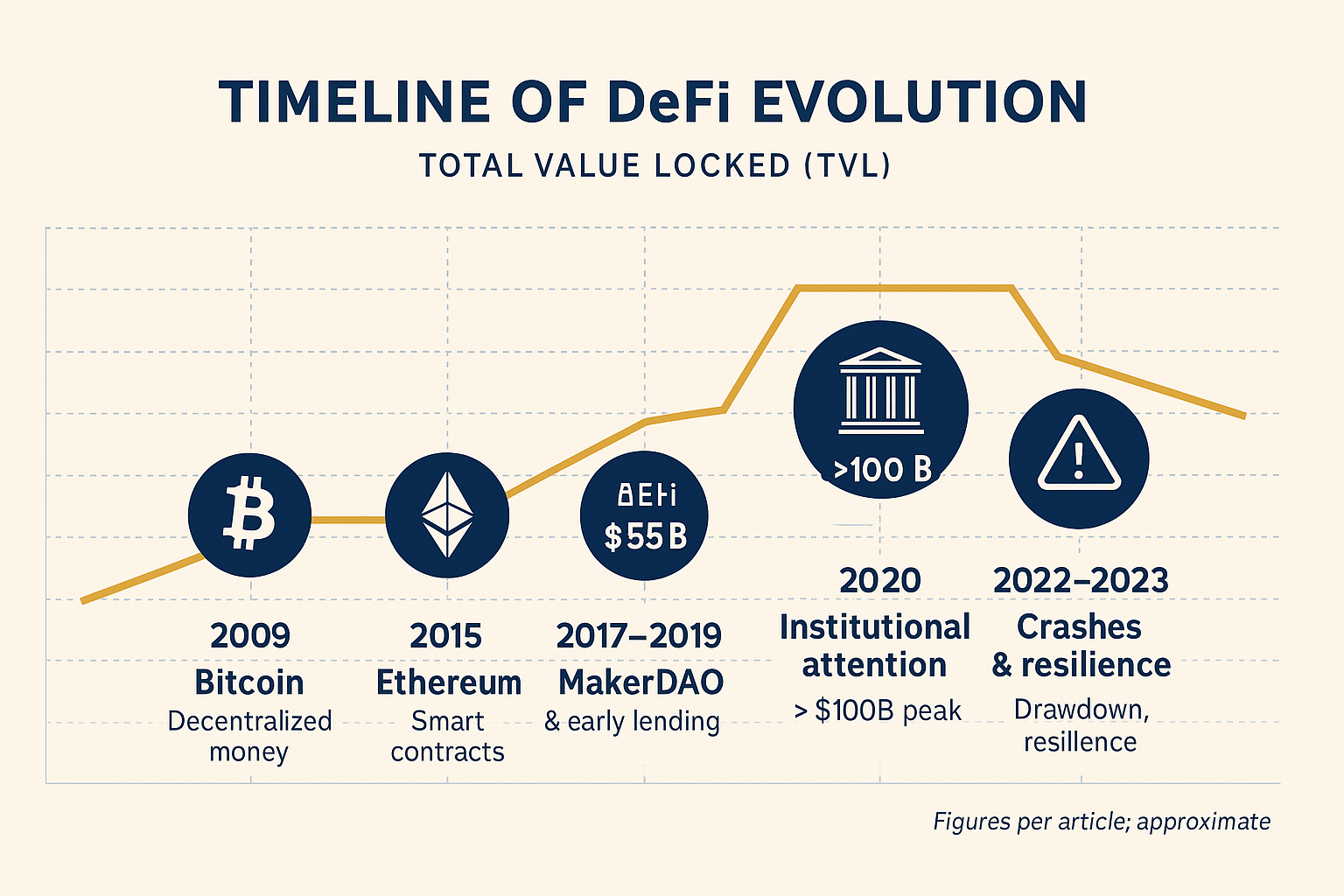
- Bitcoin as the spark (2009): Bitcoin was designed as a decentralized payment system, but it didn’t offer lending or credit functions. Still, it showed that money could exist without banks.
- Ethereum and smart contracts (2015): Ethereum’s programmable blockchain enabled complex financial applications—laying the foundation for DeFi.
- Early experiments (2017–2019): Protocols like MakerDAO launched, proving that decentralized lending and stablecoins were possible.
- “DeFi Summer” (2020): A boom in yield farming and liquidity mining drove total value locked (TVL) in DeFi from under $1B in early 2020 to over $15B by year’s end. Uniswap, Aave, and Compound became household names in crypto circles.
- Mainstream attention (2021): As crypto prices surged, DeFi TVL surpassed $100B. Institutions began to explore DeFi yields.
- Correction and resilience (2022–2023): The collapse of Terra/Luna and centralized firms like Celsius and FTX shook confidence, but core DeFi protocols largely continued functioning as designed.
This trajectory shows that while DeFi is volatile, it has survived multiple market cycles and continues to evolve.
The Traditional Credit Model vs. DeFi
In traditional banking:
- Depositors place funds in banks.
- Banks lend those funds to borrowers.
- Banks earn the spread (difference between what they pay depositors and what they charge borrowers).
In DeFi:
- Users deposit assets into a protocol’s liquidity pool.
- Borrowers draw from that pool, posting collateral (usually crypto) to secure the loan.
- Interest rates adjust algorithmically based on supply and demand.
- Lenders earn returns directly, without a bank in the middle.
This shift removes intermediaries and theoretically passes more value back to users.
Key Components of DeFi
1. Lending and Borrowing Protocols
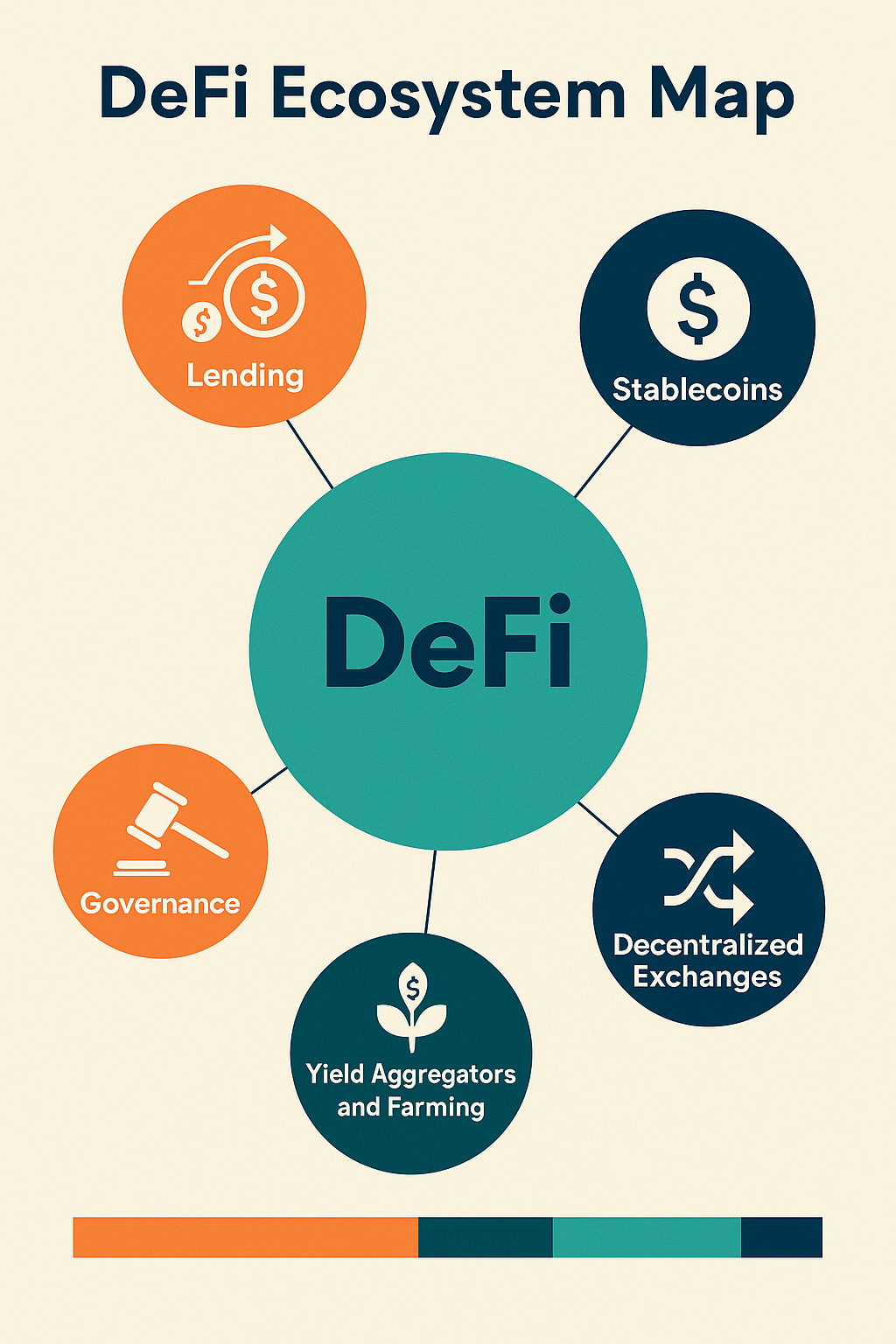
Platforms like Aave, Compound, and MakerDAO let users lend digital assets and earn interest, or borrow against collateral.
- Collateralization is essential. Because there are no credit scores in DeFi, borrowers must post more collateral than they borrow (e.g., $150 of ETH to borrow $100 of stablecoins).
- If the collateral falls below required thresholds, the loan is automatically liquidated.
2. Stablecoins
Stablecoins—tokens pegged to traditional currencies like the U.S. dollar—are the lifeblood of DeFi. They provide stability in a volatile crypto market and act like digital cash. USDT (Tether), USDC (Circle), and DAI (MakerDAO’s decentralized stablecoin) dominate.
3. Decentralized Exchanges (DEXs)
Protocols like Uniswap and Curve allow peer-to-peer asset swaps without centralized exchanges. Liquidity providers supply trading pools and earn fees.
4. Yield Aggregators and Farming
Advanced DeFi strategies involve “stacking” protocols—depositing into one to earn tokens, then reinvesting those rewards elsewhere. This is often called yield farming.
5. Governance Tokens
Many DeFi platforms issue tokens (e.g., COMP, AAVE) that give holders voting rights in protocol governance. In theory, users collectively control the platform’s evolution.
Case Studies: Successes and Failures
MakerDAO and DAI: The Cornerstone of DeFi
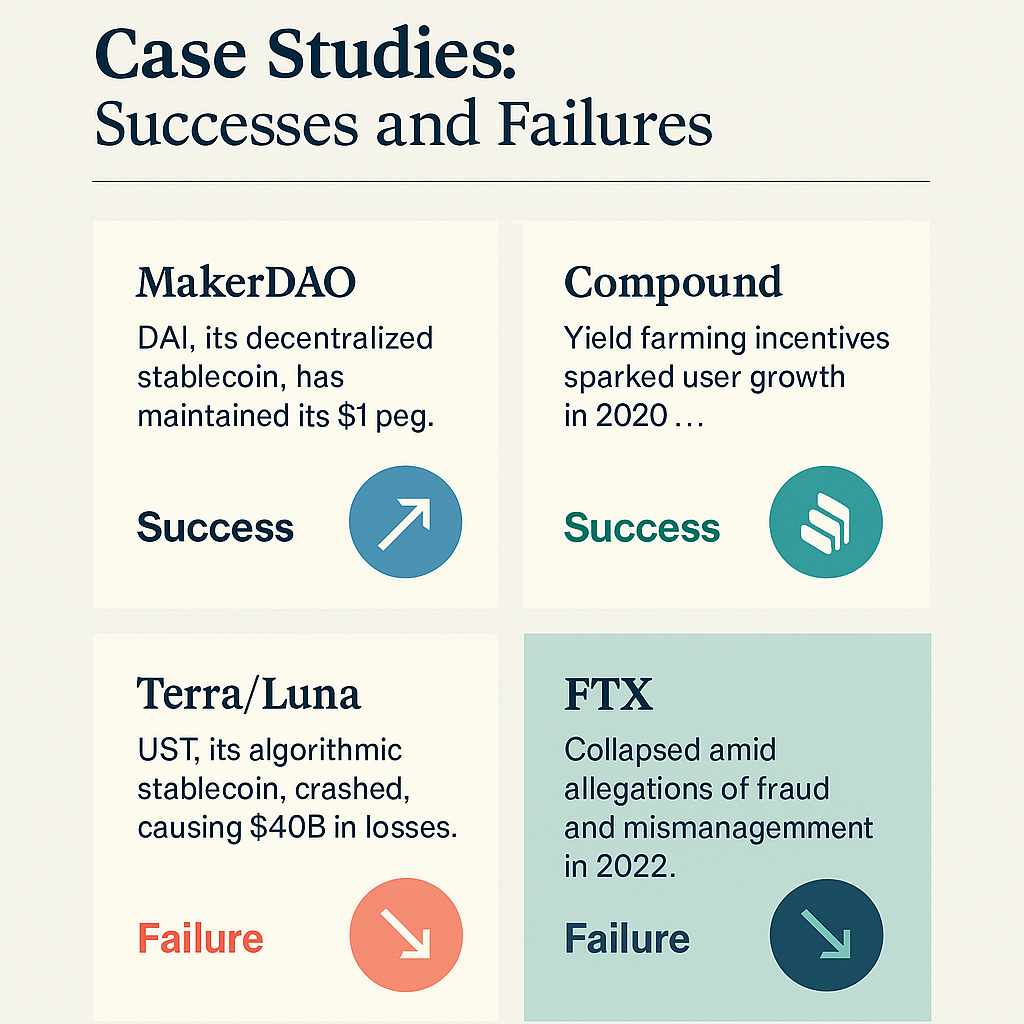
MakerDAO’s system of collateralized debt positions (CDPs) created DAI, a decentralized stablecoin. DAI’s stability relies on overcollateralization, not trust in a company. Despite market shocks, DAI has remained close to its $1 peg for years—illustrating that decentralized credit can work at scale.
Compound and the Yield Farming Boom
In 2020, Compound launched COMP, a governance token distributed to users who provided or borrowed assets. This incentive created the first wave of “yield farming,” where users chased high returns by moving funds across protocols. It demonstrated both the power of incentives and the dangers of unsustainable yield-chasing.
Terra/Luna: A DeFi Collapse
Not all experiments succeed. Terra’s algorithmic stablecoin, UST, was supposed to hold its $1 peg through an arbitrage system with its sister token, Luna. In May 2022, the peg failed, wiping out $40B in value. The event rattled confidence and reminded investors that not all “decentralized” systems are robust.
CeFi vs. DeFi: Lessons from Celsius and FTX
While not technically DeFi, the failures of Celsius (a crypto lender) and FTX (a centralized exchange) in 2022 highlighted DeFi’s contrast. These companies collapsed due to mismanagement and opaque practices. Meanwhile, core DeFi protocols like Aave and Uniswap kept running transparently, with liquidations and trades executed exactly as coded.
How DeFi Challenges Banks
DeFi directly competes with traditional banks on several fronts:
Interest Rates
- Traditional savings accounts often pay below 1%.
- DeFi lending protocols have historically offered higher yields (though volatile).
Access
- Banks require identification, credit checks, and minimum balances.
- DeFi requires only a crypto wallet and internet access.
Speed
- Bank loans and transfers can take days.
- DeFi transactions settle in minutes or seconds.
Transparency
- Bank balance sheets are opaque.
- DeFi contracts are open-source and auditable.
Of course, DeFi also introduces risks banks are designed to manage—such as fraud protection, customer service, and deposit insurance.
DeFi and Shadow Banking: A Useful Comparison
Traditional economists often compare DeFi to shadow banking—non-bank entities that provide credit outside regulated systems (think money market funds or mortgage securitization). Like shadow banks, DeFi expands credit creation without traditional oversight. Both can be innovative but also pose systemic risks.
Where DeFi differs:
- It is programmable and transparent, with open-source code visible to anyone.
- It is global by default, unlike most shadow banking, which is jurisdiction-bound.
- Its risks (like “cascading liquidations”) resemble margin calls in traditional finance, but they play out faster and automatically.
For novice investors, this comparison shows that “new” DeFi echoes older experiments in finance—reminding us that innovation always comes with risk.
The Social Finance Angle: Promise and Obstacles
DeFi advocates argue it could bank the unbanked. But can it really?
The Promise
- Accessibility: Anyone with a smartphone and internet can open a wallet.
- Borderless finance: Migrant workers can send remittances cheaply with stablecoins.
- Microloans: Collateralized stablecoin loans could help small entrepreneurs access capital without local banks.
The Obstacles
- On-ramps: People still need local currency to buy crypto in the first place.
- Volatility: Using crypto as collateral can be dangerous in unstable economies.
- Tech literacy: DeFi interfaces are intimidating for non-technical users.
- Regulation: In some countries, accessing DeFi may be restricted or even illegal.
So while DeFi has real inclusion potential, it must overcome practical barriers before it can rival microfinance institutions or mobile banking solutions like M-Pesa in Africa.
Risks and Limitations
Despite its promise, DeFi is not without major risks.
- Volatility and Over-Collateralization– Because collateral is in volatile assets like ETH or BTC, sudden price drops can trigger mass liquidations.
- Smart Contract Bugs– Code errors or exploits can drain funds instantly. Billions have been lost to hacks.
- Regulatory Uncertainty– Governments are still figuring out how to classify DeFi. New rules could reshape the landscape overnight.
- Complexity– DeFi is not user-friendly for beginners. Mistakes (like sending tokens to the wrong address) are irreversible.
- No Safety Net– Unlike bank deposits, DeFi funds are not insured. Losses are borne directly by users.
Beyond the Basics: Additional Risks
- Composability Risks: Because DeFi apps stack like “money Legos,” a failure in one protocol can cascade.
- Oracle Risk: Manipulation of price feeds can destabilize lending platforms.
- Governance Risk: Wealthy token holders often dominate supposedly decentralized decision-making.
- Liquidity Crunches: Bank-run dynamics can unfold in minutes when liquidity evaporates.
Integrating DeFi with the Real World
One of the biggest frontiers for DeFi is real-world assets (RWAs):
- Tokenized Treasuries: In 2023–24, protocols began offering tokenized U.S. Treasuries, letting investors earn yield on-chain.
- Real estate: Experiments exist in tokenizing property ownership, though legal frameworks are complex.
- Carbon credits: DeFi could improve transparency in environmental markets.
These bridges could make DeFi more relevant beyond crypto-native assets, tying it closer to global credit markets.
Where Traditional Finance Adapts
Banks and fintechs are paying attention.
- Custody services: Major institutions like JPMorgan and Fidelity now offer crypto custody.
- On-chain experiments: Some banks are piloting blockchain-based settlement systems.
- Bridging worlds: Stablecoins and tokenized assets are creating links between fiat and crypto ecosystems.
Rather than being wholly replaced, traditional finance may integrate DeFi’s innovations into hybrid models.
The Future of DeFi in Credit and Banking
DeFi is still young, but several trends will shape its trajectory:
- Regulation: Clearer rules may make DeFi safer but could also dampen permissionless innovation.
- Scalability: As networks like Ethereum scale (via rollups, sharding), DeFi can become cheaper and faster.
- Integration with Real-World Assets: Tokenized U.S. Treasuries, real estate, and carbon credits could expand DeFi beyond crypto-native assets.
- Central Bank Digital Currencies (CBDCs): Governments may issue their own digital money, which could either compete with or complement DeFi stablecoins.
- User Experience: Simpler interfaces and better risk management tools could make DeFi accessible to mainstream users.
The Future: Scenarios Ahead
Scenario 1: Institutional Integration
Large banks and asset managers could plug into DeFi for settlement and liquidity, treating protocols as infrastructure—similar to how they use exchanges today.
Scenario 2: Parallel Ecosystem
DeFi could remain a separate, crypto-native financial system—serving enthusiasts, developers, and global users excluded from banks.
Scenario 3: Convergence with CBDCs
If governments issue Central Bank Digital Currencies (CBDCs), these could coexist with or compete against DeFi stablecoins. Imagine borrowing DAI with collateral but repaying in a digital dollar backed by the U.S. Federal Reserve.
Scenario 4: Hybrid Models
Most likely, we’ll see hybrids: regulated entities offering DeFi-powered services behind user-friendly interfaces. Users may not even realize they’re interacting with DeFi contracts.
Lessons for Traditional Finance
Traditional banks are learning from DeFi too:
- Programmable money: Smart contracts show how conditional payments can automate business logic.
- 24/7 settlement: DeFi’s nonstop markets contrast with banking’s limited hours.
- Transparent ledgers: On-chain data demonstrates what radical transparency looks like.
Even if DeFi never replaces banks, its ideas are influencing them.
Expanded Lessons for Novice Investors
- History repeats. Just as shadow banking and dot-com startups reshaped finance, DeFi is part of a long lineage of disruptive but risky innovations.
- Concentration risk is real. Many DeFi users chased unsustainable yields in 2020–21 and paid the price in 2022’s crashes.
- Transparency is powerful. Unlike opaque hedge funds or banks, DeFi lets anyone audit contracts and flows. That doesn’t eliminate risk—but it changes how risk is visible.
- Think globally. DeFi is borderless. For novice investors, this highlights both opportunity (global access) and challenge (regulatory gray zones).
- Stay humble. Even experts underestimated risks in Terra/Luna. The lesson: size positions carefully.
- Adopt the mindset. You don’t have to invest in DeFi to learn from it. Thinking about credit, risk, and transparency differently can improve your broader investing habits.
Closing Thoughts
DeFi is neither a utopia nor a gimmick. It’s a fast-moving experiment in rebuilding credit and banking without intermediaries. It offers speed, transparency, and inclusivity, but it also carries volatility, fragility, and complexity.
For novice investors, the value of DeFi lies not just in potential returns, but in the perspective shift: finance can be open, programmable, and global. Whether DeFi integrates with banks, competes with them, or evolves into something entirely different, one thing is certain—traditional credit and banking will never look the same again.