

This Content Is Only For Subscribers
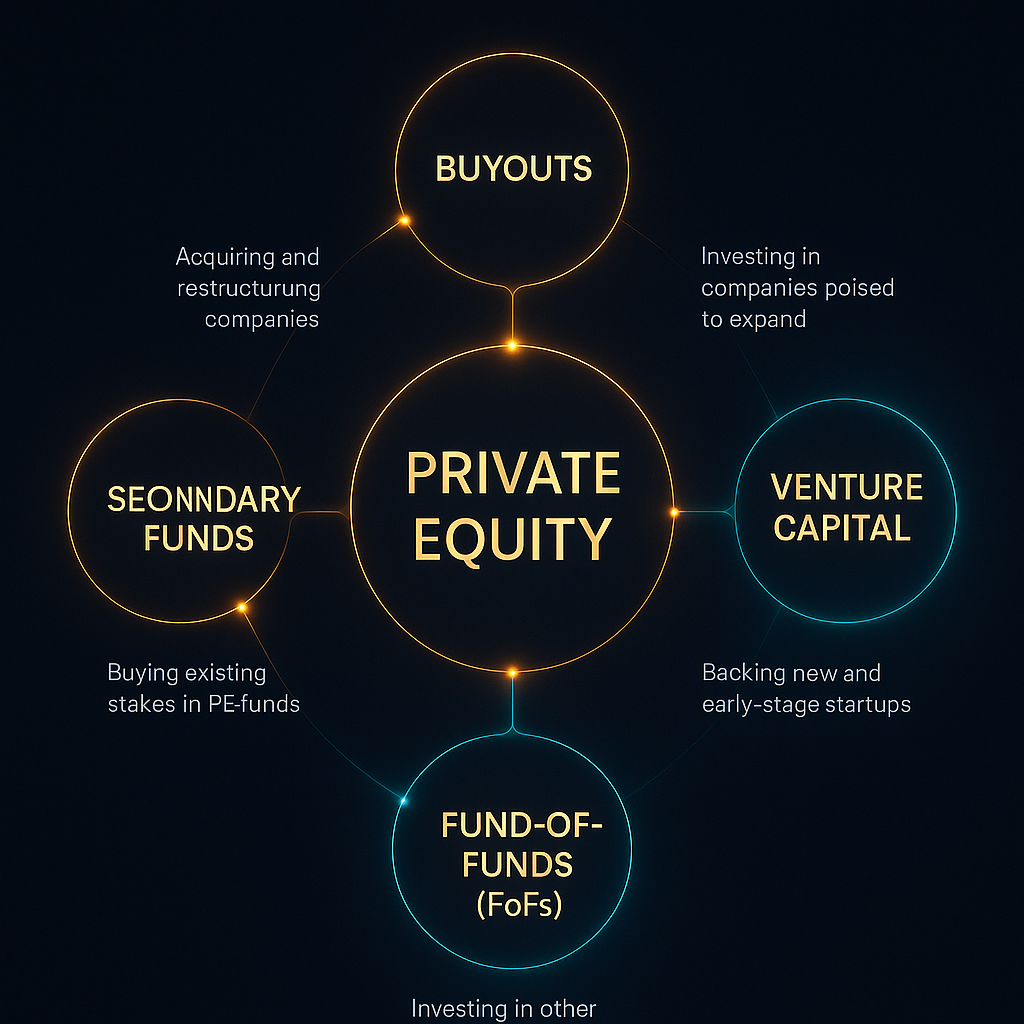
When most people think of private equity, they picture buyouts, growth capital, or distressed turnarounds. But there are also strategies that focus less on acquiring companies directly and more on investing in the funds themselves. These are secondary funds and fund-of-funds (FoFs).
While they don’t grab as many headlines as billion-dollar acquisitions, these strategies play an important role in the private equity ecosystem. They offer investors more flexibility, liquidity, and diversification—qualities often missing in traditional PE. For novice investors, understanding how they work provides a fuller picture of the private equity landscape.
What Are Secondary Funds?
Private equity investments typically lock up money for 7–10 years. But sometimes, an investor—say, a pension fund or wealthy family—wants to exit early. That’s where the secondary market comes in.
Secondary funds buy stakes in existing private equity funds from investors who want liquidity. For example:
- A university endowment commits $100 million to a buyout fund in 2016.
- By 2021, it needs cash for campus projects but can’t wait until the fund winds down.
- A secondary fund purchases its stake, usually at a discount, and assumes the rights to future profits from that fund’s portfolio companies.
This creates a “win-win.” The seller gains liquidity, and the secondary buyer gets access to a portfolio of more mature investments.
Advantages of Secondary Investing
- Reduced Blind Pool Risk
When investors commit to a brand-new PE fund, they don’t know what companies it will buy. In secondary deals, many portfolio companies are already known, making performance easier to evaluate. - Discounted Entry
Because sellers often want quick liquidity, buyers can acquire fund stakes at a discount, boosting potential returns. - Faster Returns
Since many of the companies in the fund are already mid-journey, secondary investors may see distributions (cash returns) sooner than if they invested at the beginning.
Risks of Secondary Investing
Secondary deals aren’t risk-free. Valuations can be tricky—if the underlying companies underperform, the “discount” may not be enough to protect returns. Competition among buyers has also increased, making bargains harder to find.
There’s also the challenge of information. While secondary buyers have more data than early investors, they don’t always have full transparency into how portfolio companies will perform in the future.
What Are Fund-of-Funds?
A fund-of-funds (FoF) takes a different approach. Instead of investing directly in companies, it invests in a portfolio of private equity funds. Think of it as a “meta-fund.”
For example, a FoF might spread capital across 10 different funds: some in buyouts, some in growth equity, and others in secondaries or venture capital.
Advantages of Fund-of-Funds
- Diversification
Private equity is inherently concentrated—one fund may hold only 10–20 companies. A FoF provides broader exposure across multiple managers, strategies, and geographies. - Access to Top Managers
The best PE funds are often closed to new investors or have high minimum commitments. A FoF can gain entry and give smaller institutions or wealthy families indirect access. - Professional Selection
Fund-of-funds managers evaluate hundreds of PE funds and select those they believe have the best chance of success, saving investors the burden of due diligence.
Risks and Drawbacks of Fund-of-Funds
The biggest drawback is cost. Investors in a FoF pay two layers of fees—first to the FoF manager, and then to the underlying funds. This fee-on-fee structure can eat into returns.
Performance can also vary widely depending on the FoF’s selection skill. If the managers choose poorly, diversification alone won’t save returns.
Real-World Examples
- Ardian is one of the world’s largest secondary and fund-of-funds managers, overseeing hundreds of billions in assets.
- HarbourVest Partners has long specialized in secondaries and FoFs, offering institutions and high-net-worth investors exposure to global PE markets.
- Pantheon is another major player, focusing on diversified PE investments through FoFs and secondary deals.
These firms demonstrate how secondaries and FoFs have grown into mainstream strategies within private equity, not just niche sidelines.
Lessons for Novice Investors
Even if you never invest directly in a secondary fund or FoF, the concepts are worth understanding:
- Liquidity Matters: The secondary market shows that even illiquid investments can create opportunities for flexibility.
- Diversification Reduces Risk: Just as FoFs diversify across managers and sectors, individual investors can reduce risk by diversifying across asset classes in their own portfolios.
- Costs Count: High fees can eat into performance, whether in PE or in mutual funds, ETFs, or personal investments.
The Bigger Picture
Secondary funds and fund-of-funds reflect the growing sophistication of private equity. As the asset class has matured, investors have demanded more flexibility and broader access. These strategies provide both.
For sellers, secondaries offer liquidity. For buyers, they provide discounted access to seasoned portfolios. And for smaller investors or institutions, FoFs open the door to private equity strategies that might otherwise be out of reach.

Final Thoughts
Private equity isn’t just about taking over companies—it’s also about building smarter ways for investors to access the asset class. Secondary funds and fund-of-funds may not be as glamorous as headline-making buyouts, but they’re vital tools in the PE toolkit.
For new investors, the takeaway is simple: in any market, there are multiple paths to participate. Some are direct and high-risk, while others are diversified and indirect. Understanding strategies like secondaries and FoFs helps demystify private equity and shows that, even in this exclusive world, flexibility and creativity matter just as much as capital.