

This Content Is Only For Subscribers
Real estate investing isn’t just about buying a home or renting out an apartment building. For institutional and high-net-worth investors, real estate is often accessed through real estate funds—pooled investment vehicles that acquire, manage, and sometimes develop properties.
Understanding the different types of real estate funds is essential for investors seeking to align their risk tolerance, return expectations, and investment horizon with a fund’s strategy. In this article, we’ll explore the three primary categories of real estate funds—Core, Value-Add, and Opportunistic—as well as key considerations, fund structures, risk management strategies, historical performance, geographic diversification, regulatory and tax context, and the role these funds play in diversified portfolios.
We will also examine market cycles, global opportunities, and real-world case studies to help novice investors understand how each strategy performs in different environments.
What Are Real Estate Funds?
A real estate fund is an investment vehicle that pools capital from multiple investors to acquire, manage, and sometimes develop properties. Funds can hold commercial, residential, industrial, or mixed-use real estate, often with professional management teams handling acquisitions, leasing, operations, and development when necessary.
Investors benefit from:
- Diversification: Exposure to multiple properties reduces the impact of a single underperforming asset.
- Professional Management: Experienced fund managers make acquisition and operational decisions.
- Access: Investors can participate in large-scale real estate deals that would be difficult to execute individually.
- Economies of Scale: Funds can negotiate better financing, bulk purchasing, and vendor agreements than individual investors.
- Tax Efficiency: Depending on structure, some funds offer favorable tax treatment through REITs or partnership vehicles.
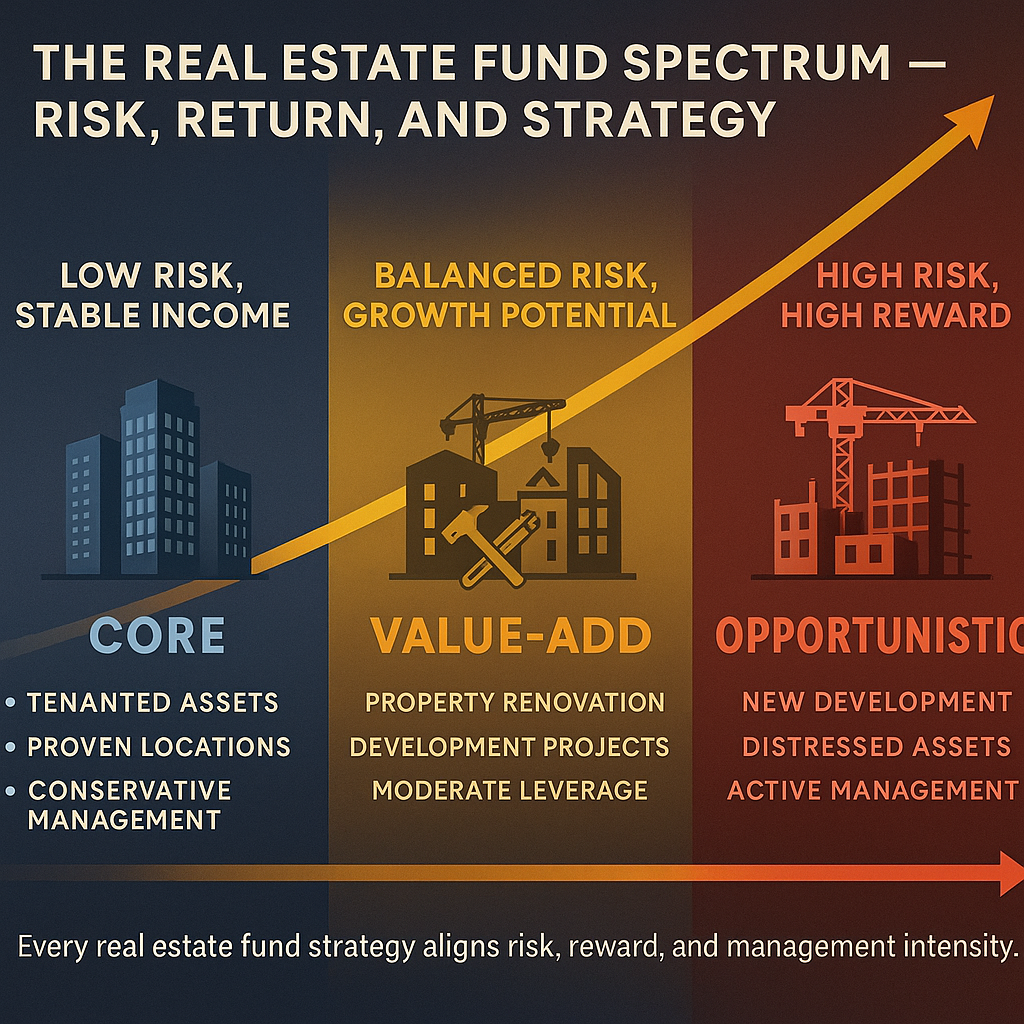
Real estate funds differ in terms of risk, expected returns, and liquidity, largely depending on their strategy. The three primary strategies are Core, Value-Add, and Opportunistic, each offering unique benefits and trade-offs.
Core Real Estate Funds
Core funds are considered the most conservative type of real estate fund. They focus on high-quality, fully leased properties in prime locations, often referred to as “Class A” assets.
Key Characteristics
- Low Risk: Core properties typically have stable cash flows, established tenants, and long-term leases.
- Moderate Returns: Investors can expect 5–8% annual returns, primarily from rental income rather than capital appreciation.
- Minimal Leverage: Core funds typically use limited debt, reducing financial risk.
Typical Assets
- Office buildings in central business districts
- High-end apartment complexes in major metropolitan areas
- Retail properties with long-term anchor tenants
- Industrial warehouses near key logistics hubs
Investor Suitability
Core funds are suitable for risk-averse investors seeking predictable income and long-term stability. These funds are often considered the “core” of a broader real estate portfolio.
Example: A fund acquires a fully leased, Class A office tower in downtown Chicago with a long-term lease to a Fortune 500 company. The fund focuses on maintaining the property and collecting rental income rather than pursuing redevelopment or aggressive rent increases.
Advantages
- Predictable Cash Flow: Long-term leases and high-quality tenants ensure steady rental income.
- Lower Volatility: Core properties tend to hold value even in economic downturns.
- Institutional Access: Many core funds are structured for institutional investors, providing exposure to large, professionally managed assets.
Historical Performance
Over the past two decades, core real estate funds have consistently delivered stable returns, with lower volatility compared to equities. During economic downturns, such as the 2008 financial crisis or the 2020 pandemic slowdown, core properties experienced fewer vacancies and retained more value than opportunistic or value-add properties.
Example: During the 2008 recession, Class A office buildings in Manhattan saw rental rates decline modestly, but fully leased properties retained most of their value, preserving investor capital.
Market Cycles and Core Funds
Core funds tend to perform well across most market cycles due to their conservative nature. In a rising interest rate environment, long-term leases in prime locations help stabilize cash flow. Even in economic slowdowns, tenants in Class A properties are more likely to continue honoring lease commitments, making core funds a defensive component in diversified portfolios.
Value-Add Real Estate Funds
Value-add funds occupy the middle of the risk-return spectrum. These funds acquire properties that require improvements, repositioning, or management upgrades to increase cash flow and property value.
Key Characteristics
- Moderate Risk: Properties may have occupancy or operational challenges or may be older assets in need of upgrades.
- Higher Returns: Investors typically target 8–12% annual returns, combining rental income and capital appreciation.
- Active Management: Fund managers implement renovations, improve leasing, and optimize operations.
- Moderate Leverage: Debt amplifies potential returns but adds some risk.
Typical Assets
- Underperforming apartment complexes
- Retail centers needing modernization
- Office buildings with outdated facilities
- Industrial parks with inefficient layouts
Investor Suitability
Value-add funds are suited for investors willing to accept moderate risk for the potential of higher returns. Investors should have a longer investment horizon to allow improvements to generate returns.
Example: A fund buys a 200-unit apartment complex with 70% occupancy. The fund renovates units, updates common areas, and improves management, ultimately increasing rental income and occupancy rates. The combination of higher cash flow and improved property value generates returns for investors.
Advantages
- Potential for Appreciation: Renovations and operational improvements increase the property’s market value.
- Enhanced Cash Flow: Upgrades attract higher-paying tenants and reduce vacancy rates.
- Strategic Flexibility: Fund managers can adjust strategies based on market trends, such as converting office space to residential units or upgrading retail centers.
Historical Performance
Value-add strategies have historically delivered higher returns than core funds, though with more volatility. During the 2010–2015 economic recovery in the U.S., many value-add funds benefited from renovating and repositioning mid-tier office and apartment properties, capturing strong rental growth and property appreciation.
Example: A suburban office park purchased in 2011 for $30 million, upgraded with modern amenities and new tenants, sold in 2016 for $55 million, delivering investors both rental income and significant appreciation.
Global Perspective
Value-add strategies are increasingly pursued in emerging markets, where urbanization and population growth create opportunities for property repositioning. For instance, a partially vacant office building in a growing Southeast Asian city could be upgraded to attract international tenants, resulting in high occupancy and rental growth.
Opportunistic Real Estate Funds
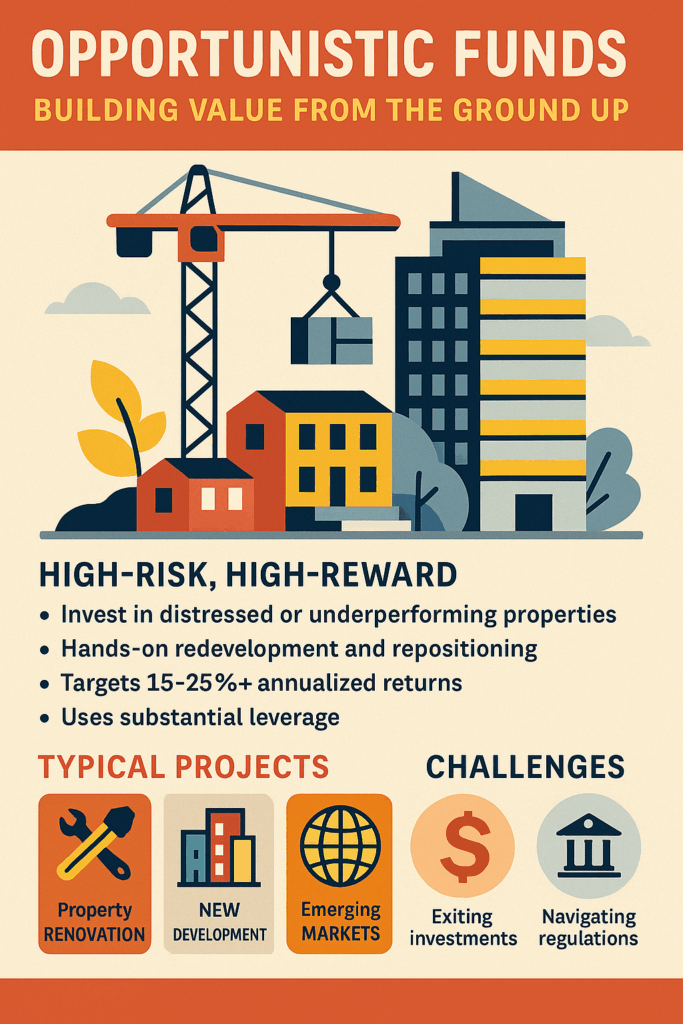
Opportunistic funds represent the highest risk and potentially the highest reward segment of real estate investing. These funds target complex, underperforming, or distressed properties or engage in ground-up development projects.
Key Characteristics
- High Risk: Properties may be in poor condition, located in emerging markets, or subject to regulatory or construction challenges.
- High Returns: Investors target 15–25% or more annualized returns, relying on both operational improvements and appreciation.
- Very Active Management: Fund managers oversee construction, redevelopment, rezoning, or tenant leasing strategies.
- High Leverage: Opportunistic funds often use higher debt to enhance returns.
Typical Assets
- Distressed commercial properties
- Ground-up development projects
- Properties in emerging or transitional markets
- Hotels, resorts, and specialized real estate
Investor Suitability
Opportunistic funds are suitable for investors with high risk tolerance, a long-term horizon, and the ability to withstand potential losses. These funds are often used as a “satellite” allocation in a diversified real estate portfolio.
Example: A fund purchases a distressed office park with 40% occupancy. The fund invests in renovations, markets aggressively to new tenants, and repurposes some units for coworking spaces. The successful repositioning generates significant returns for investors when the property is sold.
Advantages
- High Potential Returns: Successful repositioning or development can generate significant gains.
- Market Timing Opportunities: Opportunistic funds can capitalize on distressed or undervalued markets.
- Creative Strategies: Managers can redevelop properties, convert uses, or leverage zoning changes to enhance value.
Historical Performance
Opportunistic funds have historically produced the highest returns among real estate funds but are also the most sensitive to economic cycles. During the 2009–2014 recovery period in the U.S., many opportunistic funds acquired distressed properties at discounted prices and executed repositioning strategies that generated double-digit annualized returns for investors.
International Opportunities
Opportunistic strategies are common in developing regions where infrastructure and commercial markets are expanding. For example, hotels and mixed-use developments in fast-growing cities in Latin America or Africa can generate outsized returns, though political and regulatory risks are higher.
Geographic Diversification
Real estate performance varies by location, making geographic diversification a key consideration.
- U.S. Coastal Cities: Core office and multifamily assets in cities like New York, San Francisco, and Boston are historically stable but expensive.
- Secondary Markets: Mid-sized cities often provide value-add opportunities with growing populations and lower acquisition costs.
- Emerging Global Markets: Opportunistic investments in Asia, Latin America, or Eastern Europe may offer higher returns but carry political, regulatory, and currency risk.
Regulatory and Tax Considerations
- REIT Structures: Real estate investment trusts offer liquidity and favorable tax treatment but often have restrictions on leverage and property types.
- Partnership Structures: Private funds often operate as limited partnerships, allowing pass-through taxation but with long lock-up periods.
- Local Zoning and Development Rules: Compliance with zoning, environmental regulations, and building codes is essential, especially for value-add and opportunistic strategies.
Portfolio Role of Real Estate Funds
Real estate funds provide income, growth potential, and portfolio diversification.
- Income Generation: Rental income provides steady cash flow.
- Capital Appreciation: Property improvements and market growth drive long-term returns.
- Diversification: Real estate returns often have low correlation with stocks and bonds.
- Inflation Hedge: Rents and property values typically rise with inflation.
Practical Tips for Novice Investors
- Align the fund strategy with risk tolerance.
- Review the experience and track record of fund managers.
- Diversify across fund types, property classes, and geographic regions.
- Examine fees and carried interest carefully.
- Understand liquidity terms, lock-ups, and exit strategies.
- Consider economic and market cycles when investing.
- Factor in tax and regulatory implications before committing capital.
- Review environmental and sustainability practices, which increasingly affect property value.

Conclusion
Real estate funds provide access to a range of strategies for investors of all risk tolerances. Core funds offer stability, value-add funds balance risk and reward, and opportunistic funds pursue high returns through complex or distressed investments.
By understanding differences in risk, return, leverage, geography, and management approach, investors can construct a diversified real estate portfolio aligned with financial goals. With careful research, professional management, attention to market cycles, and a long-term perspective, real estate funds can be a cornerstone of wealth building, offering both income and growth potential.