

When investors think about fixed income, public bonds are usually the first thing that comes to mind. From U.S. Treasuries to investment-grade corporates and even high-yield junk bonds, the public debt markets are deep, liquid, and globally accessible. But over the past decade, another corner of lending has emerged as a serious contender for investor capital: private credit.
As explored in our pillar article, What Is Private Credit? An Investor’s Guide, private credit refers to lending outside the traditional banking and public bond markets. It’s grown into a $1.5 trillion industry globally and is increasingly seen as a mainstream alternative asset class. For investors building diversified portfolios, the natural question is: how does private credit differ from public debt, and when should you favor one over the other?
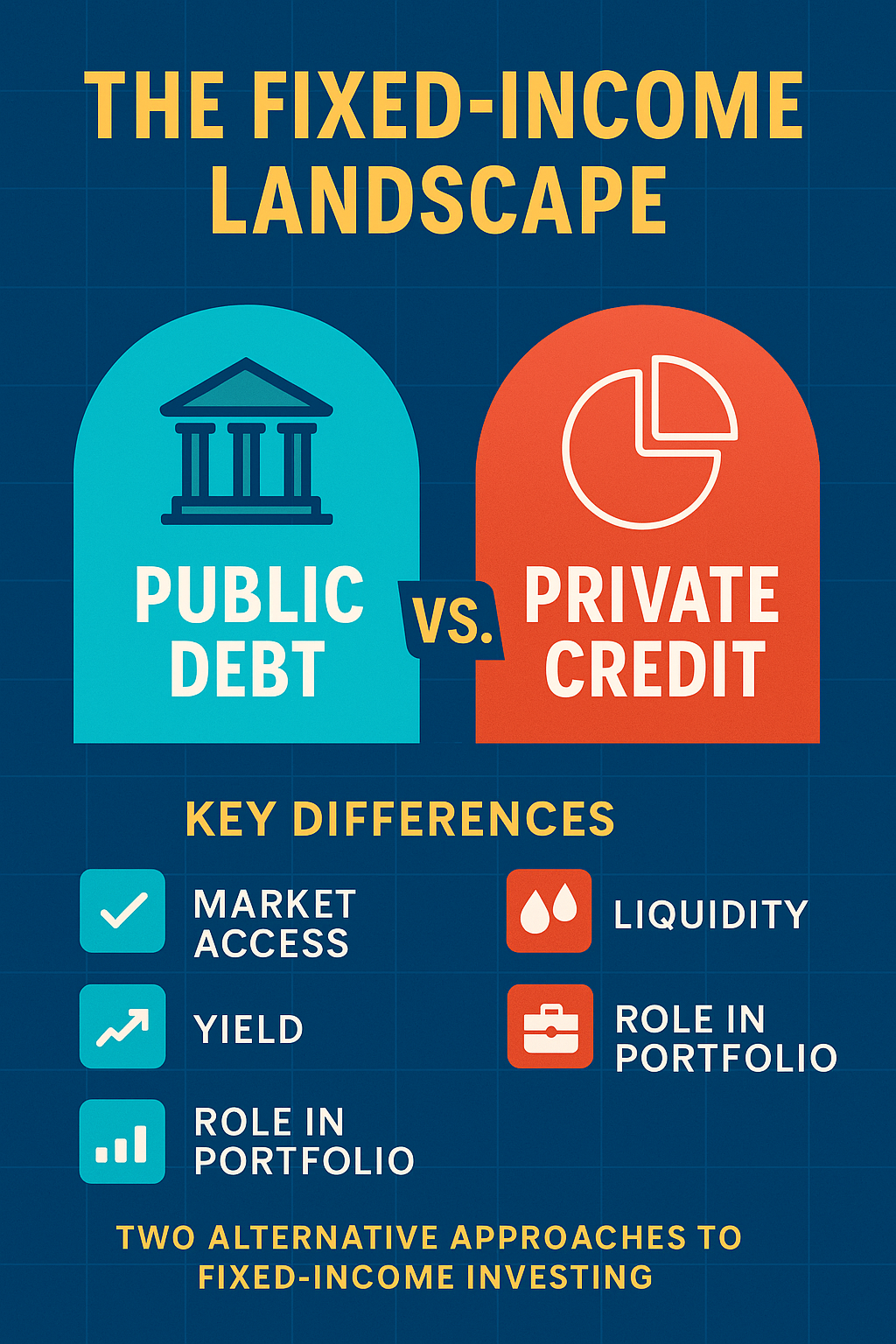
1. Market Access and Availability
- Public Debt: Anyone with a brokerage account can access government or corporate bonds. Minimums can be as low as a few hundred dollars, and most securities trade daily. This accessibility makes public debt ideal for retail investors or institutions with liquidity needs.
- Private Credit: Participation is restricted. Investors typically must be accredited or qualified purchasers, with minimum commitments in the millions. While newer semi-liquid funds are lowering thresholds, private credit remains largely an institutional playground.
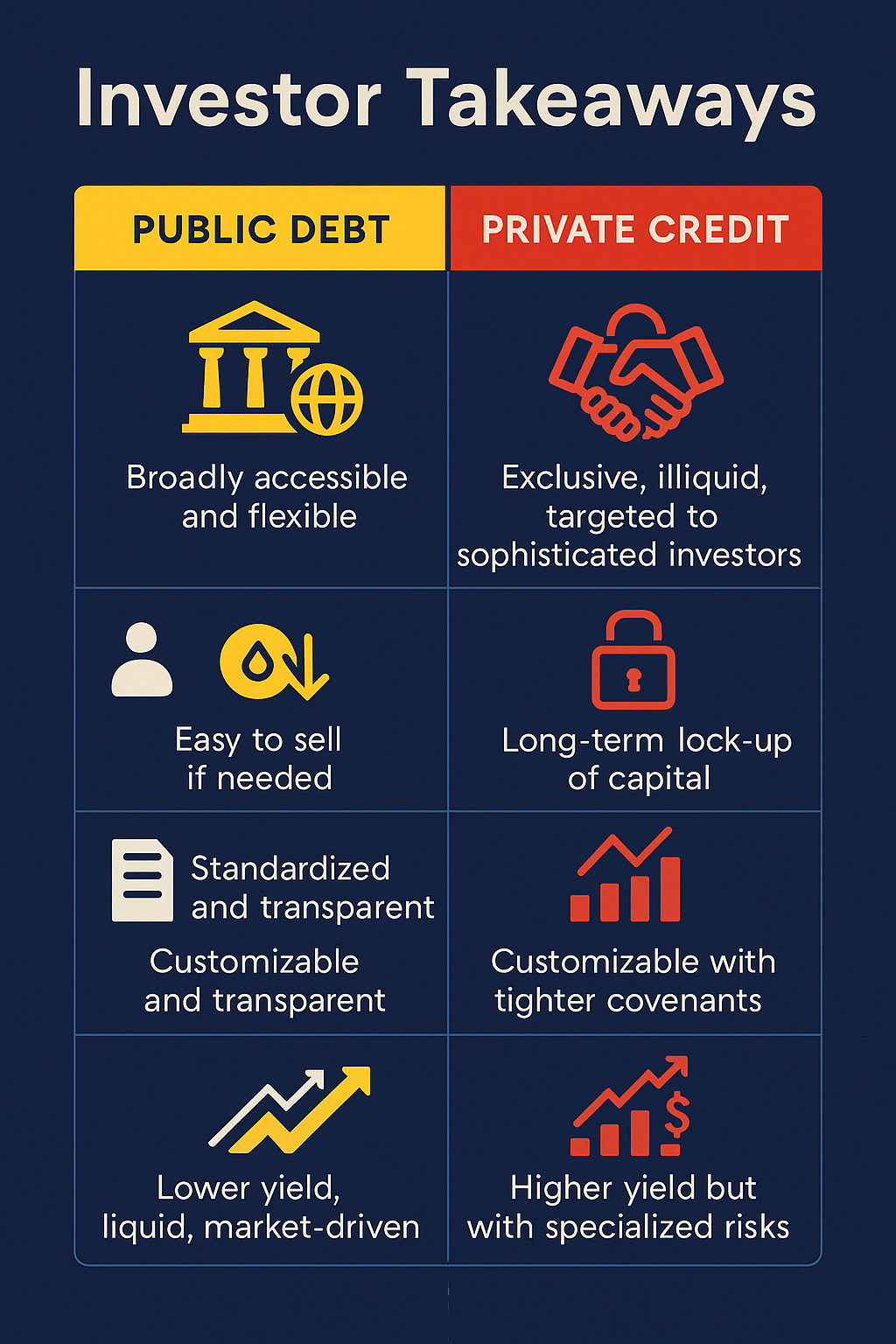
Investor takeaway: Public debt is broadly accessible and flexible; private credit is exclusive, illiquid, and targeted at sophisticated investors.
2. Liquidity
- Public Debt: Bonds are listed and traded in active secondary markets. Even high-yield bonds usually have some level of liquidity. Investors can sell quickly, though pricing depends on market conditions.
- Private Credit: Loans are privately negotiated and held to maturity. Secondary markets exist but are limited, and exiting early often comes at a steep discount.
Investor takeaway: If liquidity matters, public debt wins. Private credit is better suited for investors who can lock capital away for 5–10 years.
3. Structure and Customization
- Public Debt: Terms are standardized—coupon rates, maturities, covenants, and documentation follow market norms. This transparency allows easy comparison but offers little room for tailoring.
- Private Credit: Structures are bespoke. Lenders and borrowers negotiate directly, setting covenants, repayment terms, and collateral packages. This flexibility benefits borrowers who can’t meet strict public market criteria, while giving lenders more control over risk protections.
Investor takeaway: Private credit offers customization and tighter covenants, but public debt delivers transparency and standardization.
4. Yield and Return Potential
- Public Debt: Yields vary by credit quality. Investment-grade bonds may return 3–6% annually, while high-yield debt pushes into the 6–8% range. Returns are lower but more predictable, and investors can reinvest proceeds quickly.
- Private Credit: Direct lending funds often target net returns of 8–12%, mezzanine loans 10–15%, and distressed/special situations even higher. Floating-rate structures also help offset inflation and rising rates.
Investor takeaway: Private credit generally offers higher yields to compensate for illiquidity, complexity, and credit risk.
5. Risk Profile
- Public Debt: Risks include interest-rate sensitivity, credit downgrades, and market volatility. Defaults do happen, especially in high-yield, but recovery rates are fairly transparent.
- Private Credit: Illiquidity risk looms large—once invested, capital is tied up. Borrowers are often smaller, less established, and more leveraged than public companies. Returns hinge on the manager’s ability to source quality deals and enforce covenants.
Investor takeaway: Public debt spreads risk across liquid markets, while private credit concentrates risk in illiquid, manager-driven loans.
6. Role in a Portfolio
- Public Debt: Provides ballast. Government bonds, in particular, serve as a hedge against equity volatility. Even corporate bonds trade with some correlation to stocks, but they still add diversification and stability.
- Private Credit: Plays an income and diversification role, offering equity-like returns with lower correlation. It can help smooth portfolio volatility, but the lack of liquidity means it shouldn’t replace core bond holdings.
Investor takeaway: Use public debt for liquidity and safety; allocate to private credit for yield and diversification if your time horizon allows.
7. Market Dynamics
- Public Debt: Heavily influenced by macro factors—Federal Reserve policy, inflation, and global capital flows. Pricing is transparent and updated in real time.
- Private Credit: Less sensitive to daily headlines, but vulnerable to credit cycles. During recessions, defaults can spike, and recovery processes are lengthy. Because deals are private, information flow is slower and harder to benchmark.
Investor takeaway: Public debt is marked-to-market daily; private credit values shift more slowly but can be harder to assess.
Putting It All Together
For most investors, the right question isn’t public debt or private credit—it’s how much of each. Public bonds remain the foundation of fixed income, providing liquidity and portfolio stability. Private credit offers a complementary role: higher yield, differentiated risk exposure, and insulation from public market swings.
Institutional investors often allocate 5–15% of their portfolios to private credit, while still maintaining large bond positions for liquidity. Individual accredited investors may use private credit to boost income, but should avoid overcommitting capital they might need before the fund term ends.
The Bottom Line
Private credit and public debt may both involve lending, but they serve different functions in a portfolio. Public bonds deliver liquidity and stability; private credit offers yield and diversification, with the trade-off of illiquidity and complexity.
As discussed in our pillar article What Is Private Credit? An Investor’s Guide, the rise of private credit reflects structural changes in global finance. For investors who understand the differences—and who have the patience to commit capital long-term—it can be a valuable complement to traditional fixed income, helping reshape the way portfolios generate return in a world of shifting markets.