

This Content Is Free After You Enter Your Email
If you follow the world of startups, you’ve probably come across the terms accelerator and incubator. They’re often mentioned in the same breath, and sometimes even used interchangeably. But for entrepreneurs and investors alike, the differences matter. These two types of programs play distinct roles in helping young businesses get off the ground — and understanding how they work can provide a window into the early stages of innovation.
What Are Startup Accelerators?
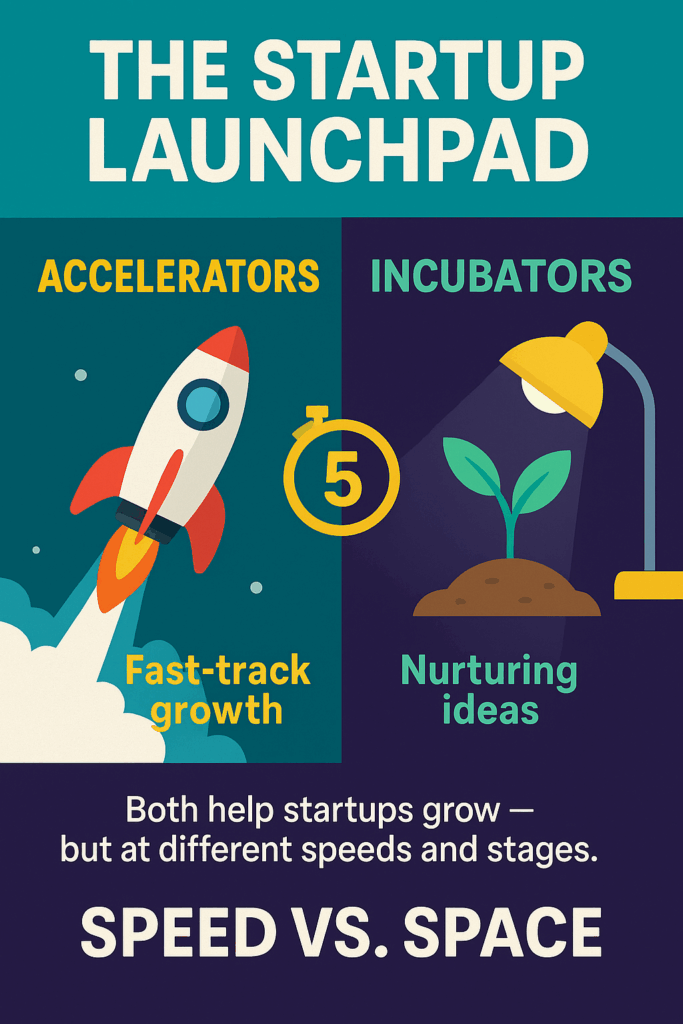
Startup accelerators are time-bound, cohort-based programs designed to rapidly scale promising young companies. Think of them like a bootcamp: startups are accepted into a program, receive funding and mentorship, and work intensively for several months before “graduating” in a showcase event called Demo Day.
The best-known accelerators include Y Combinator, Techstars, and 500 Global (formerly 500 Startups). These programs have helped launch household names such as Airbnb, Dropbox, Stripe, and Reddit.
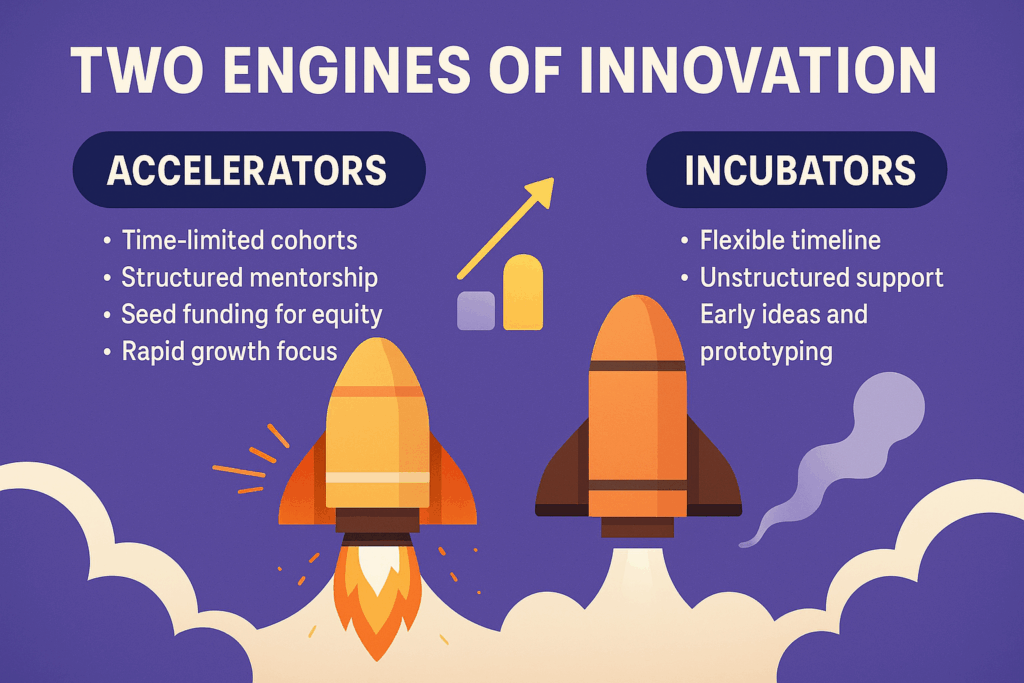
Accelerators usually:
- Provide a small seed investment (often in exchange for 5–10% equity).
- Offer structured mentorship from experienced entrepreneurs and investors.
- Connect founders with a powerful alumni and investor network.
- Push startups to hit growth milestones quickly.
The intensity is part of the design: accelerators compress years of learning and iteration into just a few months.
What Are Startup Incubators?
Incubators, by contrast, are generally longer-term, flexible programs that focus on nurturing early ideas — sometimes even before a company has a product. They act as a “safe space” where entrepreneurs can experiment, test assumptions, and refine their business models.
Incubators typically:
- Provide office space, shared resources, and basic infrastructure.
- Offer mentorship, though less structured than accelerators.
- Allow startups to stay for extended periods — six months, a year, or even longer.
- May not always provide direct funding (though some do).
University-based incubators (such as those at Stanford or MIT) and local government-supported innovation hubs are common. Some incubators also come from corporations looking to support entrepreneurs aligned with their industries.
Key Differences Between Accelerators and Incubators
While both support startups, their approaches diverge in important ways:
Stage of company
- Accelerators favor startups that already have a prototype or some traction.
- Incubators often work with founders who may only have an idea or early concept.
Time frame
- Accelerators run for a fixed period, usually 3–6 months.
- Incubators can last much longer and are often open-ended.
Funding model
- Accelerators typically provide seed funding in exchange for equity.
- Incubators may or may not provide funding, and when they do, the equity terms are often lighter.
Structure
- Accelerators are highly structured, with curricula, milestones, and a final Demo Day.
- Incubators are less formal, giving founders more freedom to explore.
Outcome
- Accelerator graduates aim to emerge “investment ready” — often raising larger VC rounds.
- Incubator participants may leave with a stronger idea or early prototype, but not necessarily funding.
Why Investors Care
For investors, accelerators and incubators can act as deal pipelines. A startup that comes out of a top accelerator often carries a kind of “seal of approval” — it has been vetted by mentors, pressure-tested in a cohort, and shown enough promise to secure early backing.
For example, Y Combinator Demo Day is a must-attend event for venture capitalists scouting their next investment. Startups that appear on stage there have a higher chance of raising significant rounds quickly.
Incubators, while less visible, can also produce high-quality startups. They give founders the time and space to refine ideas without the pressure of immediate scaling. For investors who specialize in very early-stage or pre-seed deals, incubators are fertile ground.
Benefits and Drawbacks for Startups
Accelerators
Pros
- Access to funding, mentorship, and investor networks.
- Strong brand recognition if from a top program.
- Intense learning curve — fast growth and exposure.
Cons
- High-pressure environment may not fit every founder.
- Giving up equity early can be costly if the company succeeds.
- Limited program length means the support ends quickly.
Incubators
Pros
- Flexible timeline, less pressure to scale overnight.
- Access to workspace, resources, and community.
- Often lower equity requirements (or none at all).
Cons
- Less funding and investor access compared to accelerators.
- May lack the strong alumni networks accelerators boast.
- Less structured mentorship can lead to slower progress.
The Blurring Line
In practice, the line between accelerators and incubators is blurring. Some accelerators now run longer-term programs with incubator-like features, while many incubators offer seed funding and structured curricula. Corporations are also experimenting with hybrid models, using elements of both to support entrepreneurs aligned with their strategies.
For example, Plug and Play Tech Center operates programs that combine accelerator speed with incubator-style resources. Similarly, many government-backed programs offer flexible timelines but still culminate in investor showcases.
Which Is Better?
Neither model is inherently better — it depends on the founder’s stage and needs. A team with a working product and early traction may benefit from the intense pace and investor exposure of an accelerator. A solo founder still refining an idea may find the safety net of an incubator more valuable.
For investors, both environments are worth watching. Accelerators can surface promising startups ready for Series A rounds, while incubators may be the birthplace of future disruptors.
Key Takeaways
- Accelerators: short, intense programs designed to scale startups quickly, usually with funding and structured mentorship.
- Incubators: longer, more flexible programs aimed at nurturing early ideas, often with resources but less funding.
- For investors: accelerators provide vetted, investment-ready startups, while incubators offer a window into the earliest stages of innovation.
Both play vital roles in shaping the startup ecosystem, and understanding their differences helps demystify how entrepreneurial ideas grow into tomorrow’s businesses.