

This Content Is Free After You Enter Your Email
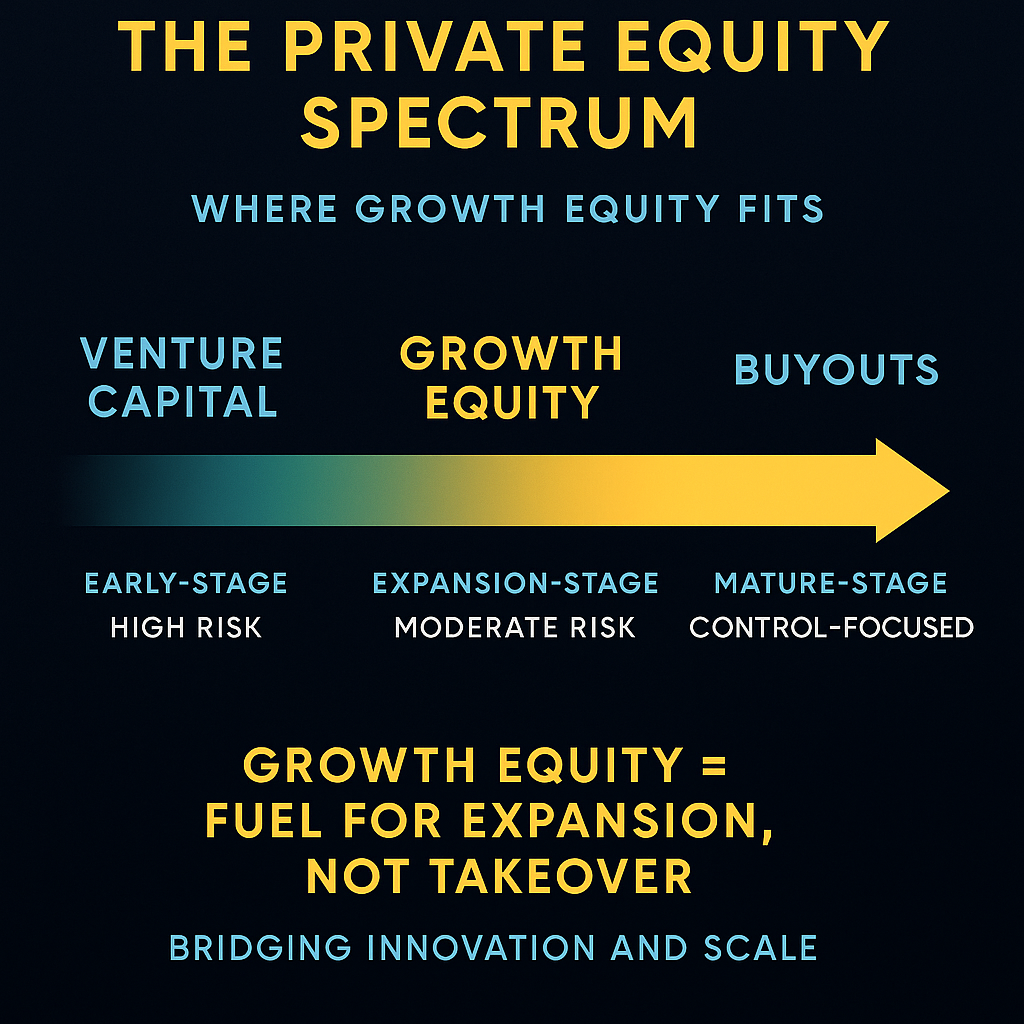
Private equity isn’t only about taking over companies with debt-fueled buyouts. Another important strategy sits in the middle ground between early-stage venture capital and large-scale leveraged buyouts: growth equity.
Growth equity, sometimes called growth capital, focuses on companies that are beyond the risky startup stage but not yet mature enough for a full buyout. These are businesses with proven products, steady revenue, and significant potential to scale. For novice investors, growth equity offers a fascinating look at how private equity firms fuel expansion, not just financial restructuring.
What Is Growth Equity?
Growth equity is a form of private equity investment that provides capital to established companies in exchange for a minority ownership stake. Unlike venture capital, which bets on unproven startups, growth equity firms look for businesses with a solid track record: profitable or close to it, growing consistently, and ready to seize bigger opportunities.
The companies in this stage often face a common challenge—they need significant funding to grow, but they don’t want to take on excessive debt or give up control to a buyout firm. Growth equity bridges that gap by supplying expansion capital while leaving management in place.
What Growth Equity Looks Like in Practice
Imagine a software company with $50 million in annual revenue. The product is successful, customer retention is high, and profits are solid. However, to expand into Europe and Asia, the company needs another $100 million for hiring, marketing, and infrastructure. Instead of borrowing heavily or trying to raise money through public markets, the company partners with a growth equity firm.
The growth equity investor puts in the $100 million, takes a minority stake, and works with management to support international expansion. In five years, the company is generating $200 million in revenue and is either sold or taken public, delivering a profitable return for both the founders and the growth equity firm.
The Appeal of Growth Equity
For investors, growth equity offers several attractive features:
- Lower Risk Than Venture Capital
Startups are exciting, but most fail. Growth equity firms reduce this risk by targeting companies that already have proven business models and reliable revenue streams. - High Upside Potential
While less risky than venture capital, growth equity still offers meaningful upside. Businesses in this stage often grow at double-digit rates, and the infusion of capital can supercharge expansion. - Partnership Over Control
Unlike buyouts, growth equity deals typically don’t involve taking control away from founders or existing managers. This makes the strategy attractive to entrepreneurs who want capital without losing ownership or vision. - Diversification Within PE
For private equity funds, growth equity provides a balance between the high-risk/high-reward profile of venture capital and the steadier, debt-heavy world of buyouts.
Risks and Challenges
No investment is without risk, and growth equity has its own pitfalls:
- Execution Risk: Scaling a business is harder than it looks. Expanding into new markets or launching new products can fail if demand doesn’t materialize.
- Competition: Many growth equity deals are in fast-growing industries like technology, healthcare, or consumer goods. Fierce competition can erode margins quickly.
- Valuation Risk: Growth equity investors often pay premium valuations for high-potential companies. If the company doesn’t meet expectations, returns can shrink.
- Limited Control: Because investors usually take minority stakes, they have less power to intervene if management makes mistakes.
Notable Growth Equity Deals
Some of today’s household names were fueled by growth equity capital.
- Airbnb: Before becoming a public company, Airbnb raised significant late-stage capital from private investors, helping it expand globally.
- Facebook: In 2009, private equity firm Digital Sky Technologies invested $200 million in Facebook, valuing it at $10 billion at the time. That bet paid off enormously when Facebook went public just a few years later.
- Spotify: Growth equity helped fund Spotify’s global rollout, making it the streaming giant it is today.
These cases highlight how growth equity can take already-successful companies and help them dominate on a global scale.
How Firms Add Value Beyond Capital
Growth equity investors don’t just write checks—they often bring expertise, connections, and credibility. They might:
- Introduce the company to potential customers or partners.
- Help recruit top executives to support growth.
- Provide guidance on financial management, international expansion, or regulatory issues.
- Offer credibility that makes it easier for the company to raise future capital or prepare for an IPO.
This support can be just as valuable as the money itself.
Lessons for Novice Investors
Even if you’re not investing directly in private equity funds, growth equity offers insights that apply to everyday investing:
- Timing Matters: Just as growth equity investors target companies at the right stage, individuals should think carefully about when to invest in companies—too early can be risky, too late can limit upside.
- Capital Fuels Growth: Expansion often requires more than good ideas. Adequate funding is critical to scaling a business.
- Partnership Is Key: Growth is easier with the right partners, whether they are investors, advisors, or strategic allies.
You might also be indirectly invested in growth equity already. Pension funds, endowments, and insurance companies often allocate part of their portfolios to growth equity funds, meaning everyday investors benefit from this strategy without realizing it.
Final Thoughts
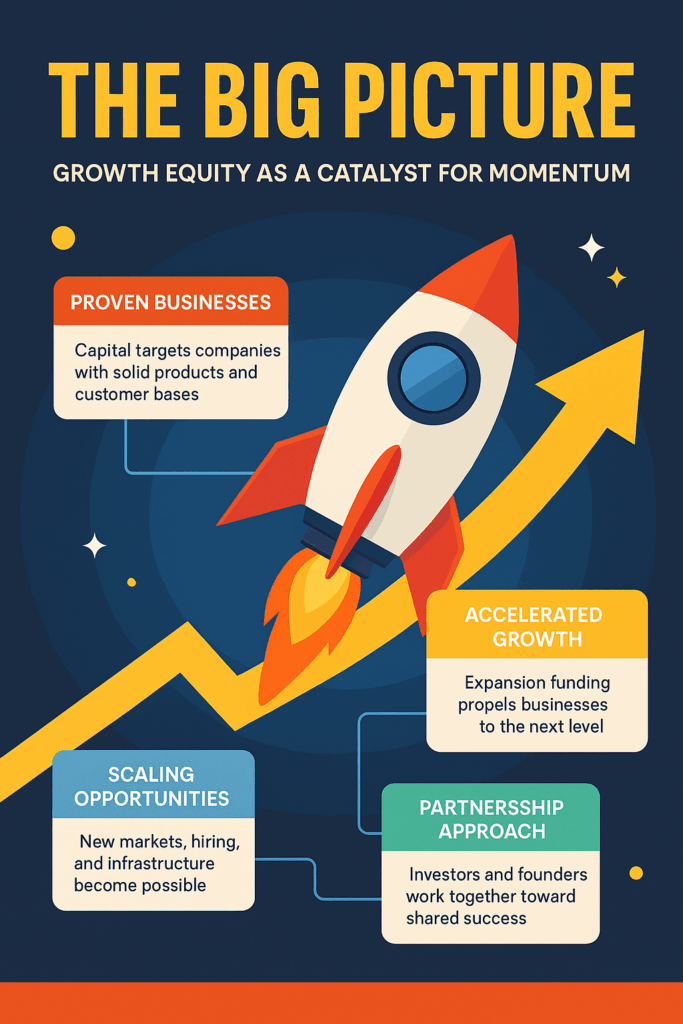
Growth equity occupies a unique space in the investment world: it’s less risky than venture capital but more dynamic than traditional buyouts. By backing proven companies at a pivotal stage of expansion, growth equity investors help businesses achieve their next level of success.
For novice investors, it’s a useful reminder that capital isn’t just about ownership or control—it’s also about enabling growth. Whether it’s helping a software firm expand into new markets or giving a consumer brand the resources to scale globally, growth equity is about fueling momentum.
Understanding this strategy provides a window into how private equity shapes the business landscape—and how growth, when supported with the right mix of capital and expertise, can turn good companies into great ones.