

In the last article, we unpacked the big picture: what exactly is a real estate fund, and why would you invest in one?Now, let’s get a little more specific. If you’ve looked into real estate funds, you’ve probably seen terms like REITs, Limited Partnerships (LPs), and syndications tossed around. These aren’t just buzzwords—they describe the legal and financial structures that determine how the fund operates, how you earn money, and what risks you take on as an investor.
Understanding structure is critical. Two funds might both invest in, say, multifamily apartments, but the way they’re organized can completely change your experience. One might offer daily liquidity and stock-like dividends; the other could lock your money up for years and require a long-term commitment. Knowing the differences helps you match your goals to the right structure.

Real Estate Investment Trusts (REITs)
The Basics
A REIT, short for Real Estate Investment Trust, is one of the most common structures. Think of a REIT as a company that owns, operates, or finances real estate. To qualify in the U.S., it must meet strict IRS guidelines, such as distributing at least 90% of taxable income to shareholders.
How It Works
- You buy shares in a REIT much like you would in Apple or Coca-Cola.
- Many REITs are publicly traded, so you can buy and sell them easily.
- Returns come mainly through dividends and share price appreciation.
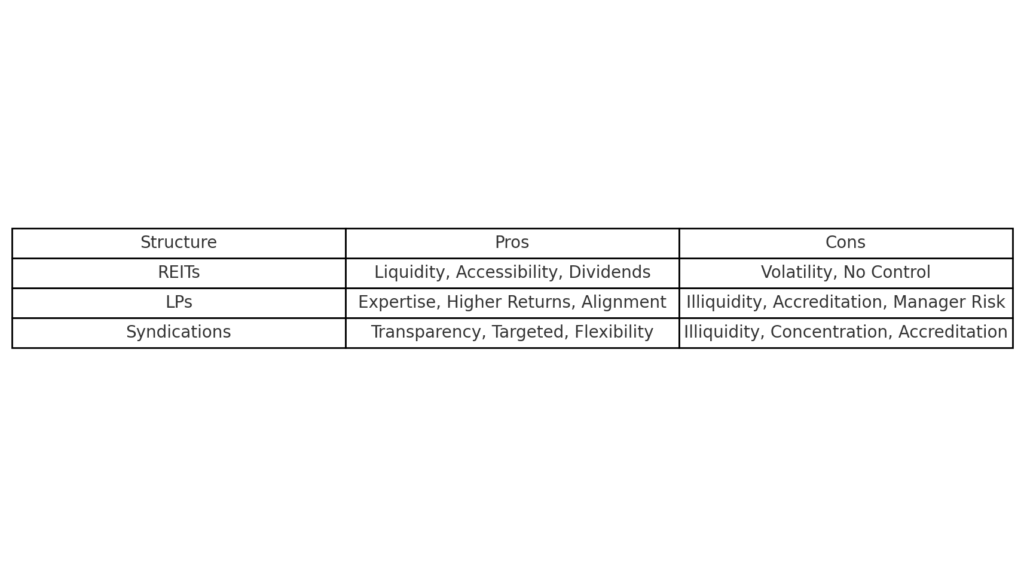
Pros
- Liquidity: Buy or sell shares whenever markets are open.
- Accessibility: Even small investors can participate.
- Steady Income: Known for consistent dividends.
Cons
- Market Volatility: Prices can swing with the stock market.
- Limited Control: You don’t choose the properties.
Limited Partnerships (LPs)
The Basics
Many private real estate funds are organized as limited partnerships with two roles:
- General Partner (GP): Runs the fund and makes all decisions.
- Limited Partners (LPs): Provide capital but stay passive.
How It Works
- LPs contribute money; the GP pools it to buy properties.
- The GP manages acquisitions, financing, and sales.
- Profits are shared, often with investors receiving a “preferred return” first.
Pros
- Professional Expertise: Run by seasoned managers.
- Higher Potential Returns: Can pursue specialized strategies.
- Alignment: GPs often invest their own money.
Cons
- Illiquidity: Capital is usually locked up for years.
- Accreditation: Often limited to high-net-worth investors.
- Manager Risk: Success depends on the GP’s skill.
Real Estate Syndications
The Basics
A syndication is a deal-specific version of a limited partnership. Instead of a broad fund, investors pool money for a single project—say, an apartment building or office conversion.
How It Works
- A sponsor finds the deal and sets up the structure, often an LLC.
- Passive investors put in capital.
- Returns come from rental income and the property’s eventual sale.
Pros
- Transparency: You know the exact property.
- Targeted Returns: Often value-add opportunities.
- Flexibility: Investors choose which projects to join.
Cons
- Illiquidity: Money stays tied up until the project ends.
- Concentration Risk: All your capital is in one property.
- Accreditation: Usually for accredited investors only.
Comparing the Structures
Here’s a simple way to think about it:
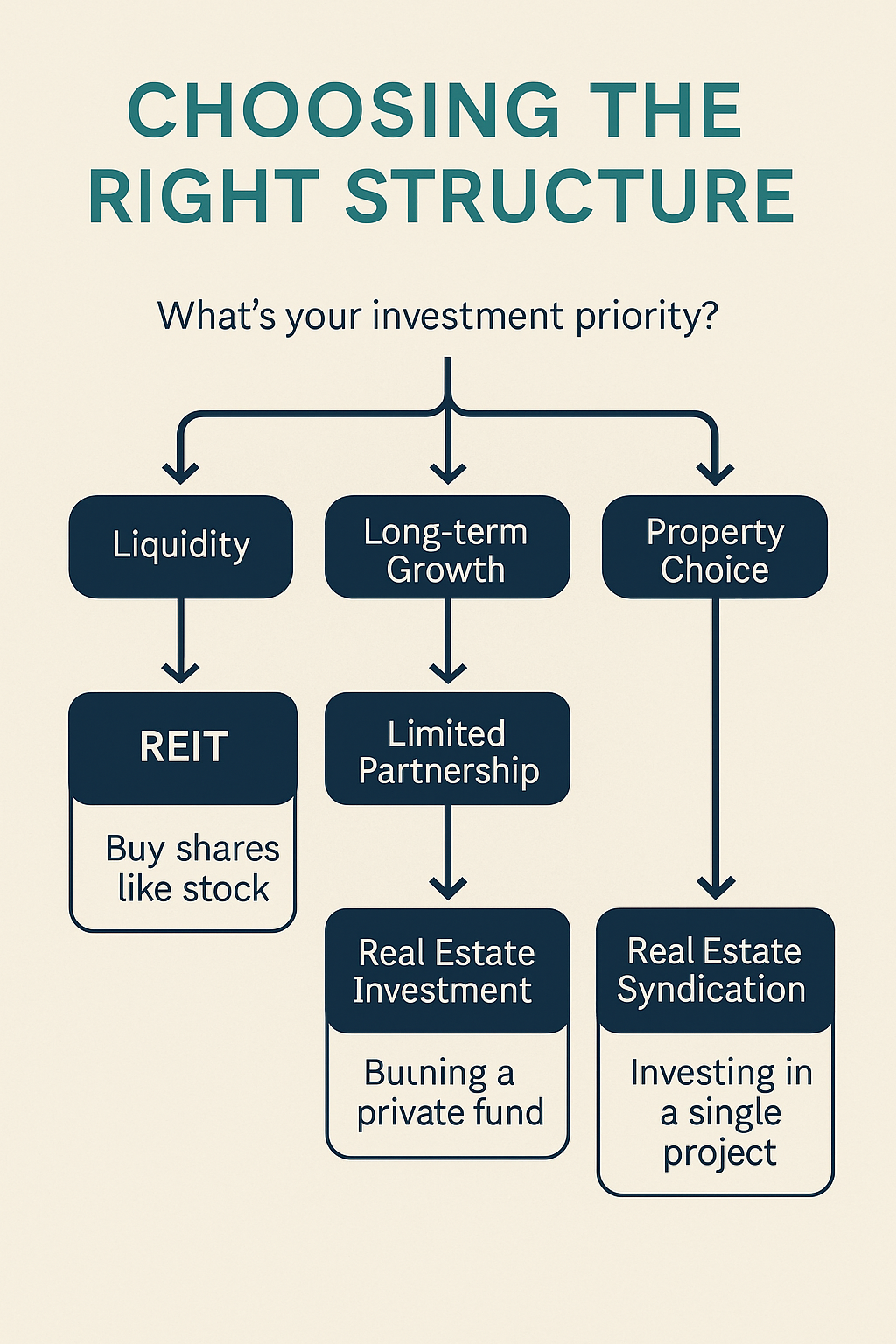
- REITs are like buying stock—you’re liquid, diversified, but passive.
- LPs are like joining a private club—longer commitment, potentially bigger payoffs.
- Syndications are like investing in a friend’s business—project-specific and concentrated.
Each structure has trade-offs. Some investors use REITs for liquidity while also committing a portion of their portfolio to LPs or syndications for diversification and higher potential yields. It doesn’t have to be an either/or choice.
The Bottom Line
When it comes to real estate funds, structure matters as much as strategy. A multifamily REIT, a private LP, and a syndication on one retail center all involve real estate, but your experience as an investor will differ.
If you want liquidity, REITs are a good fit. If you can tie up money for years in exchange for higher returns, LPs make sense. If you like knowing exactly where your dollars go, syndications may be the way.
The structure isn’t just paperwork—it’s the framework that shapes your journey as an investor. And once you know the differences, you can decide not only whether to invest in real estate funds, but also how you want to participate.