

This Content Is Only For Subscribers
Private credit’s headline yields can be eye-catching—especially when base rates are high. But the number that matters isn’t the sticker coupon; it’s the risk-adjusted return: what you can expect after defaults, recoveries, fees, and the cost of locking up your money. Here’s a clear, investor-friendly framework to evaluate it.
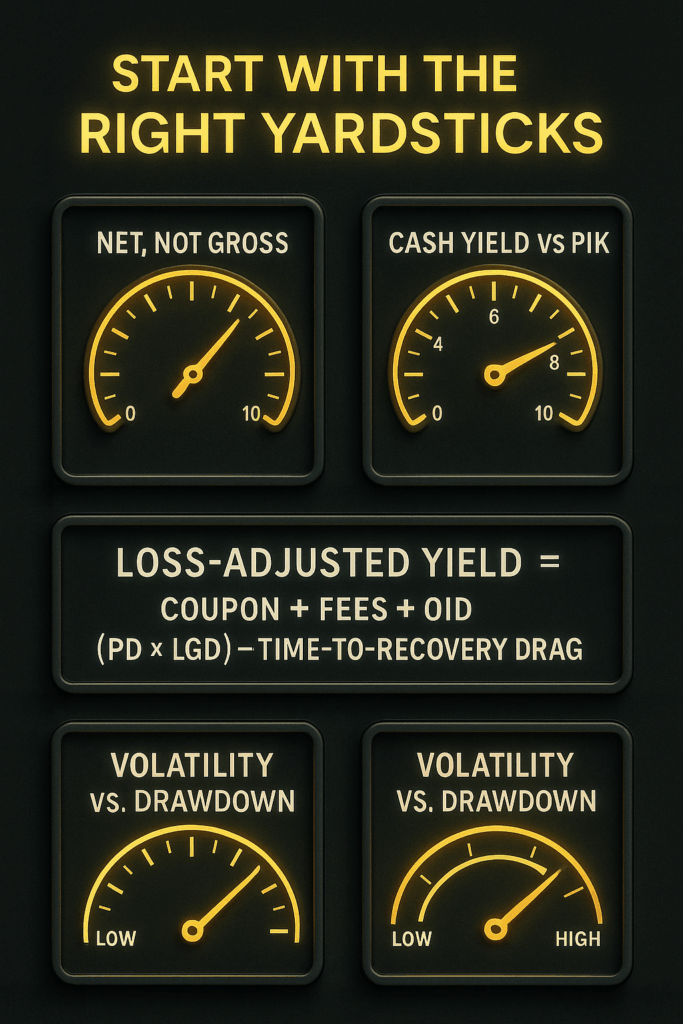
Start with the right yardsticks
Net, not gross. Anchor on net IRR and net MOIC after management fees, expenses, and carry. Gross yields flatter fee-heavy strategies and short holding periods.
Cash yield vs. total return. A 12% coupon with 6% PIK (pay-in-kind) is not the same as 12% all-cash. PIK accrues and relies on a future exit; rising PIK can signal borrower stress.
Loss-adjusted lens. Convert the headline coupon into an after-loss expectation:
Loss-Adjusted Yield ≈ Coupon + Fees + OID − (PD × LGD) − Time-to-Recovery Drag
where PD = probability of default and LGD = loss given default after recoveries and costs.
Volatility vs. drawdown. Private credit shows low mark-to-market volatility, but low marks don’t equal low risk. Focus on permanent capital loss and the depth/duration of drawdowns.
Price the illiquidity
Illiquidity should pay you. Ask:
- What is the liquidity premium versus comparable public credit?
- How long is capital locked? What are the gate/suspension mechanics?
- If rates fall and spreads tighten, can the manager recycle at similar returns—or will reinvestment yields drop?
A simple sanity check: if high-quality public credit yields 8–9% with daily liquidity, a multiyear private strategy targeting 11–12% must justify that gap after fees and expected losses.
Look through the label to the PD/LGD
Different sleeves carry different default and recovery profiles:
- Senior secured / ABL: lower LGD due to collateral and borrowing-base discipline; lower target yields.
- Unitranche/direct lending: blended senior-junior risk; outcomes hinge on covenant strength and sponsor behavior.
- Second-lien/mezzanine: higher coupons and more PIK; expect higher LGD in stress.
- Specialty finance/securitized pools: risk sits in the underlying assets (consumer/SBA/solar, etc.), servicer quality, and trigger mechanics.
The same 12% target can imply very different expected losses across these categories.
Underwriting quality shows up in the math
Two managers can post 12% net via different paths:
- Covenants and control. Maintenance tests, negative covenants, and cash dominion enable early intervention and amendment fees instead of write-offs.
- Documentation teeth. Tight restricted-payments baskets and clean intercreditor terms protect recoveries.
- Reserve design. Interest/operating reserves cut timing risk during ramp-up or integration.
- Workout capability. Realized results depend on how fast a team triages, negotiates, and, when needed, takes control.
Ask for evidence: reduced realized losses, faster recoveries, and fees earned in amendments.
Normalize by cycle and vintage
Private credit is vintage-sensitive:
- Deals from frothy years may feature looser docs and thinner cushions.
- Rate regimes matter: rising base rates lift coupons and borrower burden; falling rates can compress income unless spreads widen.
- Bank competition swings—better terms when banks retrench often normalize later.
Insist on vintage-by-vintage results and loss triangles (defaults and recoveries by underwriting year), not just a single blended IRR.
A simple “stress-adjusted return” request
Standardize comparisons by asking each manager for:
- Base-case net return (post fees/expenses).
- Stress assumptions: defaults at X%, LGD at Y%, cash vs. PIK mix, and a 6–12 month time-to-recovery.
- Resulting net IRR/MOIC under stress and the expected max drawdown.
Managers running disciplined processes will already have this analysis.
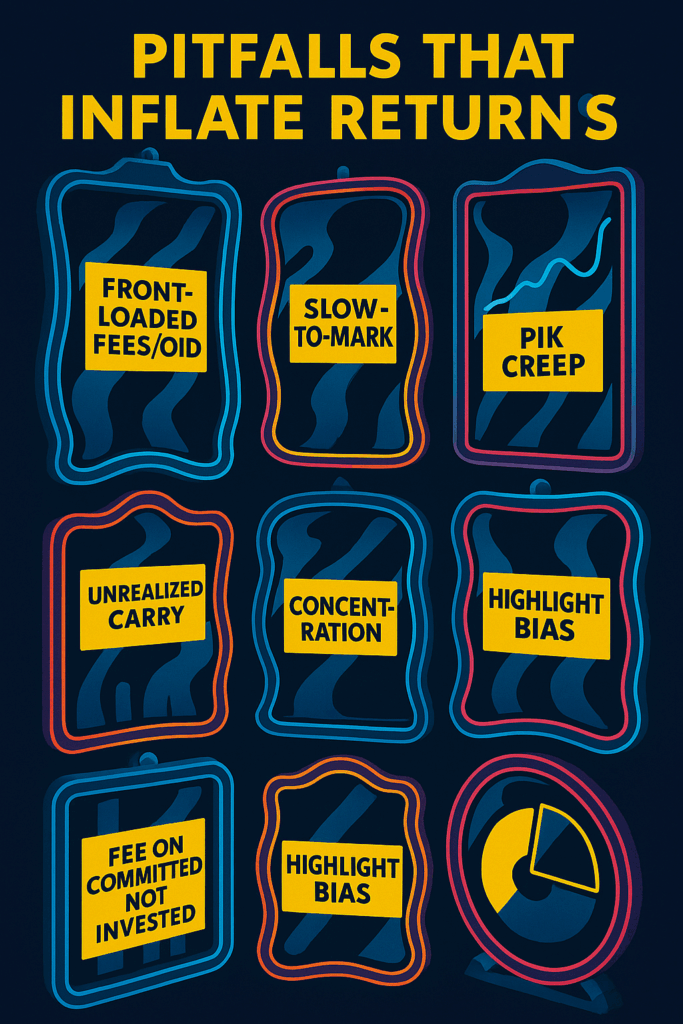
Common pitfalls that inflate returns
- Front-loaded fees/OID. Early IRRs can look great while future losses are still unrecognized.
- Slow-to-mark credits. Delayed write-downs boost today’s IRR at tomorrow’s expense.
- PIK creep. Rising PIK keeps accounting yields high as cash generation weakens.
- Concentration. A few outsized positions dominate outcomes; dispersion matters.
- Highlight bias. One or two home runs can mask a mediocre population—demand full-population data.
Diligence questions to copy/paste
- Loss-adjusted yield today: assumptions for PD, LGD, and time-to-recovery.
- Non-accrual rate and trend: how quickly do you mark down?
- Cash vs. PIK mix now and expected through the cycle.
- Vintage analysis: net returns and loss rates by underwriting year.
- Documentation: one anonymized covenant package and intercreditor summary.
- Workout case study: timeline from first breach to resolution; amendment fees vs. capital at risk.
- Liquidity: facility covenants, gate mechanics, and how you price the illiquidity premium.
Bottom line
Evaluating private credit isn’t about the biggest coupon—it’s about repeatable, loss-aware, and liquidity-aware returns. Translate headline yields into loss-adjusted expectations, normalize by vintage and cycle, and verify that covenants, cash control, reserves, and workout skills actually show up in realized outcomes. When a manager can walk you through those numbers calmly and with receipts, you’re much closer to owning durable risk-adjusted returns, not just a rate on a slide.