

This Content Is Only For Subscribers
If you’ve spent any time around hedge funds, you’ve heard the phrase “offshore structure.” It can sound exotic, but the idea is simple: create a fund in a jurisdiction that’s tax-neutral, familiar to global investors, and set up for efficient cross-border investing. Done right, an offshore structure doesn’t hide money; it simplifies how different investor types pool capital and how the manager runs the strategy. Here’s a plain-English tour of what that looks like—and what you should ask before wiring a dollar.
Why go offshore?
Three practical reasons:
- Tax neutrality. Offshore funds don’t add another layer of local tax at the fund level. That lets investors from different countries (and U.S. tax-exempt investors like endowments and foundations) each deal with their own tax rules rather than a second tax imposed by the fund’s home country.
- Global capital. A Cayman or BVI fund feels “standard” to institutions on multiple continents. Legal docs, service providers, and fund plumbing are built for cross-border investing, which means faster onboarding and fewer bespoke fixes.
- Operational flexibility. These jurisdictions have purpose-built fund laws, experienced courts, and deep local ecosystems (administrators, directors, audit firms, counsel). Managers can set terms—liquidity, classes, side pockets—without reinventing the wheel.
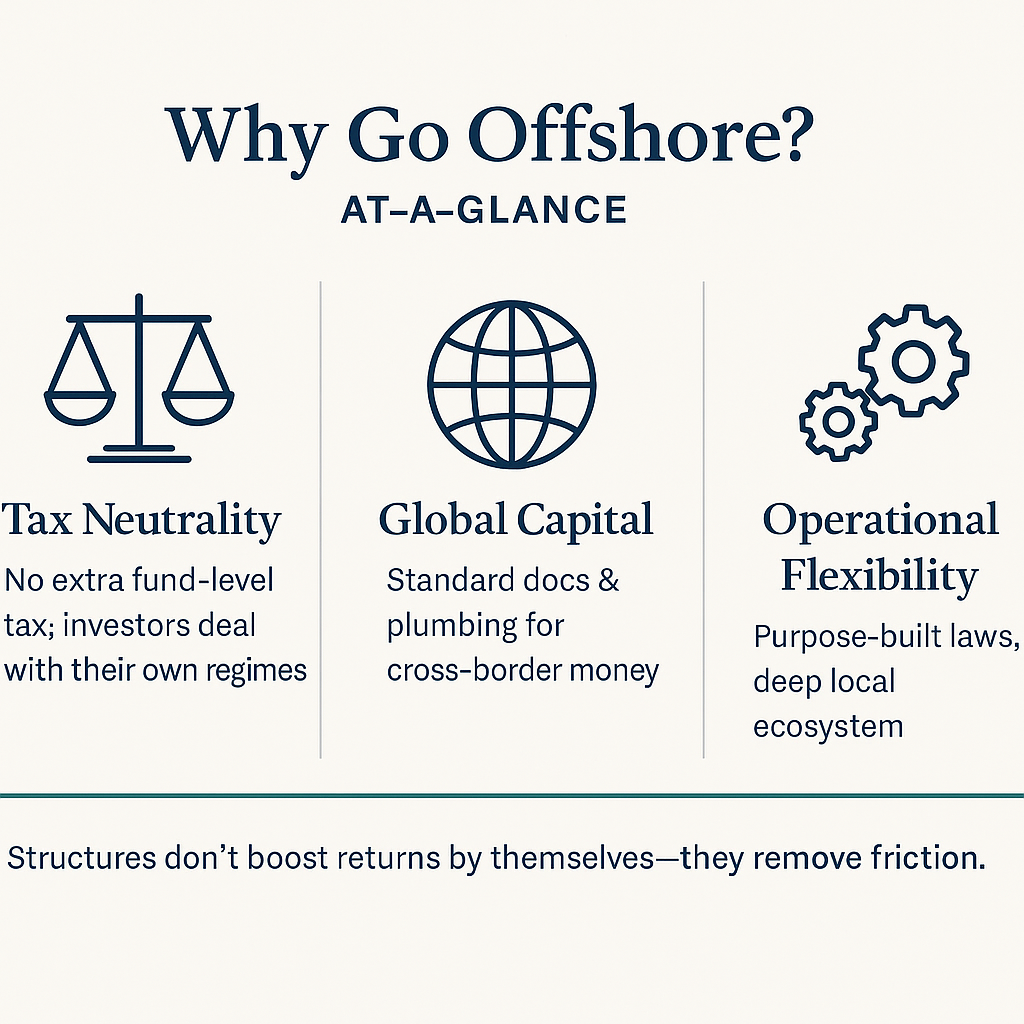
None of this makes returns better on its own. It just keeps the structure from getting in the way.
The classic blueprint: master–feeder
For many strategies, you’ll see a master–feeder setup:
- A U.S. feeder (often a Delaware LP/LLC) for taxable U.S. investors.
- An offshore feeder (commonly Cayman or BVI) for non-U.S. and U.S. tax-exempt investors.
- A master fund (often Cayman) where the actual portfolio lives.
Both feeders invest into the master, which trades and books results. Investors get clean allocations, the manager runs one portfolio, and the administrator produces one NAV with different classes as needed (currency, fee terms, founder class, and so on).
Alternatives exist—standalone offshore funds, “mini-masters” where the U.S. fund is the master and the offshore feeder invests into it, or segregated portfolio companies (SPCs) that create legally separate cells under one umbrella—but master–feeder remains the workhorse.
The big three jurisdictions (plus a couple of neighbors)
- Cayman Islands. The default for hedge funds. Deep bench of administrators, directors, law firms, and auditors; familiar regulatory filings; and efficient court processes. Most large allocators are fully calibrated to Cayman documents and timetables.
- British Virgin Islands (BVI). Similar advantages with a lighter cost profile for some vehicles and a streamlined company law framework. Often used for feeders or smaller funds.
- Bermuda. Longstanding fund and insurance hub with high-quality service providers and robust governance traditions.
You’ll also see Jersey/Guernsey for certain European-facing structures and, in a different category, Ireland or Luxembourg when a manager wants a fully onshore European product that can distribute more broadly there. Those are different regulatory animals than classic offshore hedge funds, but they sometimes sit alongside them in the product shelf.
What regulation looks like offshore
“Offshore” does not mean “unregulated.” Expect:
- Fund registration or notice regimes. Funds typically register or notify under a local funds law, with ongoing obligations such as appointing approved service providers, filing basic statistical returns, and maintaining local records.
- Annual audit. Offshore funds commonly deliver audited financial statements each year, prepared under recognized accounting standards and signed by an approved auditor.
- Local oversight. A local regulator (e.g., a monetary authority or financial services commission) supervises the sector, can request information, and may examine service providers.
- AML/KYC and sanctions screening. Onboarding documents aren’t busywork: they tie into international anti-money-laundering standards and sanctions compliance. Expect verification of identity, source of funds, and ongoing monitoring.
- Global tax reporting. Even in tax-neutral jurisdictions, funds and administrators handle investor data for FATCA and CRS—automatic exchange regimes that send account information to relevant tax authorities.
The headline: reputable offshore funds live under a steady hum of filings, audits, and controls. It’s not a free-for-all.
Who does what: the service-provider stack
A quality offshore fund will have:
- Investment manager/adviser. Often U.S. or UK-based, making the trades and handling risk.
- Administrator. Calculates NAV, processes subscriptions/redemptions, maintains the investor register, and supports FATCA/CRS and AML/KYC. Independence here is a big deal: it’s the check on fees, performance allocations, and capital flows.
- Auditor. Signs the annual financials and tests controls. Look for a firm with real hedge-fund depth, not just a logo.
- Independent directors or a GP board. They oversee the fund, approve valuations (where applicable), and review conflicts and key policies. Good boards ask real questions and keep minutes.
- Prime brokers/custodians. Hold assets, provide financing and securities lending, and route trades. Multiple primes help with counterparty diversification.
- Legal counsel (onshore and offshore). Draft the offering memorandum, the constitutional docs (LPA/LLC agreement or company articles), and the subscription package, and advise on marketing across jurisdictions.
Strong providers don’t guarantee returns, but they materially lower operational risk.
Terms that actually matter
- Liquidity. Offshore vehicles make it easier to tailor liquidity to the strategy: quarterly or semiannual redemptions, lockups for early years, gates in stress, and side pockets for hard-to-sell assets. What matters is alignment between asset liquidity and investor liquidity—and that the rules are clear before you invest.
- Fees. The familiar mix: an annual management fee plus a performance allocation (carry, incentive fee) with a high-water mark. Founder classes or larger tickets can negotiate lower fees; feeders sometimes add a platform or admin layer.
- Classes and currencies. It’s common to see USD/EUR/GBP share classes and even currency-hedged classes for non-USD investors.
- Side letters. Large allocators may negotiate special terms (information rights, fee breaks, capacity). Many funds run “most-favored-nation” processes so similarly situated investors can elect comparable rights. Ask how the manager administers this.
What to ask before you allocate
- Why offshore for this strategy and investor base? Listen for a clear, practical answer, not buzzwords.
- Which structure is in place—and why? Master–feeder vs. standalone vs. SPC; how it supports liquidity, tax, and trading.
- Service providers. Who’s the administrator, auditor, and counsel? How long have they been engaged? What are the escalation paths when there’s a break or valuation dispute?
- Governance. Who are the directors? How often do they meet? What have they pushed back on in the last year?
- Valuation. For less liquid assets, what’s the methodology? Are there independent prices? How are overrides handled? Are there committee minutes?
- Liquidity tools. Under what scenarios would the fund use a gate, suspend redemptions, or create a side pocket? How would that be communicated to investors?
- Operational resilience. Cybersecurity controls, business continuity plans, and vendor oversight apply offshore, too. Ask about testing and recent incidents.
- Regulatory and tax footprint. How are FATCA/CRS handled? Which investors get which tax forms? Are there any marketing or distribution frictions in key countries?
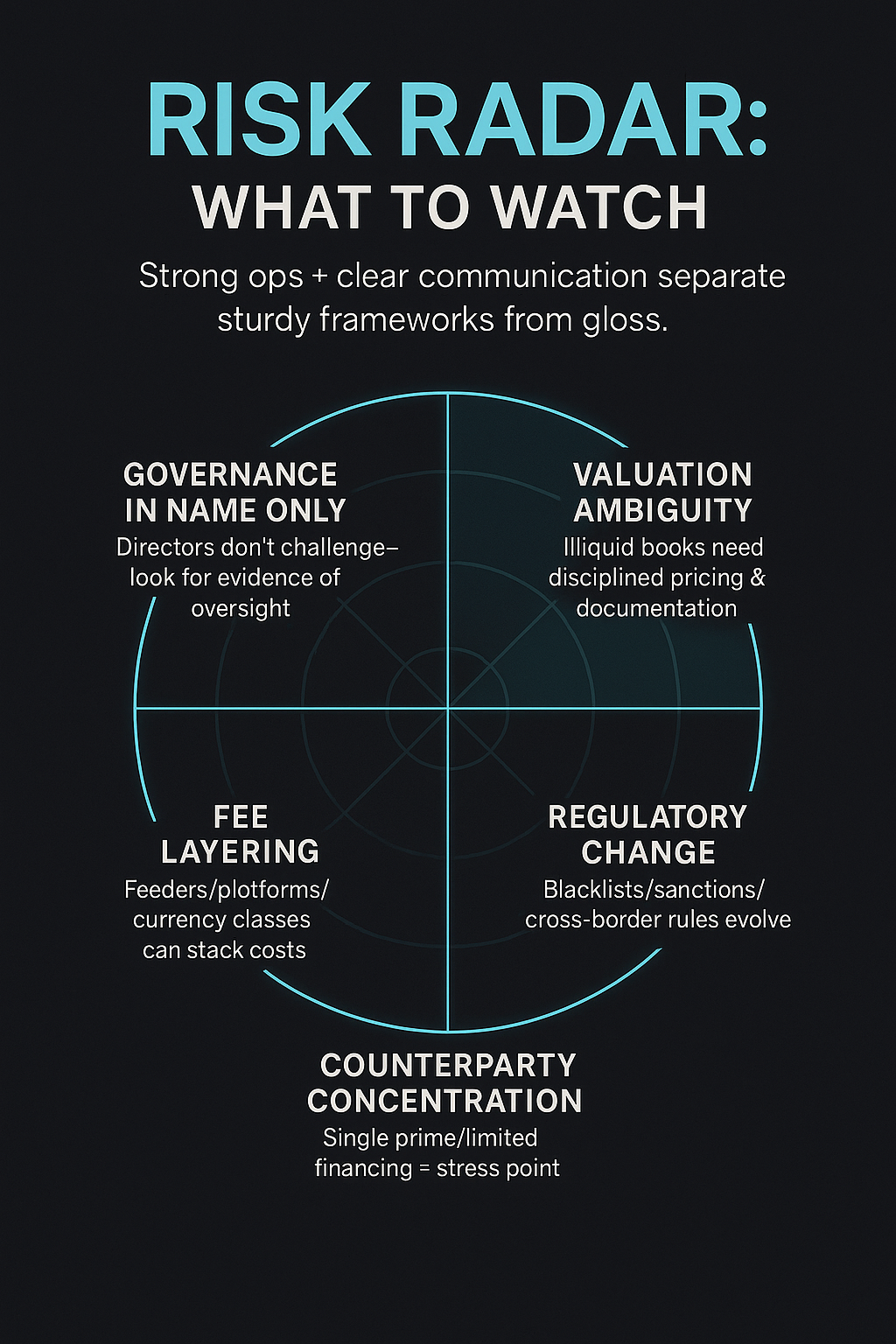
Risks to keep on your radar
- Governance in name only. Independent directors who never challenge management aren’t adding value. Look for evidence of real oversight.
- Valuation ambiguity. Illiquid strategies demand disciplined pricing and documentation. “Trust us” isn’t a control.
- Fee layering. Feeders, platforms, and currency classes can add cost. Read the operating expense sections carefully.
- Regulatory change. Blacklists, sanctions, and cross-border rules evolve. Solid managers monitor this and update documents without drama.
- Counterparty concentration. One prime broker or a thin financing stack can become a stress point quickly.
Bottom line
Offshore hedge funds exist to streamline global investing, not to obscure it. The best versions pair tax neutrality and flexible terms with independent administration, credible audits, engaged boards, and clear investor communications. If you focus your diligence on structure, governance, valuation, liquidity alignment, and the quality of service providers, you’ll separate sturdy frameworks from glossy brochures—no passport stamps required.