

This Content Is Only For Subscribers
Private credit has come a long way in a short time. From a niche product after the 2008 financial crisis to a global market with over a trillion dollars under management, it now plays a central role in financing companies, supporting private equity deals, and generating income for institutional investors.
But what comes next? The future of private credit will be shaped by growth drivers—forces that could propel the market toward $2–3 trillion in assets by the end of the decade—as well as challenges that could test its resilience. Investors who understand both sides of the ledger will be best positioned to navigate the road ahead.
Growth Drivers
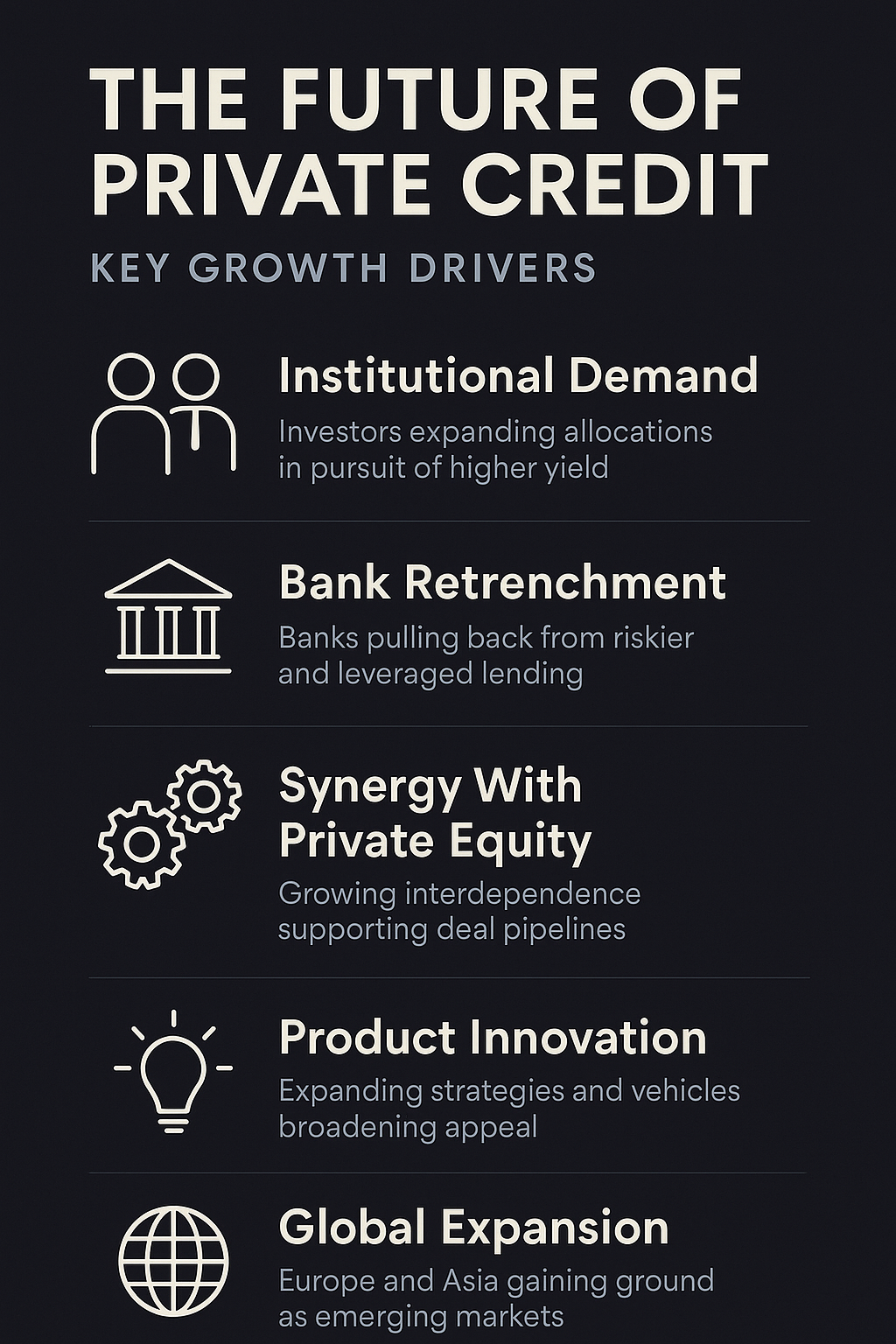
1) Institutional Demand for Yield
Pension funds, insurers, and sovereign wealth funds are under pressure to meet long-term obligations. With public bonds often delivering modest returns, private credit has become a vital source of enhanced yield. As institutions continue to increase allocations, the sector is likely to expand further.
Why it matters: Larger allocations mean more capital to deploy, pushing the market into new geographies, borrower segments, and product innovations.
2) Bank Retrenchment
Post-crisis regulations made it more expensive for banks to lend to riskier or leveraged borrowers. That dynamic is unlikely to reverse anytime soon. Even in 2025, banks remain cautious in corporate lending, creating space for private funds to step in.
Why it matters: Private credit is not just a “nice-to-have”—for many borrowers, it is now the primary funding option.
3) Synergy With Private Equity
Private credit and private equity are increasingly interdependent. Private equity sponsors rely on direct lenders for buyout financing; credit funds benefit from repeat deal flow and aligned incentives. As private equity continues to raise record funds, the pipeline for private credit is likely to grow alongside it.
Why it matters: Sponsor-backed lending ensures a steady stream of deals for credit managers and confidence for investors.
4) Product Innovation
The menu of private credit strategies keeps expanding:
- Unitranche loans simplify capital structures.
- NAV loans give private equity funds liquidity without selling assets.
- Specialty finance (royalties, litigation funding, asset-backed lending) diversifies return streams.
- Evergreen vehicles make the asset class accessible to wealth platforms and high-net-worth individuals.
Why it matters: Innovation broadens the investor base and deepens the market.
5) Global Expansion
The U.S. still dominates private credit, but Europe is catching up quickly and Asia-Pacific is on the rise. In Asia, markets like Japan and Australia are institutionalizing fast, while India and Southeast Asia offer growth opportunities, albeit with higher risk.
Why it matters: The globalization of private credit allows investors to diversify and capture opportunities across regions with different cycles.
Challenges
1) Economic Downturns
Private credit has not yet experienced a deep, prolonged recession at its current scale. A severe downturn could test the resilience of portfolios, especially those with aggressive leverage or weak covenants.
Investor takeaway: Manager selection and diversification will be crucial in weathering a full credit cycle.
2) Default Risk
Borrowers in private credit are typically non-investment grade. In benign markets, defaults remain low, but rising rates, slowing growth, or sector stress (e.g., in cyclical industries) can lead to spikes. Unlike public markets, workouts in private credit require hands-on negotiations with sponsors.
Investor takeaway: Default risk is not hypothetical; it is a core feature of the asset class.
3) Crowding and Spread Compression
As more capital pours into private credit, spreads have compressed. The competition is especially fierce in large-cap sponsor-backed loans. Managers may take on more risk to maintain yields, creating concerns about underwriting discipline.
Investor takeaway: Growth can dilute returns; investors should assess how managers balance volume with credit quality.
4) Regulatory Scrutiny
With size comes attention. U.S. and European regulators are increasingly focused on transparency, leverage, and potential systemic risks. While private credit is unlikely to be regulated as tightly as banks, additional disclosure requirements or capital constraints could emerge.
Investor takeaway: Regulation could reshape fund structures and reporting, affecting both managers and investors.
5) Liquidity Mismatch
The growth of semi-liquid and evergreen vehicles has expanded access, but redemption pressures could create challenges in stress scenarios. Unlike public markets, underlying loans cannot be easily sold to meet outflows.
Investor takeaway: Liquidity features sound attractive, but investors should read the fine print—gates, proration, and manager discretion can all limit redemptions.
Scenarios for the Next Decade
Optimistic Case
- Steady economic growth.
- Default rates remain moderate (2–3%).
- Institutional allocations rise to 15–20% of portfolios.
- Global AUM surpasses $3 trillion.
Cautious Base Case
- Slower growth with occasional recessions.
- Default rates rise cyclically but remain manageable.
- Larger managers consolidate smaller ones.
- Global AUM grows steadily, but returns normalize lower.
Bearish Case
- Prolonged recession stresses borrowers.
- Defaults spike (6–10%+).
- Liquidity mismatches emerge in evergreen vehicles.
- Regulatory clampdowns reduce flexibility.
- Investor enthusiasm wanes, slowing growth.
What Investors Should Watch
- Default trends in sponsor-backed lending.
- Fundraising flows—are investors still committing at record levels?
- Spread dynamics—are yields compensating adequately for risk?
- Global expansion pace—how quickly Europe and Asia scale up.
- Regulatory developments—disclosure, leverage, and systemic oversight.
- Manager concentration—are mega-funds squeezing out smaller players?
Final Thoughts
Private credit’s future looks bright, but not without shadows. Growth drivers like institutional demand, bank retrenchment, and private equity synergy suggest the asset class will keep expanding. But challenges—defaults, crowding, liquidity strains, and regulation—will test both managers and investors.
For allocators, the message is clear: private credit belongs in modern portfolios, but it requires careful manager selection, diversification, and a clear-eyed view of risk. The next decade will likely confirm private credit as a core pillar of global finance—so long as investors remember that yield never comes free.