

Private equity (PE) is one of the most influential, yet often misunderstood, corners of the investment world. For many investors, the term conjures images of billionaire buyouts, complex corporate deals, and the world’s largest private companies operating far from public scrutiny. While these perceptions are partially accurate, they only scratch the surface of what private equity is, how it operates, and why it matters to investors seeking long-term growth and diversification.
This article serves as a foundational guide to private equity investing. We’ll explore the structure of private equity, types of funds and deals, investor requirements, potential returns, risks, and the evolving role of PE in a modern investment portfolio. By the end, readers will have a solid understanding of private equity as a distinct asset class and its place within an investment strategy.

Defining Private Equity
At its core, private equity refers to investments in companies that are not publicly traded. PE firms pool capital from institutional investors and high-net-worth individuals to acquire, restructure, and grow companies over a defined period—typically 4 to 7 years—before selling them at a profit.
Unlike public equity, which can be bought and sold freely on stock markets, private equity involves direct ownership or controlling stakes in private businesses. This ownership allows PE firms to implement operational, strategic, and financial changes that increase company value before exit.
While private equity is often associated with large buyouts of well-known companies, it also includes venture capital, growth equity, and distressed investing, each with unique characteristics, timelines, and risk-return profiles.
The History of Private Equity
The roots of private equity date back to the mid-20th century. Early venture capital funds financed startups in the 1950s and 1960s, particularly in Silicon Valley. By the 1980s and 1990s, private equity evolved to include leveraged buyouts (LBOs)—acquiring mature companies using significant debt financing. Iconic deals, such as the RJR Nabisco buyout in 1989, demonstrated both the enormous upside potential and risks of highly leveraged transactions.
Private equity has since become a global industry managing trillions in assets, spanning small startups to multinational conglomerates. This evolution has led to multiple fund structures, investment strategies, and specialization niches tailored to diverse investor needs.
How Private Equity Works
Private equity investing typically involves four key stages:
- Fundraising: PE firms raise capital from institutional investors, high-net-worth individuals, and sometimes family offices. Investors commit a certain amount of capital that is drawn over time as opportunities arise.
- Deal Sourcing: Identifying potential investment opportunities is critical. PE firms leverage networks, investment banks, industry experts, and proprietary research to find companies that meet their strategy and target metrics.
- Due Diligence: Before investing, PE managers conduct extensive financial, operational, legal, and market analysis. This process assesses risk, validates growth potential, and determines appropriate valuation.
- Investment and Value Creation: PE managers deploy the capital to acquire or invest in private companies, taking minority or majority stakes. They actively work to increase the company’s value through operational improvements, financial restructuring, strategic initiatives, and market expansion.
- Exit: After a holding period (often 4–7 years), the firm sells the company or takes it public via an IPO, distributing profits to investors.
Returns in private equity are generally measured in internal rates of return (IRR) or multiple on invested capital (MOIC), rather than daily market fluctuations.
Types of Private Equity Investments
Private equity is not a monolithic asset class. Key subcategories include:
1. Venture Capital (VC)
Venture capital targets early-stage companies with high growth potential. While the upside is significant—think Google, Facebook, or Airbnb—the risk is high, as many startups fail. VCs often provide strategic guidance, network access, and mentorship to help young companies scale.
2. Growth Equity
Growth equity focuses on companies that are more established than startups but need capital for expansion, market entry, or acquisitions. Returns tend to be more stable than early-stage VC but still rely on execution and market conditions. Growth equity investors often take minority stakes, supporting management teams rather than controlling operations.
3. Leveraged Buyouts (LBOs)
In an LBO, a PE firm acquires a controlling stake using debt to amplify returns. Operational improvements, cost reductions, and revenue growth are implemented to maximize value before exit. The use of leverage increases both potential upside and downside risk, making careful due diligence essential.
4. Distressed and Special Situations
Some PE funds invest in struggling companies. They aim to restructure debt, improve operations, and turn around performance. While these deals can yield high returns, the risks are correspondingly higher. Investors in these funds should have a strong appetite for volatility and an understanding of complex financial restructuring.
5. Fund of Funds
Fund-of-funds invest in multiple private equity funds to provide diversification across strategies and geographies. While this reduces exposure to any single manager or strategy, it introduces an extra layer of fees, which can reduce net returns.

How Private Equity Creates Value
One of the defining aspects of private equity is active value creation. PE firms do more than provide capital—they implement strategies to improve performance. Common methods include:
- Operational Improvements: Streamlining processes, cutting unnecessary costs, upgrading technology, and improving supply chains.
- Strategic Growth: Expanding into new markets, launching products, or pursuing bolt-on acquisitions to increase market share.
- Financial Engineering: Optimizing capital structure, managing debt, or using leverage to enhance returns.
- Governance Enhancements: Strengthening leadership, board oversight, and reporting systems to align incentives and drive accountability.
- Talent Management: Recruiting experienced executives and incentivizing management teams to achieve performance goals.
For example, a PE firm acquiring a mid-sized manufacturing company might invest in automation technology, renegotiate supplier contracts, and expand into international markets. These initiatives can significantly increase enterprise value over several years.
Sector Specialization
Private equity firms often specialize in sectors to leverage expertise and drive growth. Common sectors include:
- Technology and Software: High scalability and growth potential.
- Healthcare and Biotech: Innovation-driven but highly regulated, requiring deep industry knowledge.
- Consumer Goods: Brand building, market expansion, and operational improvements drive returns.
- Industrial and Manufacturing: Efficiency gains and supply chain optimization are key.
- Energy and Renewables: Focus on global demand trends and sustainable operations.
Sector specialization allows PE firms to identify nuanced opportunities, mitigate risks, and implement tailored value creation strategies. Some funds now specialize in sub-sectors, like fintech or green energy, reflecting evolving market trends.
Case Studies and Real-World Examples
Consider a PE firm investing in a growing healthcare company. The firm might help the company expand into new regional markets, implement electronic medical records to improve efficiency, and negotiate better supply contracts. After five years, the firm exits through a sale to a larger healthcare conglomerate, generating strong returns for investors.
Another example is a technology-focused growth equity fund investing in a software-as-a-service (SaaS) company. By providing capital for product development, sales team expansion, and international expansion, the fund helps scale the company. A successful IPO or strategic acquisition provides liquidity and realizes returns for investors.
Even within LBOs, value creation can vary. For instance, a PE firm acquiring a legacy industrial company may reduce operating costs, consolidate facilities, and expand into emerging markets. Post-exit, investors may see returns multiple times their original investment.
Investor Requirements
Private equity is generally reserved for institutional investors and high-net-worth individuals due to its complexity, illiquidity, and risk profile. Requirements include:
- Accredited Investor Status: Income over $200,000 annually (or $300,000 jointly) and/or net worth over $1 million excluding the primary residence.
- Qualified Purchaser Status: Individuals with $5 million or more in investments or institutions with $25 million or more.
These standards protect investors from risks they may not be equipped to bear and ensure they can commit capital for the long term.
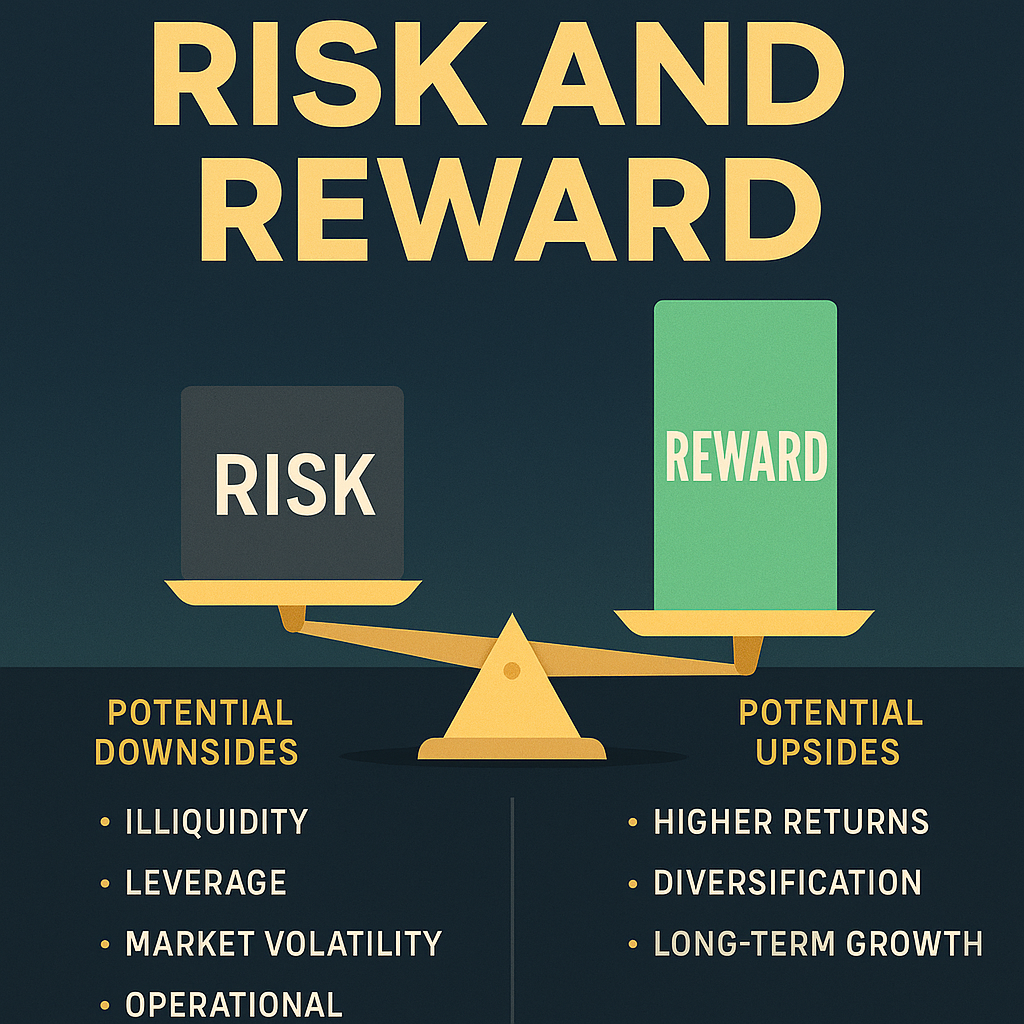
Potential Returns and Risks
Private equity can offer attractive long-term returns, often outperforming public markets over extended periods. Successful funds have historically generated IRRs of 15–25% or more, though results vary widely depending on strategy, vintage year, and management skill.
Risks include:
- Illiquidity: Capital is typically locked for 4–10 years.
- Manager Risk: Returns depend heavily on the GP’s expertise and decision-making.
- Market Risk: Economic downturns or sector-specific issues can affect performance.
- Leverage Risk: Debt amplifies both gains and losses.
- Regulatory Risk: Changes in tax, accounting, or financial regulations can impact returns.
Secondary Markets and Liquidity Options
While traditional PE investments are illiquid, secondary markets have emerged, allowing investors to buy and sell stakes in existing private equity funds. These markets provide flexibility, price discovery, and limited liquidity for long-term investors.
Additionally, some private equity firms now offer interval funds or listed PE vehicles, providing more accessible exposure with periodic liquidity. Though liquidity is still limited compared to public equities, these structures broaden investor access to the asset class.
Private Equity in a Diversified Portfolio
PE can serve as a key diversification tool, offering access to alternative assets and strategies that are uncorrelated with public markets. Typical allocations range from 5% to 15% of a diversified portfolio, depending on risk tolerance and investment horizon.
Even smaller allocations can reduce volatility, enhance long-term returns, and provide exposure to high-growth companies not available through public markets. Portfolio integration involves balancing risk, considering liquidity needs, and complementing other asset classes such as public equities, bonds, and hedge funds.
Global Trends in Private Equity
Private equity is increasingly global. Emerging markets in Asia, Latin America, and Africa offer high-growth opportunities. ESG-focused funds are attracting institutional capital, emphasizing sustainability, governance, and social responsibility.
Technological innovation, big data, and AI are enhancing deal sourcing, operational management, and performance measurement. PE firms increasingly combine traditional financial strategies with operational improvements to create measurable, sustainable value.
Regulatory and Tax Considerations
Private equity operates under a different regulatory framework than public markets. PE funds are generally lightly regulated, allowing flexibility in investment strategies. However, they must comply with SEC reporting for certain funds and adhere to fiduciary obligations.
Tax structures are another consideration. Carried interest, management fees, and fund distributions are subject to specific tax treatment. Investors need to understand the implications for net returns and consult professionals for guidance.
The Bottom Line
Private equity is a versatile, long-term investment strategy that combines active ownership, operational improvements, and strategic growth initiatives. As explored in What Is Private Equity? Understanding the Foundations of PE Investing, PE spans venture capital, growth equity, leveraged buyouts, and distressed investing, offering diverse risk-return profiles for qualified investors.
While illiquidity, leverage, and market risks are significant, private equity can enhance portfolio diversification, provide access to high-growth companies, and generate strong long-term returns. Understanding fund structures, strategies, sector specialization, fees, manager expertise, secondary market options, and regulatory considerations is essential for investors seeking to leverage this powerful asset class. For those able to commit, private equity represents an opportunity to participate in shaping tomorrow’s economy.